
Introduction
English is a beautiful language, but it can also be confusing—especially when words look similar, sound similar, or have related meanings. These are called confusing words, and they are one of the biggest challenges for learners.
Many students make mistakes like:
- Your vs You’re
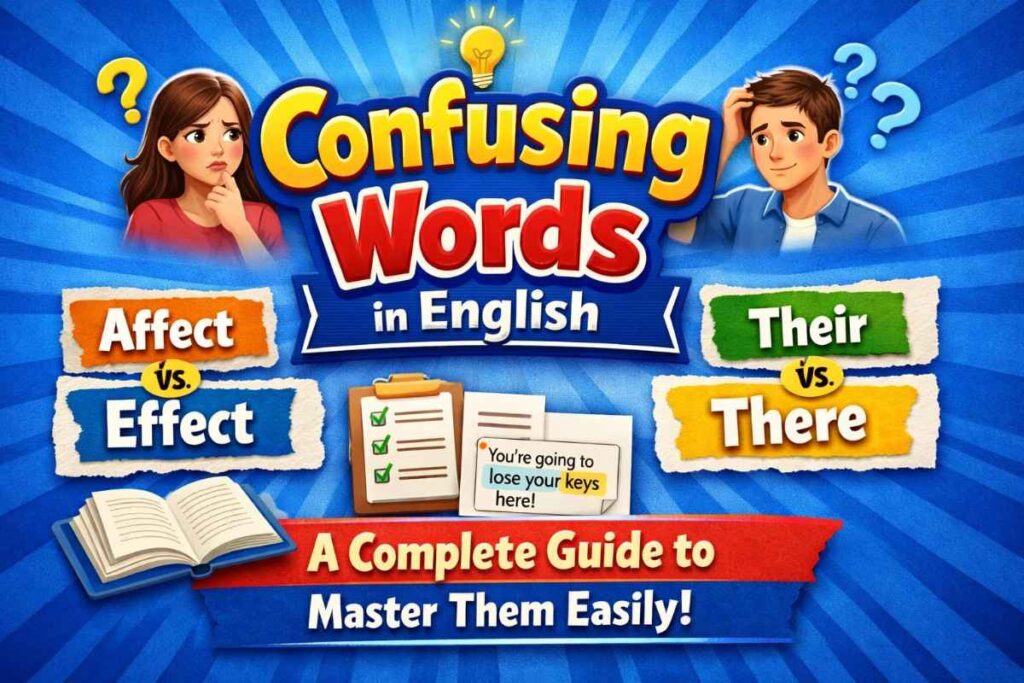
- Affect vs Effect
- Their vs There vs They’re
If you are also confused by such words, don’t worry. In this complete guide, you will learn:
✔ What confusing words are
✔ Why they cause problems
✔ Most common confusing word pairs
✔ Easy tricks to remember them
✔ Real-life examples for clarity
This article is designed in simple language, so even beginners can understand, and teachers can easily explain it in class.
What Are Confusing Words?
Confusing words are words that:
- Look similar
- Sound similar (homophones)
- Have similar meanings
👉 Because of this, learners often use the wrong word in sentences.
Example:
- She gave me good advice. ✅
- She gave me a good advise. ❌
Why Are Confusing Words Important?
Understanding confusing words is important because:
1. Improves Communication
Wrong word = wrong meaning
2. Helps in Exams
Many grammar questions are based on these words
3. Builds Confidence in Speaking
You speak more naturally and correctly
4. Essential for Writing (Blogs, Emails, Exams)
Especially important for your students and your teaching content
Types of Confusing Words
1. Homophones (Same Sound, Different Meaning)
Examples:
- Right / Write
- Sea / See
- Son / Sun
2. Similar Spelling Words
Examples:
- Accept / Except
- Advice / Advise
3. Similar Meaning Words
Examples:
- Say / Tell
- Make / Do
Most Common Confusing Words (With Easy Tricks)
1. Your vs You’re
Meaning:
- Your = belonging to you
- You’re = you are
Examples:
- This is your book.
- You’re my best friend.
Trick:
👉 If you can replace with “you are”, use you’re
2. Their vs There vs They’re
Meaning:
- Their = belonging to them
- There = place
- They’re = they are
Examples:
- Their house is big
- The book is there
- They’re playing
Trick:
👉 They’re = They are
👉 There = Here (place)
3. Affect vs Effect
Meaning:
- Affect = verb (to influence)
- Effect = noun (result)
Examples:
- The rain affected the match
- The effect was serious
Trick:
👉 A = Action (Affect = verb)
👉 E = End result (Effect = noun)
4. Advice vs Advise
Meaning:
- Advice = noun
- Advise = verb
Examples:
- He gave me good advice
- I advise you to study
Trick:
👉 Advice = Ice (noun)
👉 Advise = Size (verb)
5. Accept vs Except
Meaning:
- Accept = to take
- Except = excluding
Examples:
- I accept your offer
- Everyone came except him
6. Loose vs Lose
Meaning:
- Loose = not tight
- Lose = to fail / not win
Examples:
- This shirt is loose
- I don’t want to lose
Trick:
👉 Loose = has extra “o” → extra space
7. Then vs Than
Meaning:
- Then = time
- Than = comparison
Examples:
- Finish work, then go home
- She is taller than me
8. Say vs Tell
Meaning:
- Say = no object needed
- Tell = needs a person
Examples:
- He said something
- He told me something
9. Much vs Many
Meaning:
- Much = uncountable
- Many = countable
Examples:
- Much water
- Many students
10. Make vs Do
Meaning:
- Make = create
- Do = perform/action
Examples:
- Make a cake
- Do homework
Advanced Confusing Words (For Higher-Level Learners)
1. Economic vs Economical
- Economic = related to economy
- Economical = saving money
2. Historic vs Historical
- Historic = important event
- Historical = related to history
3. Complement vs Compliment
- Complement = complete
- Compliment = praise
4. Principal vs Principle
- Principal = head / main
- Principle = rule
Common Mistakes Students Make
❌ Using “your” instead of “you’re”
❌ Mixing affect/effect
❌ Using “advise” as noun
❌ Confusing “loose” and “lose”
👉 These mistakes reduce marks in exams and make speech less natural.
How to Master Confusing Words (Pro Tips)
1. Learn in Pairs
Always study confusing words together
2. Use in Sentences
Don’t just memorize—practice
3. Teach Others
Best method for retention (perfect for you as a teacher)
4. Use Daily Practice
Make 5 sentences daily
5. Create Personal Examples
Relate to your real life
Practice Section (For Students)
Fill in the blanks:
- This is ___ book (your/you’re)
- I gave him good ___ (advice/advise)
- She is taller ___ me (than/then)
- They ___ going home (their/there/they’re)
- I don’t want to ___ (lose/loose)
Conclusion
Confusing words are a common challenge in English, but with the right approach, they become easy.
👉 Remember:
- Understand meaning
- Learn differences
- Practice regularly
Mastering these words will:
✔ Improve your English speaking
✔ Boost your writing skills
✔ Increase your confidence