
Let me be real with you.
Tenses confused me like crazy when I was in school. Present perfect? Past continuous? Future perfect continuous?? It felt like someone was just making up names to torture students.
But here’s the truth — tenses are actually simple once you understand the logic behind them. And that’s exactly what this guide is going to do for you.
No complicated jargon. No boring textbook language. Just plain, simple English — with examples you’ll actually relate to.
Let’s go.
What is Tense? (And Why Should You Even Care?)
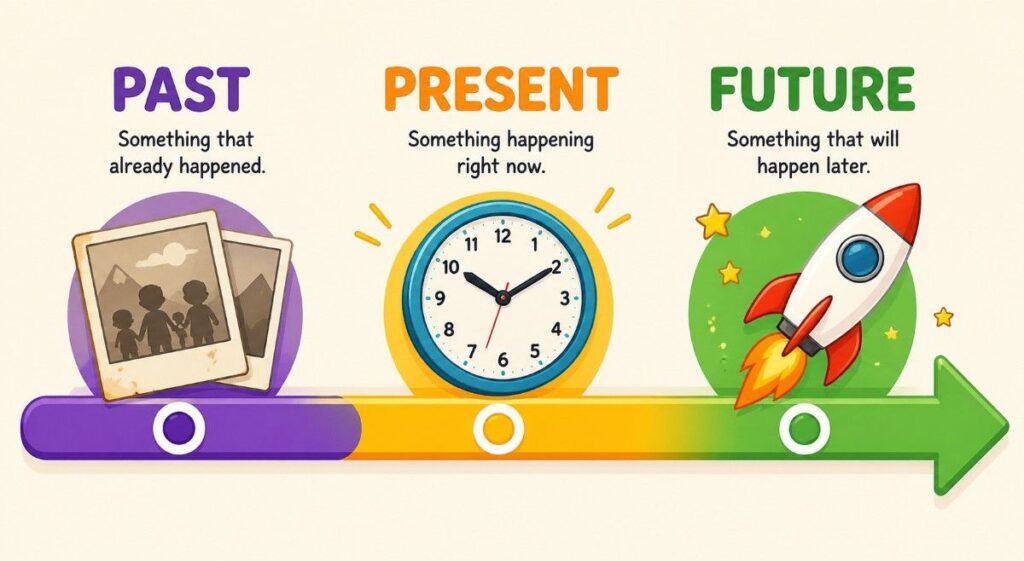
Simply put — tense tells us WHEN something happens.
That’s it. That’s the whole concept.
- Did it happen in the past?
- Is it happening right now?
- Will it happen in the future?
The word “tense” actually comes from the Latin word tempus, which means time. So whenever you use a tense, you’re basically telling your listener — “Hey, this happened at THIS point in time.”
Example:
- I eat pizza. (Right now — present)
- I ate pizza. (Already happened — past)
- I will eat pizza. (Going to happen — future)
See? Same action. Different time. Different tense. Simple.
How Many Types of Tenses Are There?
Here’s where most students get confused — and honestly, it’s because nobody explains this clearly.
There are 3 main tenses:
- Present Tense
- Past Tense
- Future Tense
But each of these 3 tenses has 4 forms, making a total of 12 tenses.
These 4 forms are:
- Simple — just states a fact
- Continuous — action is ongoing
- Perfect — action is completed
- Perfect Continuous — action was ongoing and has just completed
Think of the 3 main tenses as the big buckets, and the 4 forms as the dividers inside each bucket.
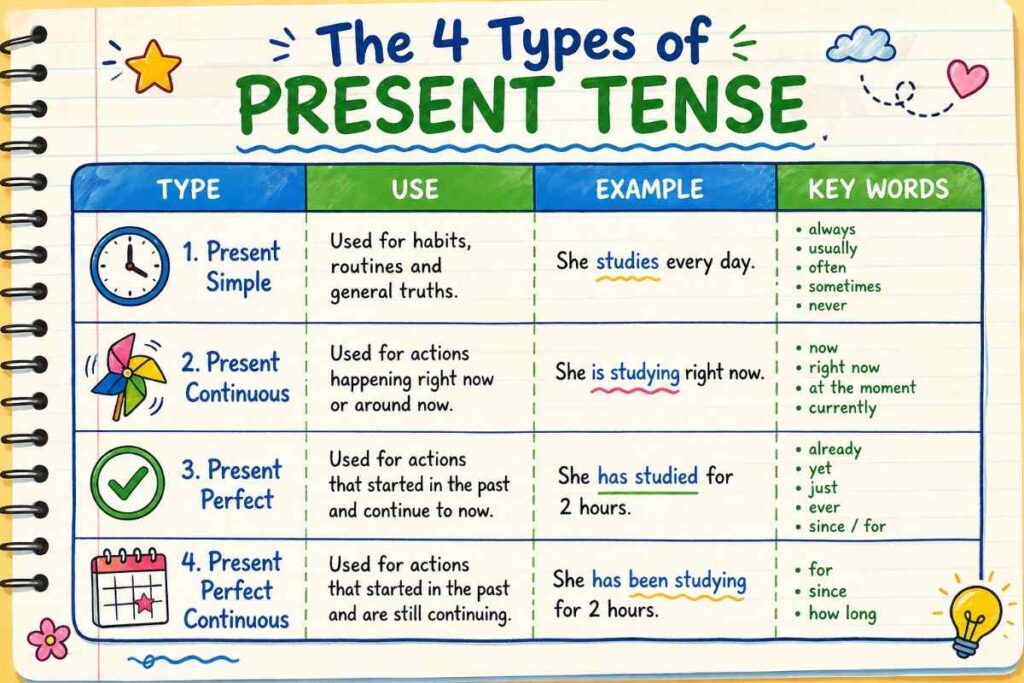
Present Tense — When Things Happen NOW (or Always)
Simple Present Tense
Use it when:
- Something is a fact or habit
- Something happens regularly
Structure: Subject + V1 (base verb) + s/es (for he/she/it)
Examples:
- The sun rises in the east.
- She drinks coffee every morning.
- I play cricket on Sundays.
Quick tip: If the subject is he, she, it, or a name — add -s or -es to the verb. That’s the only rule.
Present Continuous Tense
Use it when:
- Something is happening RIGHT NOW at this moment
Structure: Subject + is/am/are + V1+ing
Examples:
- I am writing this blog right now.
- She is watching TV.
- They are playing in the garden.
Easy memory trick: If you can say “right now” at the end of your sentence — it’s probably present continuous.
Present Perfect Tense
Use it when:
- Something happened in the past but it’s connected to the present
- You did something and it still matters now
Structure: Subject + has/have + V3 (past participle)
Examples:
- I have eaten lunch. (So I’m not hungry now)
- She has finished her homework.
- They have lived here for 10 years.
The key difference from simple past:
- Simple past: I ate lunch. (Just stating it happened)
- Present perfect: I have eaten lunch. (And because of that, I’m full now)
Present Perfect Continuous Tense
Use it when:
- An action started in the past and is STILL continuing now
Structure: Subject + has/have + been + V1+ing
Examples:
- I have been studying for 3 hours.
- She has been working here since 2020.
- It has been raining all day.
Past Tense — Things That ALREADY Happened
Simple Past Tense
Use it when:
- Something happened at a specific time in the past and it’s done
Structure: Subject + V2 (past form of verb)
Examples:
- I watched a movie last night.
- She called me yesterday.
- We went to Delhi in 2022.
Important: For negative sentences, use did not + V1.
- I did not watch TV. (NOT: I did not watched)
Past Continuous Tense
Use it when:
- Something was happening at a particular moment in the past
Structure: Subject + was/were + V1+ing
Examples:
- I was sleeping when the phone rang.
- They were playing cricket at 5 PM yesterday.
- She was cooking dinner when I arrived.
Notice: Past continuous often pairs with simple past. One long ongoing action + one short sudden action. “I was studying (ongoing) when the lights went off (sudden).”
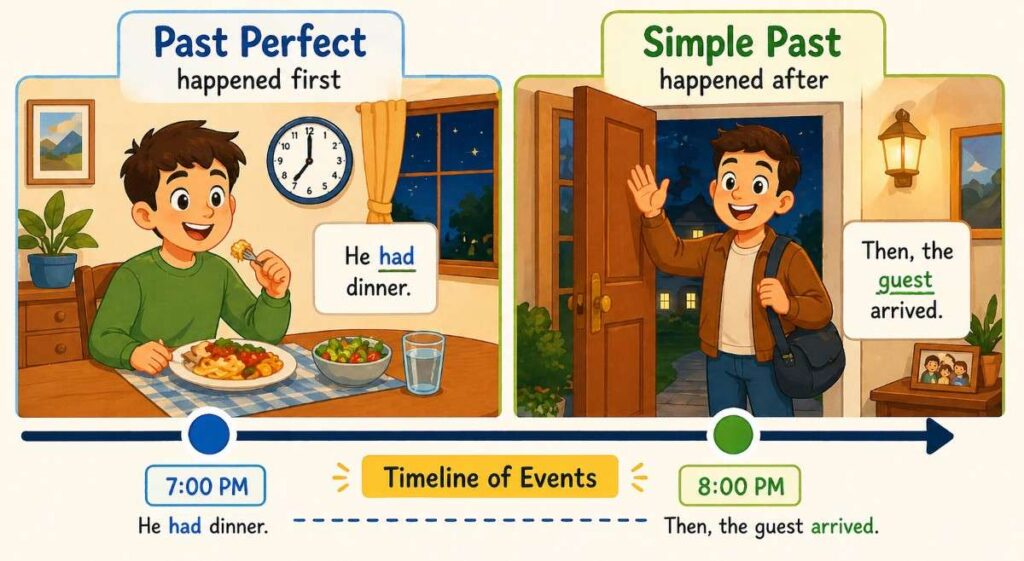
Past Perfect Tense
Use it when:
- You’re talking about TWO past events, and one happened BEFORE the other
Structure: Subject + had + V3
Examples:
- I had eaten before she arrived.
- By the time the movie started, we had already bought popcorn.
- She had left before I called her.
Think of it as: The “older past.” The thing that happened first gets the past perfect.
Past Perfect Continuous Tense
Use it when:
- An action was going on continuously in the past before another past action
Structure: Subject + had + been + V1+ing
Examples:
- I had been waiting for an hour when the bus finally came.
- She had been crying before I entered the room.
- They had been working on the project for weeks before it was cancelled.
Future Tense — Things That WILL Happen
Simple Future Tense
Use it when:
- You’re making a prediction, promise, or decision made at the moment of speaking
Structure: Subject + will + V1
Examples:
- I will help you with the project.
- It will rain tomorrow.
- She will call you later.
Note: “Shall” is also used with I and We in formal writing, but in everyday English, “will” works fine for everyone.
Future Continuous Tense
Use it when:
- Something will be in progress at a specific future time
Structure: Subject + will be + V1+ing
Examples:
- This time tomorrow, I will be flying to Mumbai.
- She will be sleeping at midnight.
- They will be playing when you arrive.
Future Perfect Tense
Use it when:
- An action will be COMPLETED before a certain point in the future
Structure: Subject + will have + V3
Examples:
- I will have finished my homework by 8 PM.
- She will have left before you arrive.
- By next year, he will have completed his degree.
Future Perfect Continuous Tense
Use it when:
- An action will have been going on continuously up to a certain point in the future
Structure: Subject + will have been + V1+ing
Examples:
- By next month, I will have been working here for 5 years.
- She will have been teaching for 10 years by 2026.
(Honestly? This one is rarely used in daily conversation. But it’s good to know for exams!)
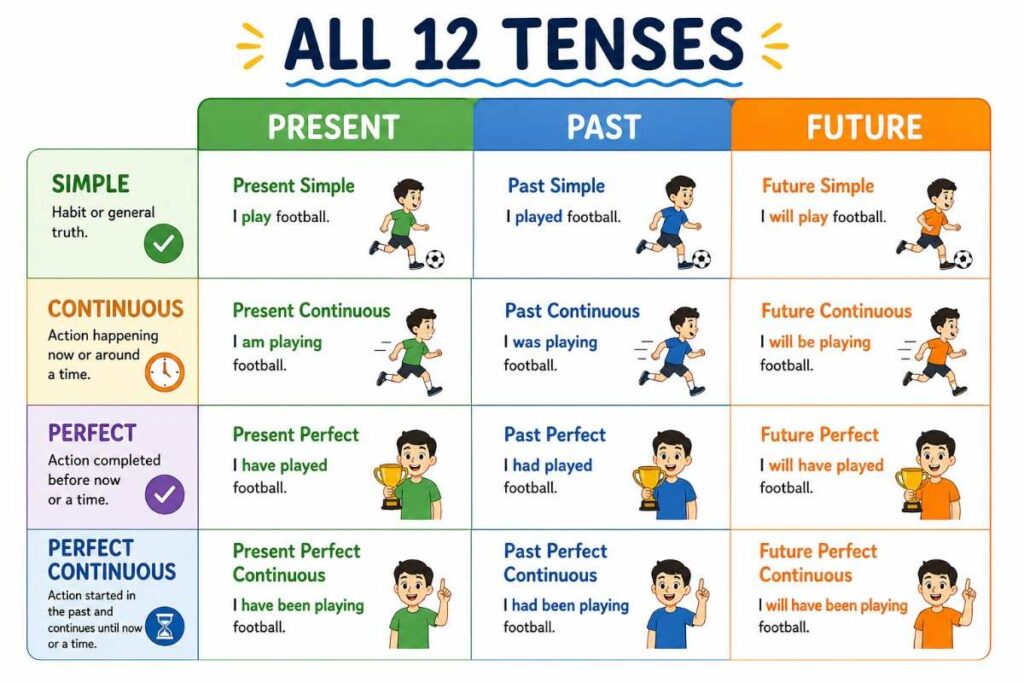
The Quick 12 Tenses Cheat Sheet
Here’s a quick reference for all 12 tenses in one place:
PRESENT:
| Type | Structure | Example |
|---|---|---|
| Simple Present | Subject + V1 | She eats. |
| Present Continuous | Subject + is/am/are + V1ing | She is eating. |
| Present Perfect | Subject + has/have + V3 | She has eaten. |
| Present Perfect Continuous | Subject + has/have + been + V1ing | She has been eating. |
PAST:
| Type | Structure | Example |
|---|---|---|
| Simple Past | Subject + V2 | She ate. |
| Past Continuous | Subject + was/were + V1ing | She was eating. |
| Past Perfect | Subject + had + V3 | She had eaten. |
| Past Perfect Continuous | Subject + had + been + V1ing | She had been eating. |
FUTURE:
| Type | Structure | Example |
|---|---|---|
| Simple Future | Subject + will + V1 | She will eat. |
| Future Continuous | Subject + will be + V1ing | She will be eating. |
| Future Perfect | Subject + will have + V3 | She will have eaten. |
| Future Perfect Continuous | Subject + will have been + V1ing | She will have been eating. |
Common Mistakes Students Make With Tenses (And How to Fix Them)
Mistake 1: Using past tense after “did”
❌ Wrong: I did not went to school. ✅ Right: I did not go to school.
Rule: After did/does/do — always use the base form (V1) of the verb.
Mistake 2: Forgetting -s/-es in Simple Present
❌ Wrong: She play cricket. ✅ Right: She plays cricket.
Rule: With he/she/it or any singular name — add -s or -es.
Mistake 3: Confusing “since” and “for”
- Since = a specific point in time → since 2020, since Monday, since morning
- For = a duration of time → for 3 hours, for 5 years, for a week
❌ Wrong: I have been waiting since 3 hours. ✅ Right: I have been waiting for 3 hours.
Mistake 4: Using future tense in time clauses
❌ Wrong: I will call you when I will reach home. ✅ Right: I will call you when I reach home.
Rule: After words like when, before, after, as soon as, until — use present tense (not future) even when you mean the future.
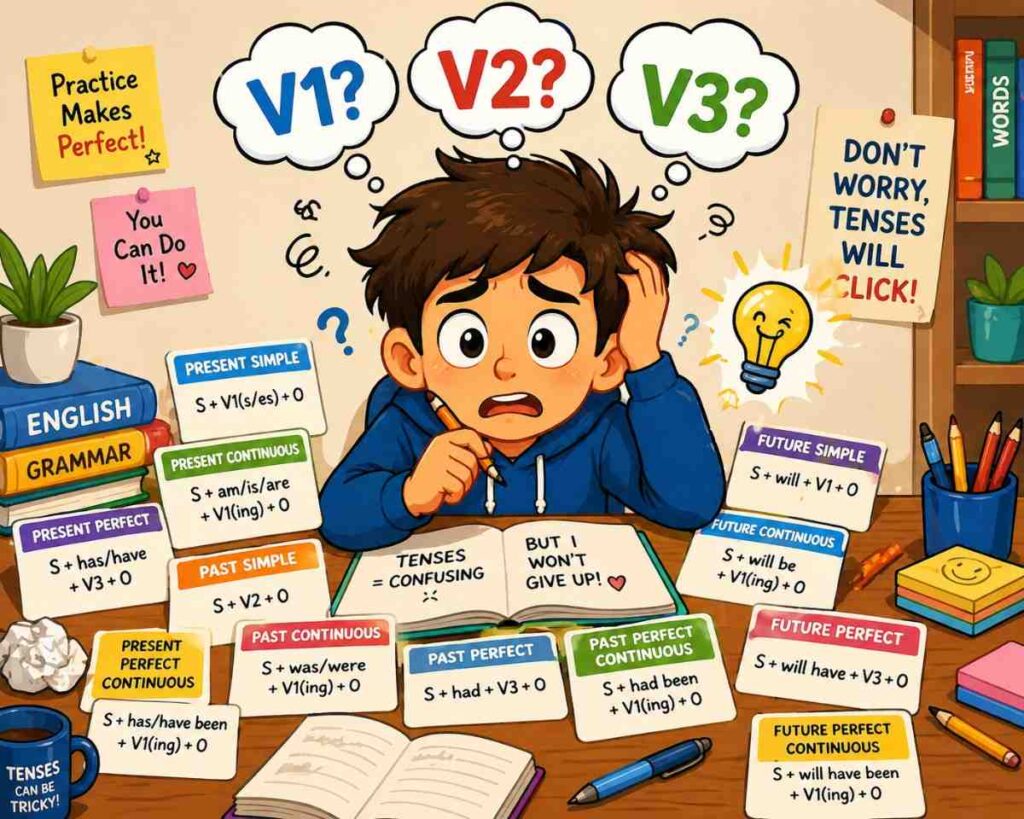
3 Simple Tips to Master Tenses Fast
Tip 1: Learn the 3 forms of each verb
Every verb has 3 forms — V1 (base), V2 (past), V3 (past participle). Learn them in groups.
Example:
- Go → Went → Gone
- Eat → Ate → Eaten
- Write → Wrote → Written
- Play → Played → Played (regular verb — easy!)
Tip 2: Use the “Time Signal Words” trick
Certain words give away which tense to use:
- Yesterday, ago, last → Simple Past
- Since, for, just, already, ever, never → Present Perfect
- Now, currently, at the moment → Present Continuous
- Tomorrow, next week, soon → Future
- By the time, by + future time → Future Perfect
Spot the time signal word → pick the tense. Done.
Tip 3: Practice with your daily routine
The fastest way to master tenses? Write 5 sentences about your day — every day.
- What did you do? (Simple Past)
- What are you doing right now? (Present Continuous)
- What will you do tomorrow? (Simple Future)
You’ll be surprised how quickly it sticks.
Frequently Asked Questions About Tenses
How many tenses are there in English?
There are 12 tenses in English — 4 types under each of the 3 main time frames: Present, Past, and Future.
What is the easiest way to remember tenses?
Focus on the structure (formula) and the key time signal words. Once you understand the logic of what each tense expresses, the formulas become easier to remember.
What is the difference between Simple Past and Present Perfect?
Simple Past talks about a completed action with no connection to the present. Present Perfect connects a past action to the present situation. Example: “I lost my phone” (simple past — just stating what happened) vs. “I have lost my phone” (present perfect — and I still don’t have it now).
Is “will” the only way to express future tense?
No! You can also use “going to” for planned actions or predictions based on evidence. Example: “It is going to rain” (you can see dark clouds) vs. “It will rain tomorrow” (a simple prediction).
Wrapping It Up
Okay, let’s be honest — tenses feel overwhelming at first. But once you understand that it’s all just about time, everything clicks into place.
You now know:
- What tense is and why it matters
- All 12 types with structures and examples
- The most common mistakes and how to avoid them
- Practical tips to actually remember and use them
The only thing left? Practice.
Start small. Write a few sentences every day. Read in English. Watch shows or movies in English with subtitles. Tenses will start coming to you naturally — without even thinking about it.
And hey — if this blog helped you, share it with a classmate who’s struggling with tenses. Let’s help each other out. 😊
Got questions? Drop them in the comments below. I read and reply to every single one.
YOU MIGHT ALSO LIKE:
- Parts of Speech: Complete Guide for Beginners
- Subject-Verb Agreement: Rules & Examples
- Active and Passive Voice: Simple Explanation with Examples
- Modals in English Grammar: Can, Could, Should, Would & More
TAGS: English Grammar, Tenses, Present Tense, Past Tense, Future Tense, Grammar for Beginners, English for Students, Learn English, Grammar Rules