

So, You Think You Are “Good” at English? (Welcome to C1)
Let me tell you a story.
I remember sitting in a café in Dublin about eight years ago. I had passed my B2 exam six months earlier. I felt proud. I could order food without sweating. I could ask for directions. I could even chat with my taxi driver about the rainy weather for a solid two minutes.
Then, my Irish friend Sarah introduced me to her group.
They started talking fast. Not just fast, but… sideways. They used sarcasm. They quoted a TV show I had never seen. They made jokes where the punchline was a feeling rather than a word. One of them said, “Ah, sure look, it’s grand,” which I later learned means about ten different things depending on the tone of their voice.
I smiled and nodded for an hour. I understood every single word. But I missed the soul of the conversation.
That is the difference between B2 (Upper Intermediate) and learning C1 level of English.
If B2 is the level where you survive, C1 is the level where you live. It is not about memorizing more grammar rules. It is about becoming a flexible, confident human being inside the English language. And honestly? It is the hardest plateau to break. But once you break it, the world opens up.
Let’s walk this road together. No fancy academic words. Just the real, messy, wonderful truth of getting to advanced English.
What Does C1 Actually Feel Like? (Not the Dictionary Definition)
You can look up the official definition from the Common European Framework of Reference (CEFR) if you want the technical terms. It will tell you things like “Can understand a wide range of demanding, longer texts, and recognize implicit meaning.”
Boring, right?
Let me translate that into human.
At C1, you stop translating in your head. Seriously. When you hear “apple,” you don’t think of the word in your native language first. You just see the red fruit in your mind. The same happens with abstract ideas like “justice” or “awkward.” The English word connects directly to the concept.
At C1, you can have opinions about opinions. A B2 student can say: “I think climate change is bad.” A C1 student can say: “While I understand the economic concerns raised by the opposition, I find their dismissal of the scientific data to be dangerously short-sighted.”
At C1, you know when to break the rules. You know that saying “Ain’t nobody got time for that” is grammatically a disaster, but you also know it is perfect for a casual chat with a friend. You understand the texture of the language.
The Brutal Truth: Why You Are Stuck at B2 (And How to Get Unstuck)
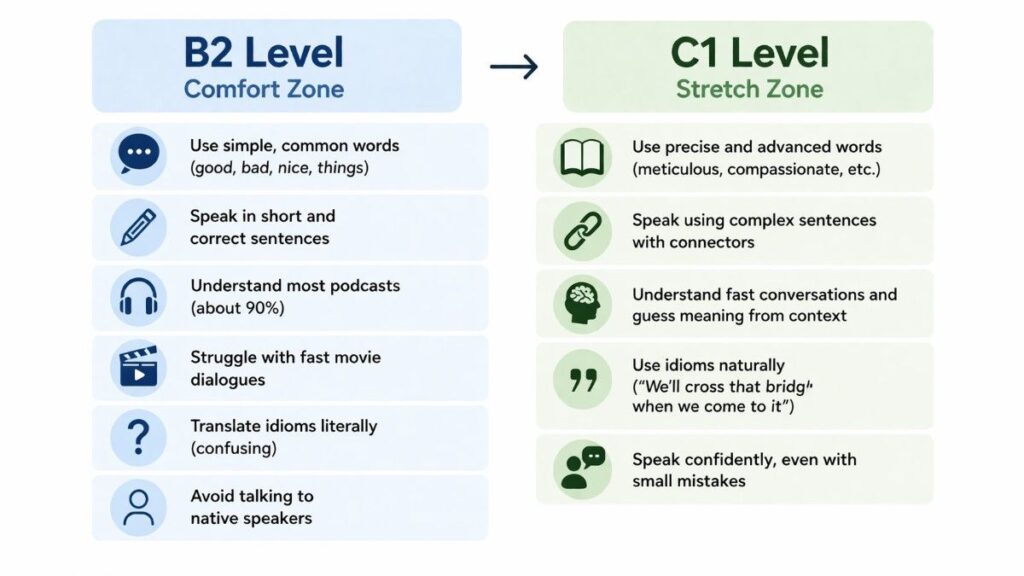
If you have been studying English for years and feel like you are running on a treadmill, you are not alone. Most learners get stuck at the “Intermediate Plateau.”
Here is why.
| B2 Level (The Comfort Zone) | C1 Level (The Stretch Zone) |
|---|---|
| You use safe, common words (good, bad, nice, things) | You use precise words (meticulous, detrimental, compassionate, elements) |
| You speak in short, correct sentences | You use complex sentences with clauses and connectors |
| You understand 90% of a podcast host | You understand 70% of a fast movie dialogue (and guess the rest from context) |
| You translate idioms literally (“It’s raining cats” = Huh?) | You use idioms naturally (“We’ll cross that bridge when we come to it”) |
| You avoid conversations with native speakers | You jump in, even if you make small errors |
To move up, you have to stop studying English and start living in it. That sounds like a motivational poster, I know. But let me give you three ugly truths about C1:
- Your grammar book will not save you. You already know the tenses. You know the conditionals. C1 is about collocation (which words naturally go together). Do we say “do a mistake” or “make a mistake”? (It is “make”). Do we have “strong rain” or “heavy rain”? (It is “heavy”).
- You will feel stupid again. Remember when you were a beginner and you felt proud for saying “My name is…”? At C1, you will feel frustrated because you know you made a subtle error but cannot fix it. That frustration is actually the sign of growth. Embrace it.
- Passive learning is a lie. Listening to English radio while cooking dinner is nice. But it will not get you to C1. You need active wrestling with the language.
The Secret Sauce: Input + Output + Attitude
Every successful C1 learner I have ever met follows a simple formula. Let’s call it the Three Pillars.
Pillar 1: Massive, Deliberate Input (Listening & Reading)
You cannot produce what you have never absorbed. But do not just watch Netflix with subtitles. That is too easy.
- Read one level above your comfort zone. Stop reading graded readers for learners. Pick up a BBC News article or an Economist piece. Yes, you will need a dictionary. Yes, it will be slow. But you will see how professional writers build arguments. Read 10 minutes of hard material every day.
- Listen for tone, not just words. Find a podcast where the hosts disagree with each other (try The Intelligence from The Economist or any debate podcast). Turn off the transcript. Try to hear why someone is angry, sarcastic, or hesitant. C1 is about reading between the lines.
Pillar 2: Messy, Real Output (Speaking & Writing)
This is where most people fail. They are shy. They wait until they are “perfect.” Guess what? You will never be perfect.
- Talk to yourself in the shower. Narrate your day. But push yourself. Instead of saying, “I will make pasta,” say, “I will prepare a simple pasta dish, although I am slightly concerned that I am out of garlic, which might compromise the flavor.”
- Write like you are 15 years old again. Start a private blog or a journal. Write a review of a movie you just watched. Write a complaint email to a company (even if you don’t send it). The act of constructing a long paragraph forces your brain to find connectors: However, Moreover, Consequently, On the other hand.
- Find a “language parent.” This is a concept from polyglot Stephen Krashen. Find a patient native speaker (try iTalki or a language exchange app) who will not just correct you, but will rephrase you. You say: “I went to shop for buy a milk.” They say: “Oh, you went to the shop to buy some milk.” You listen. You repeat. You grow.
Pillar 3: The C1 Mindset (Attitude is 50% of the Game)
You need to become a detective.
- Be curious about small words. Why do we say “I am interested in” but “I am good at”? Why is “I look forward to hearing from you” (with an -ing) correct, but “I look forward to hear” wrong? Don’t just memorize. Ask why until it makes sense.
- Learn chunks, not words. Do not learn the word “decision.” Learn the chunk “to make a decision.” Do not learn “responsible.” Learn “to be held responsible for.” Your brain remembers patterns faster than isolated data.
A Realistic Week in the Life of a C1 Learner (Sample Plan)
You do not need 5 hours a day. You need consistency. Here is a realistic schedule for a busy adult.
Monday (15 mins): Deep Reading
Read one page of a novel (try George Orwell – *1984* or Animal Farm are perfect for C1). Underline 5 phrases you would never say. Look them up.
Tuesday (20 mins): Active Listening
Listen to a 5-minute news segment. Pause after every sentence. Write down exactly what you heard. Compare. You will be shocked at what you misheard.
Wednesday (15 mins): Grammar Tune-Up
Pick ONE subtle grammar point. For example: Inversion (“Never have I seen such a mess” instead of “I have never seen”). Write 10 ridiculous sentences using it. Have fun. “Rarely does my cat listen to me.”
Thursday (30 mins): Speaking Practice
Call a friend who speaks English. Or record a voice memo on your phone. Describe a problem you had today. Try to use “past perfect” (I had already left when I realized…). Try to use a conditional (If I had known…).
Friday (10 mins): Vocabulary Review
Use the Goldlist Method. Write down 20 new words from the week. Do not use flashcards with forced recall. Just write them. Look at them. Trust your brain.
Weekend (45 mins): The Fun Part
Watch one episode of a TV show in English with English subtitles. Pause when you see a cool phrase. Write it down. My recommendation? Fleabag or The Crown on Netflix. The dialogue is sharp, real, and full of subtext.
The Vocabulary Shift: From “Good” to “Nuanced”
Let me show you what C1 vocabulary looks like in real life. This is the difference between a functional speaker and an advanced one.
| Instead of this (B2) | Try this (C1) |
|---|---|
| The movie was very good. | The movie was captivating (it held my attention completely) or thought-provoking (it made me think deeply). |
| She was very sad. | She was devastated (broken by sadness) or melancholic (a soft, thoughtful sadness). |
| The weather is bad. | The weather is dreadful (very unpleasant) or gloomy (dark and depressing). |
| He talks a lot. | He is verbose (uses too many words) or articulate (expresses ideas clearly). |
| I am tired of this. | I am fed up with this (informal, strong) or weary of this (formal, deep tiredness). |
Do you see the difference? C1 words carry emotional weight. They are not just labels; they are paintings.
How to Handle the “I Understand Everything But I Can’t Speak” Trap
This is the most common email I get from readers.
“Alex, I can read The New York Times. I can understand TED Talks. But when I open my mouth, I sound like a robot from the 1990s. Help!”
This happens because your passive vocabulary (words you recognize) is huge, but your active vocabulary (words you use) is tiny.
The fix is awkward but effective: Retelling.
- Read a short paragraph from a news site.
- Close the tab.
- Open a voice recorder.
- Explain that paragraph to an imaginary friend in your own words.
- Listen back.
The first time, you will stumble. You will say “thing” instead of “phenomenon.” You will say “go up” instead of “escalate.”
That is gold. Those stumbles are the exact gaps you need to fill. Do this for 10 minutes a day for two weeks. Your active vocabulary will explode.
The Final Mountain: Idioms and Cultural References
At C1, you realize that English is not a language. It is a collection of inside jokes shared by 1.5 billion people.
You will encounter phrases that make no literal sense.
- “Spill the tea” (Tell me the gossip)
- “Bite the bullet” (Do something unpleasant that you have been avoiding)
- “Throw someone under the bus” (Betray a friend to save yourself)
You do not need to memorize a list of 500 idioms. You will sound fake. Instead, learn them in context. When you hear one, write down the sentence it was used in. Learn the situation, not the definition.
Also, watch stand-up comedy. Seriously. Comedians like Trevor Noah or Taylor Tomlinson play with language. They use timing, irony, and double meanings. If you can understand why a joke is funny (not just the words), you have truly reached C1.
Your 90-Day Action Plan to C1
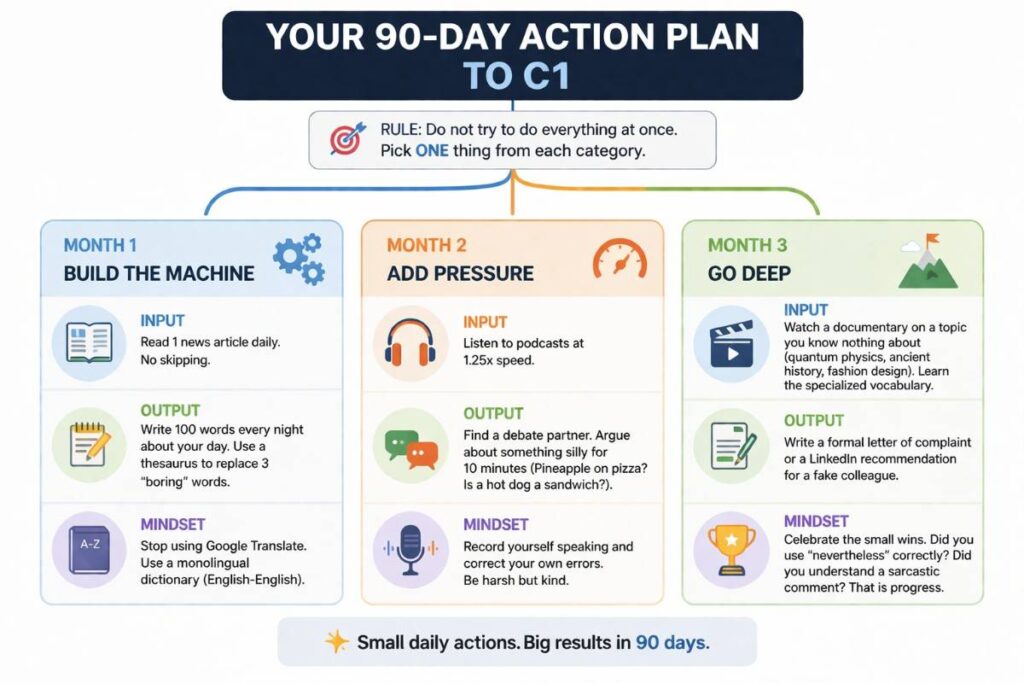
Do not try to do everything at once. Pick ONE thing from each category.
Month 1: Build the Machine
- Input: Read 1 news article daily. No skipping.
- Output: Write 100 words every night about your day. Use a thesaurus to replace 3 “boring” words.
- Mindset: Stop using Google Translate. Use a monolingual dictionary (English-English).
Month 2: Add Pressure
- Input: Listen to podcasts at 1.25x speed.
- Output: Find a debate partner. Argue about something silly for 10 minutes (Pineapple on pizza? Is a hot dog a sandwich?).
- Mindset: Record yourself speaking and correct your own errors. Be harsh but kind.
Month 3: Go Deep
- Input: Watch a documentary on a topic you know nothing about (quantum physics, ancient history, fashion design). Learn the specialized vocabulary.
- Output: Write a formal letter of complaint or a LinkedIn recommendation for a fake colleague.
- Mindset: Celebrate the small wins. Did you use “nevertheless” correctly? Did you understand a sarcastic comment? That is progress.
The Last Word (And A Gentle Push)
Learning C1 level of English is not a sprint. It is not even a marathon. It is more like learning to play jazz on a piano.
You know the scales (grammar). You know the keys (vocabulary). But C1 is when you start to improvise. It is when you make a mistake, laugh at it, and turn it into a joke. It is when you forget you are even speaking a foreign language.
Will it be hard? Yes. Some days you will feel like a genius. Other days, you will forget the word for “spoon” and want to cry. That is normal. That is human.
But imagine this: Six months from now, you are sitting in a café (real or virtual). Someone makes a clever, subtle joke. You get it. You laugh before they explain it. You fire back with your own joke. For five seconds, you forget where you were born. You are just… you. Speaking English.
That is C1. That is freedom.
So, close this article. Go find one hard sentence to read. One awkward voice memo to record. One mistake to make.
You have got this.
Call to Action (CTA)
Now it is your turn. I want you to do two things before you click away:
- Comment below (or write in your journal): What is the ONE situation where you feel your English is not enough? Is it work meetings? Dinner parties? Watching the news?
- Share this article with one friend who is also stuck at the intermediate level. You can hold each other accountable.
And if you want a free weekly newsletter with C1-level exercises (no spam, just real English), click here to join the waitlist.
Keep going. The plateau is not the end. It is just the view before the next climb.