
Prepositions of Place in English: The Easy Complete Guide (No Confusion Left!)
Do you ever wonder whether to say “the book is in the table” or “the book is on the table”? Have you confused in, on, and at when describing where something is? If yes, then this guide is exactly what you need. Prepositions of place in English are small words, but they carry big meaning. They tell us exactly where something or someone is located. In this post, you will learn every important preposition of place — with simple rules, clear examples, comparison tables, and practice exercises. By the end, you will use them confidently and correctly every single time.
Let’s begin! 🚀
What Are Prepositions of Place?
A preposition of place is a word that tells us where something or someone is. It shows the position or location of a person, animal, or object in relation to something else.
Here are some quick examples:
- The cat is on the sofa.
- She lives in London.
- He is standing at the door.
- The shoes are under the bed.
- The park is between the school and the bank.
Each bold word above is a preposition of place in English. It answers the question: WHERE?
Without prepositions of place, sentences become confusing. For example:
- ❌ The keys are the table. → unclear and incorrect
- ✅ The keys are on the table. → clear and correct
So, prepositions of place are essential. They make your English clear, natural, and easy to understand.
The Complete List of Place Prepositions
First, let’s see all the prepositions of place you need to know. Then we will study each one in detail.
| Preposition | Basic Meaning |
|---|---|
| in | inside a space or area |
| on | on a surface |
| at | at a specific point or place |
| under / beneath | below something |
| above / over | higher than something |
| between | in the middle of two things |
| among | in the middle of many things |
| behind | at the back of something |
| in front of | facing something, ahead of it |
| next to / beside | at the side of something |
| near / close to | not far from something |
| opposite | facing, on the other side |
| inside | within something |
| outside | not inside something |
| on top of | on the highest part of something |
| at the bottom of | at the lowest part of something |
| around | surrounding something |
| along | following the length of something |
| by | very close to, next to |
| against | touching and leaning on something |
| through | from one side to the other |
Now, let’s study each one carefully.
PART 1: IN, ON, AT — The Three Most Important Place Prepositions
These three prepositions cause the most confusion. However, once you understand their logic, everything becomes simple.
The Golden Rule: Think BIG → MEDIUM → SMALL
The easiest way to remember these three is to think about size:
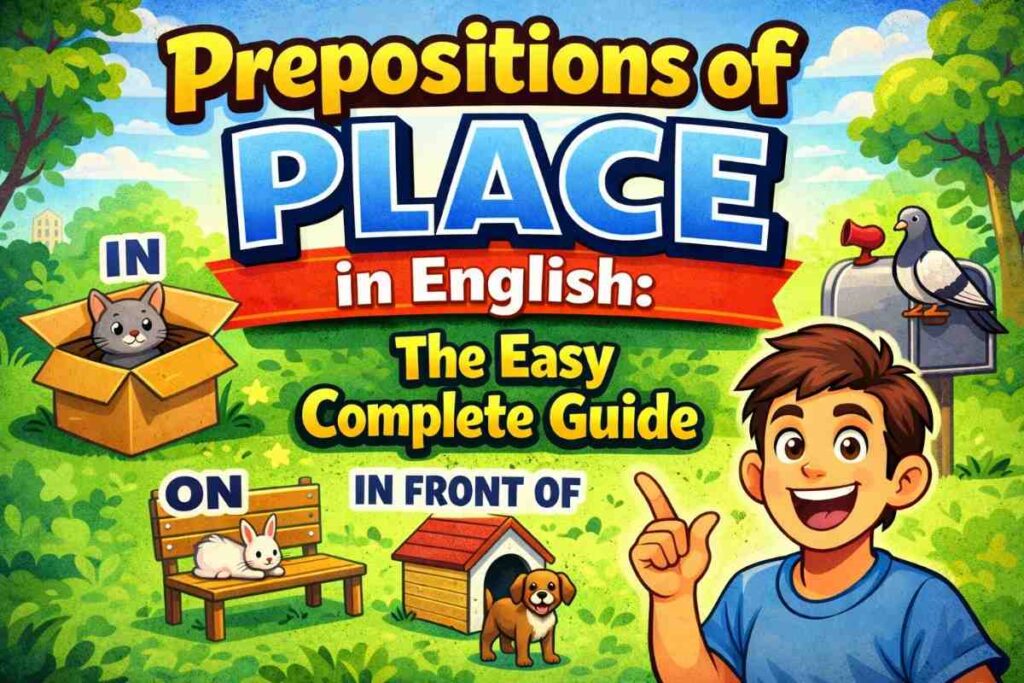
- IN = a large or enclosed space (you are inside it)
- ON = a surface or line (you are on top of it)
- AT = a specific point or location (you are exactly there)
IN — Inside a Space or Area
Use IN when someone or something is inside a space. The space can be physical (a room, a box) or geographical (a city, a country).
Use IN with:
✅ Rooms and Buildings
- She is in the kitchen.
- The children are in the classroom.
- He is in the hospital.
- They are in the office.
✅ Enclosed Spaces
- The cat is in the box.
- Put the clothes in the wardrobe.
- The money is in the drawer.
- She put the letter in the envelope.
✅ Cities, Countries, and Regions
- I live in Paris.
- He was born in India.
- She grew up in the south.
- They have a house in the countryside.
✅ Vehicles Where You Sit Inside
- She is in the car.
- He is in the taxi.
- They sat in the ambulance.
✅ Water and Liquids
- The fish are in the sea.
- She is swimming in the pool.
- There is sugar in my coffee.
✅ Lines (queues)
- Please stand in the queue.
- He was in the line for an hour.
ON — On a Surface
Use ON when something is resting on or attached to a flat surface. The surface can be horizontal (a table, a floor) or vertical (a wall, a door).
Use ON with:
✅ Flat Horizontal Surfaces
- The book is on the table.
- The cup is on the shelf.
- She is lying on the bed.
- His bag is on the floor.
✅ Vertical Surfaces (walls, doors)
- There is a picture on the wall.
- The notice is on the door.
- There is a scratch on the window.
✅ Islands
- He lives on a small island.
- She grew up on Crete.
- They have a villa on Bali.
✅ Named Streets and Roads
- She lives on Baker Street.
- The café is on Main Road.
- Turn right on Oxford Street.
✅ Floors of a Building
- His office is on the third floor.
- The restaurant is on the top floor.
- She lives on the ground floor.
✅ Transport Where You Sit or Stand
- She is on the bus.
- He is on the train.
- They are on the plane.
- I was on the ship.
(Note: Use on for public transport, but in for private cars and taxis.)
✅ Body Parts (for things attached or placed)
- She had a ring on her finger.
- He has a tattoo on his arm.
- Put the cream on your face.
AT — At a Specific Point or Place
Use AT when you are talking about a specific location or point — a place you arrive at, work at, or exist at. It is often used for places that are seen as a point rather than an area.
Use AT with:
✅ Specific Places and Buildings
- She is at the school. (general location — she is there)
- He is at the hospital. (he is there, possibly visiting)
- We met at the station.
- I’ll see you at the cinema.
✅ Events and Activities
- I was at the party last night.
- She is at a conference today.
- He was at the concert.
- Are you at the meeting?
✅ Points on a Journey
- The bus stops at every corner.
- Turn left at the traffic lights.
- We stopped at a small village.
✅ Someone’s Home or Workplace
- She is at home.
- He is at work.
- I am at my friend’s house.
- Are you at the office?
✅ Address Numbers
- She lives at 42 Park Lane.
- The office is at 15 High Street.
IN vs. ON vs. AT — The Comparison Table
This table will make everything clear at a glance.
| Situation | IN | ON | AT |
|---|---|---|---|
| Inside a room | ✅ in the room | ||
| Inside a city | ✅ in London | ||
| Inside a country | ✅ in France | ||
| On a surface | ✅ on the table | ||
| On a wall | ✅ on the wall | ||
| On an island | ✅ on the island | ||
| On a street name | ✅ on Baker Street | ||
| On a floor number | ✅ on the 2nd floor | ||
| On public transport | ✅ on the bus/train | ||
| At a specific place | ✅ at the station | ||
| At home/work | ✅ at home / at work | ||
| At an event | ✅ at the party | ||
| At an address | ✅ at 12 Park Road | ||
| In a private car/taxi | ✅ in the car |
Memory Trick for IN, ON, AT (Place) 🧠
Think of it this way:
- 🏠 IN = you are inside something. You are surrounded by it.
- 📋 ON = you are touching a surface. Something is beneath you or behind you.
- 📍 AT = you are at a point on the map. It is a specific location.
Or remember this sentence:
“I live in London, on Baker Street, at number 221B.”
This one sentence uses all three correctly and in the right order — from biggest to smallest!
PART 2: UNDER, BELOW, and BENEATH
These three prepositions all mean something is in a lower position than something else. However, they are used slightly differently.
UNDER — Directly Below (Most Common)
UNDER is the most common. Use it when one thing is directly below another — often with the two things touching or very close.
Examples:
- The cat is under the table.
- She hid the gift under the bed.
- Put your bag under your seat.
- There is a tunnel under the river.
- She wore a jacket under her coat.
BELOW — Lower Than, But Not Necessarily Directly Under
BELOW means at a lower level. However, the two things don’t need to be directly above/below each other.
Examples:
- The temperature dropped below zero.
- His apartment is below mine. (one floor down)
- The valley is far below the mountain peak.
- Please sign below the line.
BENEATH — Similar to Under, But More Formal or Literary
BENEATH is used in formal writing or literature. In everyday conversation, under is preferred.
Examples:
- She felt the sand beneath her feet.
- Beneath the surface, there was a hidden cave.
- He sat beneath a large oak tree.
Quick Rule:
- In everyday speaking and writing → use UNDER
- In formal or literary writing → use BENEATH
- For levels or measurements → use BELOW
PART 3: ABOVE and OVER
These prepositions mean something is in a higher position. They are often interchangeable, but there are some differences.
ABOVE — Higher Than, Not Necessarily Directly On Top
Use ABOVE when something is at a higher level, but not necessarily directly over it.
Examples:
- The picture is above the fireplace.
- The clouds are above the mountains.
- Her score was above average.
- The temperature is above 30 degrees.
- Please write your name above the line.
OVER — Directly Above, or Covering
Use OVER when something is directly above something else, or when it covers something.
Examples:
- A lamp hangs over the table.
- She put a blanket over the sleeping child.
- There is a bridge over the river.
- He held an umbrella over her head.
- The plane flew over the city.
ABOVE vs. OVER — Quick Comparison:
| ABOVE | OVER |
|---|---|
| Higher level, not directly on top | Directly above, or covering |
| The sign is above the door. | The lamp is over the table. |
| Temperature above 20° | She put a cloth over the mirror. |
| No contact implied | Can imply covering or contact |
PART 4: BETWEEN and AMONG
BETWEEN — In the Middle of Two Things
Use BETWEEN when something is in the middle of two specific things.
Examples:
- The bank is between the post office and the café.
- She sat between her mother and her sister.
- There is a wall between the two gardens.
- He divided the money between the two children.
- The park is between the school and the station.
AMONG — In the Middle of Many Things
Use AMONG when something is surrounded by many things (not just two).
Examples:
- She found the letter among the old papers.
- He was among the best students in the class.
- The house was hidden among the trees.
- She stood among a crowd of people.
- The treasure was among the ruins.
Quick Rule:
- Two things → BETWEEN
- Many things → AMONG
| BETWEEN | AMONG |
|---|---|
| Two things | Many things |
| between the two chairs | among the crowd |
| between Monday and Friday | among the students |
PART 5: BEHIND and IN FRONT OF
These two are opposites. They are straightforward and easy to learn together.
BEHIND — At the Back of Something
Examples:
- The garden is behind the house.
- She was sitting behind me in class.
- There is a park behind the school.
- He hid behind the door.
- The battery is behind the back panel.
IN FRONT OF — Facing Something, Ahead of It
Examples:
- There is a fountain in front of the palace.
- She was standing in front of the mirror.
- A car is parked in front of our house.
- He sat in front of the computer all day.
- The teacher stood in front of the class.
PART 6: NEXT TO, BESIDE, and BY
All three of these mean at the side of something. They are very similar. However, there are small differences.
NEXT TO — Right at the Side of Something
Examples:
- The pharmacy is next to the supermarket.
- She sat next to me on the bus.
- Put the chair next to the desk.
- His house is next to the river.
BESIDE — At the Side Of (slightly more formal than next to)
Examples:
- He sat beside his wife at the ceremony.
- The dog slept beside the fire.
- She knelt beside the bed.
- Leave your shoes beside the door.
BY — Very Close To, Right Next to
Examples:
- She stood by the window.
- The hotel is by the beach.
- Come and sit by me.
- He waited by the entrance.
Quick Note: All three (next to, beside, by) are very similar in meaning. In everyday English, next to is the most common choice.
PART 7: NEAR and CLOSE TO
Both mean not far from something. They are almost always interchangeable.
Examples:
- Is there a bank near here?
- She lives near the city center.
- The school is close to the park.
- He stayed close to his family.
- Is there a pharmacy near the hotel?
Small Difference:
- Close to often implies slightly nearer than near.
- She lives near the school. (in the general area)
- She lives close to the school. (very nearby, almost next to it)
PART 8: OPPOSITE and ACROSS FROM
OPPOSITE — Facing, On the Other Side
Examples:
- The post office is opposite the bank.
- She sat opposite me at the table.
- The hotel is opposite the train station.
- He lives opposite us.
ACROSS FROM — On the Other Side of (used mainly in American English)
Examples:
- The café is across from the library. (AmE)
- She sat across from me. (AmE)
Note: Opposite is more common in British English. Across from is more common in American English. Both mean the same thing.
PART 9: INSIDE and OUTSIDE
These are simple and very useful.
INSIDE — Within Something
Examples:
- The children are inside the house.
- Keep this inside your bag.
- There is a letter inside the envelope.
- It is warm inside the café.
OUTSIDE — Not Inside, Beyond the Boundaries
Examples:
- He is waiting outside the building.
- She left her shoes outside the door.
- Let’s eat outside today.
- There is a long queue outside the cinema.
PART 10: ON TOP OF and AT THE BOTTOM OF
ON TOP OF — On the Highest Part
Examples:
- There is a flag on top of the building.
- She placed the book on top of the pile.
- Snow covered the peak on top of the mountain.
AT THE BOTTOM OF — At the Lowest Part
Examples:
- The answer is at the bottom of the page.
- He found the key at the bottom of his bag.
- The ship sank at the bottom of the ocean.
- Her name was at the bottom of the list.
PART 11: AROUND, ALONG, AGAINST, and THROUGH
These are very useful prepositions for describing positions and movements.
AROUND — Surrounding Something
Examples:
- There is a fence around the garden.
- She tied a scarf around her neck.
- People gathered around the stage.
- The Earth moves around the Sun.
ALONG — Following the Length of Something
Examples:
- There are trees along the road.
- She walked along the beach.
- There are benches along the path.
- He drove along the motorway.
AGAINST — Touching and Leaning On
Examples:
- He leaned against the wall.
- Park the bicycle against the fence.
- She rested her head against his shoulder.
- The ladder is against the house.
THROUGH — From One Side to the Other
Examples:
- The road goes through the forest.
- You can see the mountains through the window.
- Water flows through the pipes.
- She walked through the crowd.
The Master Summary Table: All Prepositions of Place
| Preposition | Meaning | Example |
|---|---|---|
| in | inside a space | in the room / in Paris |
| on | on a surface | on the table / on the wall |
| at | at a specific point | at the station / at home |
| under | directly below | under the bed / under the bridge |
| below | at a lower level | below the surface / below zero |
| above | at a higher level | above the clouds / above average |
| over | directly above / covering | over the table / over the city |
| between | in the middle of two | between the two chairs |
| among | in the middle of many | among the trees / among the crowd |
| behind | at the back | behind the house / behind the door |
| in front of | facing, ahead | in front of the school |
| next to / beside | at the side | next to the bank / beside me |
| by | very close to | by the window / by the sea |
| near / close to | not far from | near the station / close to home |
| opposite | facing, other side | opposite the café |
| inside | within | inside the house / inside the bag |
| outside | beyond the boundary | outside the door / outside the city |
| on top of | on the highest part | on top of the building |
| at the bottom of | at the lowest part | at the bottom of the page |
| around | surrounding | around the table / around the park |
| along | following the length | along the road / along the river |
| against | leaning on, touching | against the wall / against the fence |
| through | from one side to other | through the tunnel / through the forest |
IN vs. ON vs. AT — Buildings and Places
This is a very common area of confusion. The same type of place can use different prepositions depending on the meaning.
| Place | IN | ON | AT |
|---|---|---|---|
| School | in the classroom (inside the room) | on the school grounds | at school (you are there) |
| Hospital | in hospital (admitted as a patient) | at the hospital (visiting someone) | |
| Home | in the house (physically inside) | at home (you are there, general) | |
| Work | in the office (physically in the room) | at work (you are working) | |
| University | in the library (inside the building) | at university (you study there) | |
| Street | on Baker Street (the name of the road) | at the corner of the street |
The key difference:
- IN = you are physically inside a building or space.
- AT = you are at that location in general (it’s about being there, not physically inside).
For example:
- He is in the hospital. → He is inside the hospital building. (He is a patient OR he is physically inside)
- He is at the hospital. → He is at that location. (He could be visiting someone)
Common Mistakes with Prepositions of Place (+ Fixes)
Here are the most common errors students make. Furthermore, here is how to fix each one.
| ❌ Incorrect | ✅ Correct | Why? |
|---|---|---|
| She is in the bus. | She is on the bus. | Public transport → on |
| He lives at London. | He lives in London. | City → in |
| The picture is in the wall. | The picture is on the wall. | Surface → on |
| She sat in front of me. | She sat in front of me. | Always “in front of“ |
| The cat is above the mat. | The cat is on the mat. | Resting on surface → on |
| He is on the car. | He is in the car. | Private car → in |
| She lives on Paris. | She lives in Paris. | City → in |
| The office is in the 4th floor. | The office is on the 4th floor. | Floor number → on |
| He stood between the crowd. | He stood among the crowd. | Many things → among |
| She is at home garden. | She is in the garden. | Enclosed space → in |
| The bridge is above the river. | The bridge is over the river. | Directly covering → over |
| It’s near to the station. | It’s near the station. | Near alone — no “to” needed |
Prepositions of Place in English — In vs. On for Transport
This specific area confuses almost every student. So, let’s make it completely clear once and for all.
| Transport | IN | ON |
|---|---|---|
| Car | ✅ in the car | |
| Taxi | ✅ in a taxi | |
| Ambulance | ✅ in an ambulance | |
| Bus | ✅ on the bus | |
| Train | ✅ on the train | |
| Plane / Aircraft | ✅ on the plane | |
| Ship / Boat | ✅ on the ship / on the boat | |
| Bicycle / Motorbike | ✅ on a bike / on a motorbike | |
| Horse | ✅ on a horse |
The Simple Rule:
- Small private vehicle (car, taxi) → IN (you sit inside, it is enclosed)
- Large public or open transport (bus, train, plane, bike) → ON (you board it, it is bigger or open)
Practice Exercises — Test Yourself! 📝
Exercise 1: Fill in IN, ON, or AT
- She lives _____ a small village _____ France.
- The supermarket is _____ the third floor.
- I left my phone _____ the table.
- He is waiting _____ the bus stop.
- There is a beautiful painting _____ the wall.
- She is _____ home today.
- We met _____ a conference last week.
- He is _____ the train right now.
- The keys are _____ the drawer.
- There is a lovely garden _____ the back of the house.
Answer Key:
- in / in | 2. on | 3. on | 4. at | 5. on | 6. at | 7. at | 8. on | 9. in | 10. at
Exercise 2: Choose the Correct Preposition
- The dog is sleeping _____ the sofa. (on / in)
- The cat is hiding _____ the bed. (under / above)
- The pharmacy is _____ the bank and the post office. (between / among)
- She sat _____ the whole crowd and waited. (among / between)
- There is a lovely café _____ the library. (opposite / against)
- He leaned _____ the wall and smiled. (against / along)
- Trees line the road _____ the river. (along / through)
- The tunnel goes _____ the mountain. (through / along)
Answer Key:
- on | 2. under | 3. between | 4. among | 5. opposite | 6. against | 7. along | 8. through
Exercise 3: Find and Correct the Mistake
- She is sitting in the bus.
- He lives at a big city.
- The picture is in the wall.
- The cat is between all the other animals.
- She stood in front the class.
- His office is in the second floor.
- The book is above the shelf.
Answer Key:
- on the bus | 2. in a big city | 3. on the wall | 4. among all the other animals | 5. in front of the class | 6. on the second floor | 7. on the shelf
IN → inside a space: room, building, city, country, car, box
ON → on a surface: table, wall, floor, street name, floor number,
public transport (bus, train, plane)
AT → at a specific point: station, event, home, work, address
UNDER → directly below (cat under the table)
ABOVE → higher level, not directly on top (sign above the door)
OVER → directly above, or covering (lamp over the table)
BETWEEN → in the middle of TWO things
AMONG → in the middle of MANY things
BEHIND → at the back
IN FRONT OF → facing, ahead
NEXT TO / BESIDE / BY → at the side of
NEAR / CLOSE TO → not far from
OPPOSITE → facing, on the other side
INSIDE → within something
OUTSIDE → not inside, beyond boundaries
AROUND → surrounding
ALONG → following the length
AGAINST → leaning on / touching
THROUGH → from one side to the other
FAQ — Questions Students Always Ask
Q1: What is the difference between “in” and “inside”?
Both mean within a space. However, inside emphasizes that something is truly enclosed or contained. In is more general and far more common in everyday English.
- The cat is in the house. (general — the cat is there)
- The cat is inside the house. (emphasizes it is not outside)
In most situations, you can use either one. However, in is almost always the better, more natural choice.
Q2: When do I use “in the street” vs. “on the street”?
This depends on whether you are using British or American English.
- British English: There were people in the street. (you are among the activity of the street)
- American English: There were people on the street. (on the surface of the road/pavement)
Both are correct. However, for named streets, always use ON in both varieties:
- She lives on Baker Street. ✅
Q3: Why do we say “at home” and not “in home”?
Home in English is special. It acts as a destination or location point — not just a physical building. Therefore, we use AT (a specific point/location).
- ✅ She is at home.
- ❌ She is in home.
However, if you say “in the house”, that is correct — because you are specifically referring to the physical building.
- ✅ The children are in the house. (inside the building)
- ✅ She is at home. (she is there, at her home)
Q4: What is the difference between “above” and “over”?
Both mean higher than something. However, the key differences are:
- Above = at a higher level, not necessarily directly on top: The sign is above the door.
- Over = directly above, or covering/crossing something: A bridge over the river / She put a blanket over him.
In many situations, they are interchangeable. However, over is preferred when something covers, crosses, or is directly on top.
Q5: Can I use “beside” and “next to” in the same way?
Yes! Beside and next to mean essentially the same thing — at the side of. Next to is more common in informal, everyday speech. Beside sounds slightly more formal or literary. Both are perfectly correct.
- She sat next to me. ✅ (informal, conversational)
- She sat beside me. ✅ (slightly more formal)
Conclusion — You Are Now a Place Preposition Expert! 🎉
Well done for reaching the end! You have now learned every important preposition of place in English — from the basics of in, on, and at to more detailed prepositions like among, against, throughout, and through.
Let’s quickly recap the most important points:
- IN = inside a space (room, city, country, enclosed vehicle)
- ON = on a surface (table, wall, public transport, street name, floor number)
- AT = at a specific point (station, event, home, work, address)
- UNDER = directly below | ABOVE = higher level | OVER = directly above or covering
- BETWEEN = two things | AMONG = many things
- BEHIND = at the back | IN FRONT OF = facing ahead
- NEXT TO / BESIDE / BY = at the side | NEAR / CLOSE TO = not far
- OPPOSITE = on the other side | THROUGH = from one side to another
Furthermore, remember the most important rule: IN → ON → AT goes from big to small — from a large space to a surface to an exact point.
The best way to master these prepositions is through practice. Therefore, try describing the room you are sitting in right now using as many place prepositions as possible. It is one of the most effective exercises you can do.
Did this help you? Share it or leave a comment! 💬 Tell us — which preposition of place confused you the most? And which tip made it click for you today? We love reading your comments!