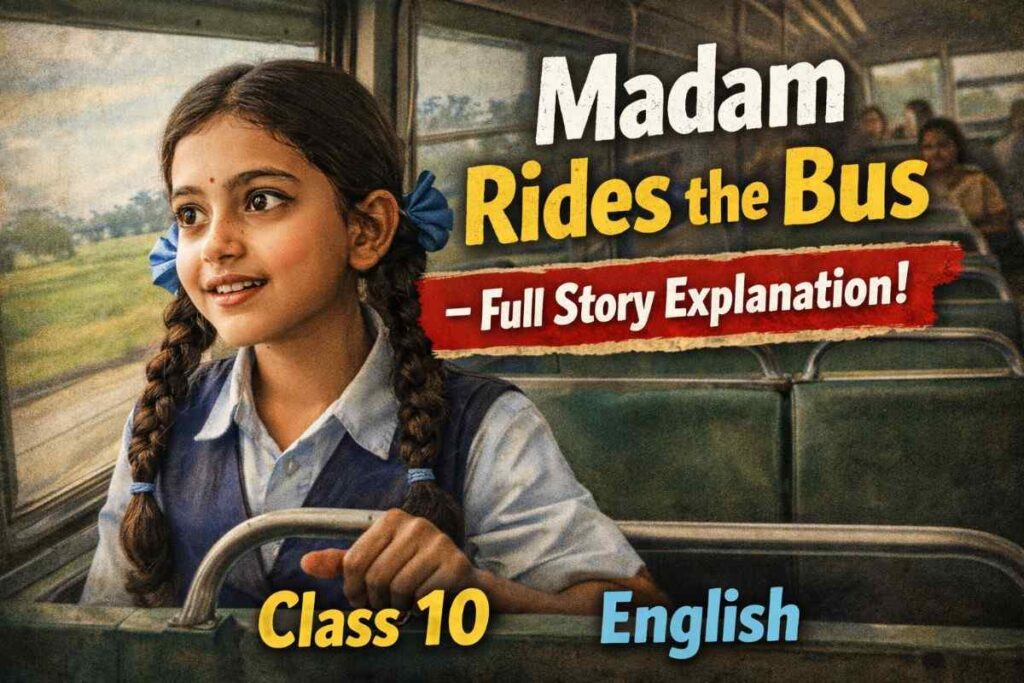

Have You Ever Wanted Something So Badly That You Planned Everything in Secret?
Think about this for a moment. You are just eight years old. You live in a small quiet village. Every single day, you stand at your front door and watch a big, beautiful bus pass by. You watch it go. You watch it come back. Day after day, week after week, month after month. And every time that bus rolls past, something inside your chest burns brighter — a wish, a dream, a fire that just will not go out.
That is exactly where our story begins.
“Madam Rides the Bus” is a beautiful, touching story written by Vallikkannan, originally in Tamil, and later translated into English by K. S. Sundaram. It is part of the Class 10 English textbook First Flight, Chapter 7. But do not let the textbook label fool you — this is not just a chapter to read and forget. This is a story about childhood curiosity, the burning desire to explore the unknown world, the sweet joy of adventure, and the sudden, heart-stopping moment when a little girl comes face to face with the harsh truth of life and death.
Once you start reading this story, you will not want to stop. And by the end of it, you will feel something deep inside — something that stays with you long after you close the book.
Let us dive in.
Who Is Valli? Meet the Little Girl With the Big Dreams
The full name of our main character is Valliammai. But everyone calls her Valli — a short, sweet name for a short, sweet girl who carries a very big world inside her tiny heart.
Valli is eight years old. She lives in a small village in Tamil Nadu, South India. She does not have a father mentioned in the story, and there are no playmates of her age on her street. So you might think — a lonely little girl with nothing to do. But that is where you would be completely wrong.
Valli is not bored. Valli is curious.
Her favourite thing to do every single day is to stand at the front doorway of her house and simply watch the street outside. That is it. No expensive toys, no games, no phone — just the doorway and the street. And for Valli, that doorway is her entire world.
She watches everything. She notices everything. A cart going by. People walking. Neighbours talking. And most importantly — the bus.
The Bus That Changed Everything
Every hour, without fail, a bus would pass through Valli’s street. It went to the nearest town and then came back. Same road, same bus, back and forth, every single hour.
For most people, a bus is just a bus. You get in, you sit down, you reach your destination, you get out. Nothing special about it.
But for Valli, that bus was magic.
She would stand at her door and stare at it with wide, shining eyes. She would watch the people getting on. She would watch the people getting off. She would stare at their faces — faces of people who had seen the town, who had been somewhere exciting, who had experienced something she had not.
And slowly, quietly, like a little seed planted in soft soil, a wish began to grow inside her.
She wanted to ride that bus.
Not because she needed to go anywhere. Not because she had an errand to run. Just because she wanted to feel what it felt like. She wanted to sit in one of those seats, feel the engine roar beneath her, and watch the world rush past her window.
Day by day, that little wish grew bigger. And bigger. And bigger. Until it was no longer just a wish — it was an overwhelming, burning, unstoppable desire.
Valli had made up her mind. She was going to ride that bus. All by herself. Without telling anyone.
The Secret Plan — How an Eight-Year-Old Became a Master Planner
Here is where the story gets absolutely fascinating.
Valli did not just dream about riding the bus and leave it at that. No. She was far too smart and far too serious for that. She decided to do her research first.
Over many days and months, Valli listened very carefully to every conversation happening around her. She listened to her neighbours talking. She listened to people who regularly travelled by bus. She quietly asked a few careful questions here and there — never too many at once, never in a way that would make anyone suspicious.
And bit by bit, like putting together pieces of a puzzle, she gathered all the information she needed.
Here is what she found out:
The nearest town was six miles away from her village. The bus fare was thirty paise one way. The journey from the village to the town took forty-five minutes. If she stayed in her seat at the town and paid another thirty paise, she could come back on the very same bus.
So the total cost of the round trip — going to town and coming back — was sixty paise.
Now, sixty paise might sound like almost nothing to you. And one well-dressed man that Valli overheard even said, “Thirty paise is almost nothing at all.” But for Valli, who hardly ever had any money of her own, sixty paise felt like a fortune.
So what did she do?
She saved.
Every single time she got any small coin — whether it was from a small errand or a kind relative or any other source — she saved it. She did not spend it on sweets, even though she wanted to. She did not buy peppermints or balloons or toys at the village fair, even when her hands itched to do so. There was even one day at the fair when she had enough money to ride the merry-go-round — something any normal child would have jumped at in a heartbeat. But Valli looked at that merry-go-round, felt the pull in her chest, took a deep breath, and walked away.
Because she had a bigger plan.
Slowly, carefully, paise by paise, she saved up a grand total of sixty paise. Her ticket money was ready.
But money was only half the problem. The second problem was even trickier: how to slip out of the house without her mother finding out.
Valli thought about this too. And she found her answer.
Every afternoon, after lunch, her mother would sleep from around one o’clock to four o’clock. Every single day, without fail — her mother would nap during these hours. Valli had always used this quiet time to stand at the door or wander a little in the village. Today, she would use those same precious hours for something much bigger.
Her plan was perfect. She would take the one o’clock bus, reach the town by one forty-five, turn right around and board the return bus, and be safely back home by two forty-five — all before her mother even woke up from her nap.
The plan was set. The money was ready. The time was right.
Valli was going on her adventure.
The Day of the Big Journey — “Stop the Bus! Stop the Bus!”
One fine afternoon, as the one o’clock bus was just about to leave the village and turn onto the main highway, something unexpected happened.
A small, sharp voice cut through the air.
“Stop the bus! Stop the bus!”
The conductor stuck his head out of the door and peered outside. And what did he see? A tiny little girl, barely reaching up to the door of the bus, with her small hand raised in the most commanding way possible — as if she owned the entire road and the bus was obligated to obey her.
The bus slowed down to a crawl.
“Hurry then!” called the conductor. “Tell whoever it is to come quickly.”
“It’s me!” shouted Valli. “I’m the one who has to get on!”
The bus stopped. And the conductor, half-amused and half-surprised, looked at this small determined child standing there with coins in her hand, chin raised, eyes bright.
“Oh, really! You don’t say so!” he said with a smile.
“Yes, I simply have to go to town,” said Valli, still standing outside the bus with absolute confidence. “And here’s my money.”
She held out her coins.
“Okay, okay, but first you must get on the bus,” said the conductor, stretching out his hand to help her up.
And here — right at this very moment — you see the true spirit of Valli.
“Never mind,” she said firmly. “I can get on by myself. You don’t have to help me.”
Eight years old. Standing at the bottom of a bus step. And already, she is saying — I don’t need anyone’s help. I can do this myself.
That, right there, is Valli in a single sentence.
She climbed on board. She had done it. She was on the bus.
Inside the Bus — A World of Wonder for Little Valli
The conductor was a jolly, fun-loving man. He called Valli “madam” — in a playful, teasing way — partly because she was being so formal and serious about the whole thing, and partly because he found it absolutely delightful that this tiny girl had the confidence of a grown woman.
“Oh, please don’t be angry with me, my fine madam,” he said with a grin. “Here, have a seat right up in front. Everybody move aside please — make way for madam!”
The other passengers on the bus — there were only about six or seven, as it was the slow, quiet part of the day — all looked at Valli and laughed along with the conductor. Valli felt a rush of shyness wash over her. She quickly walked to an empty seat and sat down, avoiding everyone’s eyes.
But the moment she sat down, she forgot everything else.
Because the bus — oh, the bus was beautiful.
It was a brand new bus. The outside was painted a bright, gleaming white with green stripes running along the sides. Inside, the overhead bars shone like silver. Right in front of Valli, above the windshield, there was a beautiful clock. And the seats — the seats were soft and so comfortable.
Valli devoured everything with her eyes like a child who has just walked into a sweet shop for the very first time.
Then she turned to look outside. But there was a problem — a canvas blind covered the lower part of her window, and because she was so small, she could not see over it while sitting down. So she did what any determined eight-year-old would do.
She stood up on the seat.
And what she saw when she peered over that blind took her breath away completely.
On one side of the road ran a long, still canal. Beyond it stood rows of tall palm trees, stretching up toward endless green grassland, with distant blue mountains fading into the horizon, and above it all — the sky. Blue, open, free sky.
On the other side of the road was a deep ditch, and then — fields. Green fields stretching as far as her eyes could reach. Not just green. Green, green, green, as far as the eye could see. The kind of green that makes your heart feel light.
“Oh, it was all so wonderful!” the story says. And you can feel those words like a warm breeze.
Valli and the Adults — The Funny Moments on the Bus
Now, of course, not everyone on that bus was happy to simply let this little girl stand on the seat and stare out the window.
An elderly man spoke up. “Listen, child,” he said, “you shouldn’t stand like that. Sit down.”
Valli sat — but she was not happy about it. She looked at this old man who had spoken to her, and while she could see he was genuinely concerned, she was annoyed. She did not want anyone treating her like a small child.
She drew herself up and said, haughtily — that means proudly, with her nose slightly in the air — “There’s nobody here who’s a child. I’ve paid my thirty paise like everyone else.”
The conductor jumped in with a teasing smile: “Oh, sir, but this is a very grown-up madam. Do you think a mere girl could pay her own fare and travel to the city all alone?”
Valli shot an angry glance at the conductor. “I am not a madam. Please remember that. And you’ve not yet given me my ticket.”
The conductor mimicked her serious tone — copying her in a funny way — and everyone laughed. And gradually, even Valli, despite herself, joined in the laughter.
He punched her ticket and handed it over. “Just sit back and make yourself comfortable,” he said. “Why should you stand when you’ve paid for a seat?”
“Because I want to,” she answered — and stood right back up again.
Then came the matter of the elderly woman who sat down beside her. This woman asked kindly, “Are you all alone, dear?”
But Valli was not impressed. In fact, she found the woman quite repulsive — meaning she strongly disliked her appearance and the smell of the betel nut the woman was chewing. She answered curtly — shortly, with a clear tone of “don’t bother me” — “Yes, I’m travelling alone. And I’ve got a ticket too.”
The old woman kept asking questions — where are you going, do you know the street, what’s the house number — and Valli finally turned her face to the window and said, firmly, “You needn’t bother about me. I can take care of myself.”
Throughout all of this, Valli is not being rude just to be rude. She is fiercely, proudly independent. She has planned this journey herself, paid for it herself, and she will manage it herself. She does not need anyone holding her hand. And that spirit — bold, brave, a little stubborn — is what makes Valli so wonderfully alive as a character.
The Hilarious Cow — The Funniest Moment of the Journey
As the bus rolled on, Valli watched the world outside with total joy. She saw the road cutting through bare open land, rushing through tiny little hamlets — small clusters of houses — past occasional roadside shops. She watched in amazement as the bus seemed, at moments, about to swallow up an oncoming vehicle or a pedestrian crossing the road, only to slip past everyone perfectly safely.
She watched the trees — and this is one of the most charming parts of the story — she watched the trees and felt as though they were running towards the bus, only to stop and stand there helplessly as the bus reached them, before rushing away in the opposite direction. That is exactly how it feels when you travel fast, seen through the eyes of a child. Trees running toward you. Trees rushing past. It is beautiful and funny all at once.
And then — the cow.
A young cow, tail sticking straight up in the air with great dignity, suddenly ran out onto the road. Right into the middle. Right in front of the bus.
The bus slowed down to a crawl.
The driver honked his horn. Loudly. Again and again.
But the more the driver honked, the more frightened the poor cow became — and the faster it ran, always right in front of the bus, tail still flying high, hooves clattering on the road.
Valli burst out laughing. She laughed so hard, so helplessly, with such complete abandon, that tears ran down her face. The whole thing — this big bus being stopped dead by one confused, panicking cow — was the funniest thing she had ever seen in her entire eight years of life.
“Hey, lady, haven’t you laughed enough?” called the conductor, grinning. “Better save some for tomorrow!”
Eventually the cow moved off the road. And the bus rolled on.
Arriving at the Town — Struck Dumb With Wonder
Soon, the bus came to a railway crossing. Valli watched a train appear in the distance — just a tiny speck at first — and then grow bigger and bigger and bigger until it roared past the crossing gate with a tremendous sound, shaking the entire bus. Valli held on tight and felt the vibration run through her whole body.
And then the bus entered the town.
Oh, the town.
First the train station. Then a busy, well-organised shopping street. And then a wide, broad thoroughfare — a main road — lined with shops on both sides. Big, bright, gleaming shops. Windows filled with beautiful clothes and merchandise laid out in glittering displays. Crowds of people everywhere. Noise. Colour. Movement. Life.
Valli had never seen anything like it. She sat completely still, her mouth slightly open, her eyes wide, staring at everything. The story says she was “struck dumb with wonder” — meaning she was so amazed that she literally could not speak.
And then the bus stopped. Everyone got off.
Everyone except Valli.
The conductor looked at her. “Hey, lady — aren’t you ready to get off? This is as far as your thirty paise takes you.”
“No,” said Valli calmly. “I’m going back on this same bus.” And she pulled out another thirty paise from her pocket and handed it to him.
The conductor was surprised. Amused. “Why, is something the matter?”
“No, nothing’s the matter. I just felt like having a bus ride, that’s all.”
He offered to let her go and look at the town. She said she was too afraid to go alone. He offered to bring her a cold drink. She refused that too — she didn’t have enough money for extras, and she would not accept charity. She had come for the bus ride. The bus ride was enough. She would sit and wait, and she would go home.
There is something quietly beautiful about this. Valli had saved just enough for the journey and not a single paise more. She had budgeted perfectly. She had come for one thing — the experience of riding the bus — and she was going to hold onto her plan exactly as she had made it, without being distracted or tempted.
The Journey Back — And the Moment Everything Changes
The return journey began. There were not many passengers again. The conductor checked on Valli — “Won’t your mother be looking for you?” — and she told him no, no one would be looking for her.
And off they went, back through the same road, past the same fields, the same palm trees, the same blue sky. But this time, something was different.
Valli was not bored. She was just as excited as before, greeting everything with the same wonder she had felt on the way to town. The green fields were just as green. The sky was just as blue.
And then — she saw it.
By the side of the road, lying completely still, was a young cow. Dead.
It had been struck by some fast-moving vehicle. Its legs were spreadeagled — spread out stiffly in all directions. Its eyes were wide open but utterly lifeless, staring at nothing. There was blood. It lay there on the road like something broken and abandoned.
Valli looked at it. And a sudden, horrible thought struck her.
“Isn’t that the same cow that ran in front of the bus on our trip to town?” she asked the conductor quietly.
The conductor nodded.
Yes. It was the same cow. The same young, energetic, silly cow that had been running in the middle of the road with its tail in the air, making Valli laugh until she cried. That cow — that full-of-life, funny, lively animal — was now lying dead by the side of the road.
Just like that.
In the space of less than an hour, that creature had gone from running joyfully down the road to lying cold and still on the roadside.
The story describes what Valli felt in these words: “What had been a lovable, beautiful creature just a little while ago had now suddenly lost its charm and its life and looked so horrible, so frightening.”
Valli was overcome with sadness. Deep, sudden, overwhelming sadness.
She turned away from the window. She no longer wanted to look outside. She no longer wanted to see the beautiful green fields or the swaying palm trees or the wide blue sky. The memory of the dead cow haunted her — it kept returning to her mind, impossible to push away — and it dampened all her enthusiasm, like a wet cloth thrown over a fire.
She sat glued to her seat in silence, staring at nothing, until the bus reached her village at three forty.
Coming Home — With a Secret Smile and a Deep Secret
Valli got up quietly, stretched herself, and turned to the conductor. “Well, sir, I hope to see you again,” she said politely.
“Okay, madam,” he answered, smiling warmly. “Whenever you feel like a bus ride, come and join us. And don’t forget to bring your fare.”
She laughed — a small, gentle laugh — and jumped down from the bus. Then she ran straight for home.
When she got inside, she found her mother was already awake, sitting and talking with one of Valli’s aunts — a very talkative aunt who never seemed to stop once she started.
“And where have you been?” asked the aunt casually when Valli walked in. She did not really expect an answer. It was just one of those things adults say to children out of habit.
Valli just smiled. Said nothing.
Her mother and aunt went on with their conversation. And then her mother said something — completely unaware of what Valli had just been through — something that unknowingly touched the very heart of Valli’s experience.
“So many things in our midst and in the world outside,” her mother said thoughtfully. “How can we possibly know about everything? And even when we do know about something, we often can’t understand it completely, can we?”
Valli’s breath caught.
“Oh, yes!” she said softly. Breathed it, really — more to herself than to anyone else.
Her mother turned, surprised. “What? What’s that you say?”
“Oh,” said Valli carefully, “I was just agreeing with what you said about things happening without our knowledge.”
Her aunt laughed it off: “Just a chit of a girl, and yet look how she pokes her nose into our conversation, just as though she were a grown lady!”
And Valli — little Valli, eight-year-old Valli who had just ridden a bus alone, seen a beautiful town, laughed until she cried, and then watched life disappear right before her eyes — Valli smiled to herself.
A private smile. A smile the adults around her could never fully understand.
The story ends with these words: “She didn’t want them to understand her smile. But, then, there wasn’t much chance of that, was there?”
The Deep Meaning Behind the Story — What Vallikkannan Really Wants to Tell Us
At first glance, “Madam Rides the Bus” looks like a simple, sweet story about a little girl going on a bus adventure. And it is that. But it is also much, much more.
The story is really about two things happening at the same time — the joy of discovery and the pain of growing up.
The Joy of Discovery: Valli’s entire journey is about the pure excitement of seeing the world for the first time. The green fields, the tall mountains, the busy town, the shining shops — all of it is magical to her because she has never seen it before. The story reminds us that the world is full of wonder, and that the best adventures are often the ones we create ourselves, with our own courage and our own careful planning.
The Lesson of Life and Death: The dead cow is not just a sad moment in the story. It is the turning point. It is the moment when Valli’s innocent, joyful view of the world cracks open just a little — and something deeper, something harder, something true slips in through that crack. The cow that was laughing and living just forty-five minutes ago is now gone forever. Life, Valli learns, is not permanent. Beauty can disappear in an instant. And there is nothing you can do to stop it. This is a lesson that no adult had sat down and explained to her. She understood it herself, quietly, on a bus seat, staring at a dead animal by the road.
The Gap Between Knowledge and Understanding: Valli’s mother says it perfectly — we know many things, but we often cannot truly understand them. Valli knew, in a general way, that death exists. But on that bus, on that return journey, she understood it — felt it in her chest, in her stomach, in her silence. And that is a very different thing.
The Independence and Courage of a Child: Throughout the story, Valli refuses help. She refuses the conductor’s hand, refuses to let anyone call her a child, refuses a free cold drink, refuses to be treated as less than capable. She is not rude — she is proud. There is a big difference. Valli shows us that children are far more capable, far more thoughtful, and far more aware than adults give them credit for.
The Secret World of Childhood: At the very end, Valli smiles a smile that the adults around her cannot understand. And that smile represents something every child knows — that there is a whole private world inside you, a world of experiences and feelings and understandings that belong only to you. Adults cannot always enter that world. And sometimes, you do not want them to.
Quick Summary of the Story — At a Glance
Here is the complete story of “Madam Rides the Bus” told simply, step by step:
Valli is an eight-year-old girl from a small village in Tamil Nadu. She has no playmates, so she spends her days watching the street from her front door. The thing she loves watching most is the bus that passes every hour between her village and the nearest town. Over time, a fierce desire grows inside her — she wants to ride that bus.
She spends months secretly gathering information about the journey — the distance, the fare, the timing. She saves sixty paise — thirty paise for the trip to town and thirty paise for the return journey — by resisting every temptation to spend money on sweets, toys, and even a merry-go-round at the village fair.
One afternoon, while her mother naps, Valli sneaks out and boards the one o’clock bus all by herself. On the bus, she is playfully called “madam” by the jolly conductor. She stands on the seat to see the beautiful countryside outside — the canal, the palm trees, the green fields, the mountains. She refuses to be treated like a child by an elderly man or befriended by an elderly woman, fiercely asserting her independence.
On the way to town, a young cow runs into the road in front of the bus, and Valli laughs until she cries watching it. She arrives in town, sees the busy streets and shops with wide-eyed wonder, but decides not to get off the bus. She pays thirty paise for the return journey and heads home.
On the way back, Valli sees the same cow lying dead by the roadside. She is deeply saddened by this sudden encounter with death and spends the rest of the journey in silence.
She returns home safely before her mother wakes up. Her mother and aunt have no idea where she has been. When her mother says thoughtfully that we can never fully know or understand everything in the world, Valli quietly agrees — because she has just lived exactly that truth.
Key Characters in the Story
Valli (Valliammai): The eight-year-old protagonist of the story. Curious, brave, independent, proud, and deeply sensitive. She plans and executes her adventure entirely on her own and learns a profound lesson about life and death in the process.
The Conductor: A jolly, kind, funny man who calls Valli “madam” throughout the journey. He represents the friendly, warm side of the outside world. He does not discourage Valli or make her feel unsafe — instead, he plays along with her confidence while keeping a gentle eye on her.
The Elderly Man: A passenger who tells Valli to sit down out of genuine concern. He means no harm, but Valli is annoyed by being treated like a child.
The Elderly Woman: Another passenger who asks Valli nosy questions about her journey. Valli finds her repulsive and dismisses her firmly.
Valli’s Mother: Does not appear much in the story, but her brief words at the end carry the entire theme of the story — the gap between knowing and understanding.
Themes of the Story — What the Story Is Really About
The Desire to Explore: Every human being — especially every child — has a deep natural desire to go beyond the familiar, to see what lies outside the boundaries of their known world. Valli’s bus ride is the physical symbol of this universal desire.
Courage and Independence: Valli shows remarkable courage. She is not fearless — she admits to the conductor that she would be afraid to walk around the town alone. But she faces what she can handle, and she faces it by herself, on her own terms.
The Reality of Death: The dead cow is a sudden, jarring reminder that life ends. The same creature that was full of energy and life in the morning was gone by afternoon. This shocks Valli into a quiet, sad understanding that beauty and life are temporary.
The Innocence and Wisdom of Childhood: The story gently challenges the assumption that children do not understand “serious” things. Valli understands more than the adults around her realise. Her quiet smile at the end is proof of that.
Important Quotes From the Story and What They Mean
“She wanted to ride on that bus, even if just once. This wish became stronger and stronger, until it was an overwhelming desire.”
— This line shows us that even small, simple dreams, when held long enough, become powerful enough to move us to action.
“Oh, it was all so wonderful!”
— This is Valli’s pure, unfiltered joy at seeing the beauty of the world outside her village for the first time. Three simple words that carry the weight of a child’s entire world.
“What had been a lovable, beautiful creature just a little while ago had now suddenly lost its charm and its life.”
— This is the heart of the story. Life is fragile. Beauty is temporary. One moment something is full of life; the next, it is gone.
“She didn’t want them to understand her smile. But, then, there wasn’t much chance of that, was there?”
— The story’s final lines. They tell us that Valli has crossed a threshold — she has experienced something real and deep that cannot be explained to the people around her. She has, in a small but significant way, grown up.
Why This Story Matters — The Lesson That Stays With You
There is a reason this story is taught to Class 10 students and not Class 1 students. It is not complicated. It is not full of difficult words or confusing ideas. But it deals with something very real and very important — the moment when a child first truly understands that life and death are two sides of the same road.
We all know that living things die. We are told about it, we read about it, we learn about it in biology class. But understanding it — feeling it, sitting quietly with it, letting it change the way you see the world — that is something completely different.
Valli did not read about death in a book. She saw it, unexpectedly, on a road she had just traveled with laughter and joy. And that made all the difference.
The story also tells us something beautiful about childhood itself — that children are capable of extraordinary courage, extraordinary planning, extraordinary sensitivity, and extraordinary depth. They just need the chance to show it.
Valli had that chance. And she used it perfectly.
Conclusion — What Did You Learn From Madam Rides the Bus?
“Madam Rides the Bus” is not just a story. It is a small, perfect world contained in a few pages. It gives you the joy of adventure, the warmth of a funny bus ride, the beauty of green countryside, and then, gently but firmly, it presses a cold, quiet truth into your hands and asks you to hold it.
Life is short. Beauty fades. Things happen without our knowledge. And even when we know that, we cannot always understand it — until we live it.
Valli lived it. And she came home carrying something heavier and deeper than sixty paise and a bus ticket. She came home carrying her first real understanding of what it means to be alive in a world where everything — every laughing cow, every green field, every bright bus — can be gone in a moment.
That private smile at the end? That is the smile of someone who just grew up, just a little, in a way that no one around her can see.
And maybe that is the most human thing of all.
Did you find this explanation helpful? Share it with your classmates and help them understand this beautiful story too! If you want full explanations of other chapters from Class 10 First Flight and Footprints Without Feet, bookmark this page and stay connected — more detailed story breakdowns are coming your way!