
You know the type of argument.
Someone brings up an old grudge. Then the other person brings up a bigger one. Then someone’s grandfather is insulted. Then someone’s dog. Then someone clutches their chest and pretends to be dying.
And you sit there watching, thinking — what is even happening right now?
That is exactly the feeling Anton Chekhov wanted you to have when you read The Proposal.
This one-act play, which is part of your Class 10 English First Flight textbook, is one of the funniest, most chaotic, and surprisingly insightful pieces you will study this year. A man comes to propose marriage. A simple, joyful thing, right? But within minutes, everything falls apart — not once, but twice — because these three people simply cannot stop quarrelling.
And yet, somehow, the proposal still happens.
This is your complete guide to The Proposal Class 10 English, Chapter 9, First Flight. Read it carefully, and you will walk into your board exam fully prepared.
About the Author — Who Was Anton Chekhov?
Anton Chekhov was a Russian writer born in 1860. He is one of the greatest short story writers and playwrights the world has ever seen.
He trained as a doctor. But writing was his true calling. He wrote hundreds of short stories and several full-length plays. His most famous plays include The Cherry Orchard, The Seagull, and Three Sisters.
Chekhov had a remarkable ability to find humour in everyday human behaviour. He loved showing how ordinary people — with all their small fears, petty jealousies, and ridiculous pride — are both funny and deeply human at the same time.
The Proposal (originally titled A Marriage Proposal) was written in 1888–89. It is a farce — a type of comedy that uses exaggerated situations, absurd misunderstandings, and over-the-top characters to make people laugh.
But under all the laughter, Chekhov is also making a sharp, serious point. He is showing us what wealthy Russian society was really like — where marriages were made not for love, but for money and land.
Characters in The Proposal — Who Are These People?
Before we dive into the play, you need to know the three characters clearly. Because understanding who they are helps you understand why they behave the way they do.
Stepan Stepanovitch Chubukov
Chubukov is an older landowner — someone who owns a large piece of land. He is the father of Natalya and the first character Lomov meets when he arrives.
Chubukov is warm and over-the-top in his greetings. He calls Lomov “my darling,” “my angel,” “my treasure” — all within the first few minutes of meeting him. But the moment any disagreement starts, his warmth vanishes completely. He becomes aggressive, insulting, and loud.
He is practical at heart. He wants his twenty-five-year-old daughter to get married. He knows Lomov is a good match — wealthy, a neighbour, well-connected. So when the quarrelling starts and Lomov storms out, Chubukov panics. He does everything he can to drag Lomov back, because he does not want to lose this opportunity.
He is greedy, excitable, and hypocritical — meaning he says one thing and does another. But he is also comically helpless when things go wrong.
Natalya Stepanovna
Natalya is Chubukov’s twenty-five-year-old daughter. She is described as an excellent housekeeper, educated, and not bad-looking.
She is also fiercely argumentative. She will not back down from any fight. When Lomov mentions the Oxen Meadows, she immediately contradicts him — even though the meadows are not worth much. When Lomov talks about his dog Guess, she insists her dog Squeezer is better.
Natalya never knows that Lomov has come to propose. She finds out only after she has driven him away with her arguing. And when she finds out, she has an absolute breakdown — she wails, she faints, she demands he be brought back immediately.
This is the comedy. She is desperately interested in marriage but completely unaware that her own temper keeps destroying her chance at it.
Ivan Vassilevitch Lomov
Lomov is a neighbour of Chubukov. He is thirty-five years old, a large and physically strong man. But emotionally? He is a complete wreck.
He suffers from palpitations — an irregular, racing heartbeat. He is excitable, anxious, and hypochondriac — meaning he is constantly worried about his own health. His lips twitch. His eyebrows twitch. His foot goes to sleep. He clutches his heart at the slightest stress.
He has come to propose to Natalya. He is not proposing out of deep romantic love. He has thought about it practically. He is thirty-five. He needs a quiet, settled life. Natalya is a good housekeeper, well-educated, not bad-looking. That is enough for him.
But he cannot even get the proposal started before he gets into a massive argument about land — and then another one about dogs. Both times, he storms out or collapses dramatically.
He is funny, sympathetic, and slightly ridiculous. Chekhov uses him brilliantly to satirise — meaning mock and criticise — the kind of society where a man proposes marriage for purely practical reasons, and still manages to turn it into a disaster.
The Play — A Complete Scene-by-Scene Walkthrough
This is the detailed walkthrough you need. Read every section carefully. This chapter has a lot of dialogue and action, and you need to understand the sequence of events perfectly for your Class 10 English board exam.
Scene 1 — Lomov Arrives to Propose
The play opens in the drawing room of Chubukov’s house. A drawing room is the formal sitting room of a house — the room used to receive guests.
Lomov enters wearing a dress-jacket and white gloves. This is a formal outfit — the kind you would wear to an important occasion. Chubukov is immediately surprised to see him dressed so formally.
Chubukov greets him with excessive warmth — “My dear fellow,” “my darling,” “my angel,” “my treasure.” This is Chekhov’s first joke. Chubukov piles on so many terms of endearment — expressions of affection — that they start to sound fake and hollow.
Chubukov notices the formal dress and assumes Lomov has come to borrow money. He says to himself: He’s come to borrow money. Shan’t give him any! This is an aside — a comment made to the audience that the other characters cannot hear. It immediately tells us that Chubukov’s warmth is not entirely genuine.
Lomov, however, is too nervous to be direct. He stutters and rambles. He keeps saying things like “I don’t deserve your help” and “I haven’t any right to count on your assistance.” Chubukov grows impatient. Spit it out! he says.
And finally, Lomov says it. He has come to ask for the hand of Chubukov’s daughter, Natalya Stepanovna, in marriage.
Chubukov explodes with joy. He embraces and kisses Lomov. He sheds a tear. He says he has always loved Lomov like his own son and that this is his continual desire — something he has always wanted.
Is this true? Has he always hoped Lomov would propose? Almost certainly yes. This is a wealthy neighbour. A marriage between Lomov and Natalya would join two estates — two large pieces of land. It would be financially and socially excellent for both families. Chubukov is delighted.
Chubukov goes to fetch Natalya. Lomov is left alone on stage.
Now comes one of the most revealing moments of the play.
Alone, Lomov speaks his thoughts out loud. He is trembling. He feels cold. He is terrified — not with romantic excitement, but with practical anxiety. He says: If I give myself time to think, to hesitate, to look for an ideal, or for real love, then I’ll never get married.
Read that again. He is saying directly: I am not marrying for love. I am marrying because I am thirty-five, because I need a settled life, because I need someone to run my household. He lists Natalya’s qualities like items on a checklist — good housekeeper, not bad-looking, well-educated. That is enough.
He also lists his many health problems in remarkable detail. He has palpitations. He gets excited easily. His lips tremble. His right eyebrow twitches. His sleep is terrible — he wakes up twenty times a night from a strange pulling sensation in his left side.
This is Chekhov at his best. The character is ridiculous. But he is also very human. He is a man trying to do a sensible, rational thing — get married — and failing spectacularly because his nerves are completely out of control.
Scene 2 — Natalya Enters, and the Oxen Meadows Dispute Begins
Natalya comes in. She is wearing an apron — she was shelling peas when her father called her. She greets Lomov cheerfully and casually. She asks why he has not visited in such a long time. She talks about the weather, about hay, about workmen.
She notices his formal dress and asks if he is going to a ball.
Lomov tries to start the proposal. He begins nervously: I’ve come to ask you to hear me out… He goes round and round. He mentions the long history of friendship between their families. He talks about how the Lomovs and the Chubukovs have always respected each other. He says his land borders hers.
And then — he mentions the Oxen Meadows.
He says: You will remember that my Oxen Meadows touch your birchwoods.
And that single sentence destroys everything.
Natalya stops him immediately. Excuse my interrupting you, she says. You say “my Oxen Meadows”. But are they yours?
And with that question, a bomb explodes.
Scene 3 — The First Great Quarrel: The Oxen Meadows
What follows is one of the funniest extended arguments in all of literature. Let us go through it carefully, because every detail matters.
Lomov says the Oxen Meadows are his. Natalya says they are hers. Back and forth. Simple as that. But they cannot stop.
Lomov explains the history. His aunt’s grandmother gave the Meadows for the temporary and free use — meaning they could use the land for free, but it was not theirs permanently — of the peasants of Natalya’s father’s grandfather. The peasants used the Meadows for forty years. Then something happened that made the land revert to the Lomovs.
Natalya contradicts him. She says her grandfather and great-grandfather always believed the land extended to Burnt Marsh. That means, in her view, the Oxen Meadows were always part of the Chubukov estate.
Now here is the interesting thing. Lomov actually says, at one point, that the Meadows are not worth much to him financially. And Natalya says the same — they only amount to five dessiatins (a Russian land measurement, roughly equal to about 2.7 acres each), worth about 300 roubles (Russian currency). Neither of them actually needs this land badly.
But neither will back down. Because this is not really about land. This is about pride. And principle.
Lomov says: I’m acting on principle. Natalya says she cannot stand unfairness. Both are fighting not for value, but for the feeling of being right.
The argument escalates rapidly. Natalya starts calling Lomov’s behaviour strange and impudent — meaning rude and disrespectful. She mentions that they lent him their threshing-machine — a machine used to separate grain from stalks — and had to delay their own harvesting because of it. And now he is trying to claim her land?
Lomov responds by calling Natalya’s family land-grabbers — people who illegally seize others’ property.
Then Chubukov enters. He was supposed to have left them alone together, but the shouting has brought him back.
Natalya asks her father to settle the dispute. Chubukov, without hesitation, sides with his daughter — of course the Meadows are theirs. He is supposed to be on Lomov’s side as a future father-in-law. But blood runs thicker than business.
Lomov refuses to accept this. He tries to explain the history again. Chubukov dismisses him. The argument grows louder and more personal.
Lomov calls Chubukov a land-grabber. Chubukov calls Lomov a pettifogger — a person who raises petty, trivial legal arguments. He says all the Lomovs are like that.
Lomov hits back. He says no Lomov has ever been tried for embezzlement — the crime of stealing money entrusted to your care. But Chubukov’s grandfather was.
Chubukov retaliates. He says the Lomovs have had lunacy — madness — in their family. All of them.
Natalya joins in. All, all, all, she echoes.
Chubukov goes further. He says Lomov’s grandfather was a drunkard, and his young aunt ran away with an architect.
Lomov hits back. He says Chubukov’s mother was hump-backed.
But then Lomov’s health starts failing. He clutches his chest. Something pulling in my side… My head… Help! Water!
Chubukov continues. Lomov’s father was a guzzling gambler — someone who drank and gambled excessively.
Natalya says no backbiter — someone who says nasty things about people behind their backs — could equal Lomov’s aunt.
Chubukov says Lomov is an intriguer — someone who plots and schemes secretly. He says it is an open secret that Lomov tried to bribe officials during the last elections.
Lomov is now barely holding himself together. He grabs his hat. My heart! Which way? Where’s the door? Oh, I think I’m dying! My foot’s quite numb!
He staggers towards the door. Chubukov shouts after him: And don’t set foot in my house again!
Lomov staggers out. He is gone.
Both Chubukov and Natalya vent their fury after he leaves. Chubukov calls him a villain, a scarecrow. Natalya calls him a monster. They are both furious and completely satisfied with themselves.
Scene 4 — The Shocking Revelation
Then Chubukov, still furious, mutters something that stops everything.
He says something like: And that blind hen has the confounded cheek to make a proposal!
Natalya freezes. What proposal?
Chubukov: Why, he came here to propose to you.
And then Natalya absolutely falls apart.
To propose? To me? Why didn’t you tell me so before?
She collapses into a chair, wailing. She demands that Lomov be brought back immediately. She says she is ill. She has hysterics — a dramatic, uncontrollable emotional breakdown. She screams that she is dying.
Chubukov is completely frantic. He is furious with himself, with his daughter, with the whole situation. He shouts: Oh, unhappy man that I am! I’ll shoot myself! I’ll hang myself! We’ve done for her!
He runs out to fetch Lomov. He mutters to himself about what a burden it is to be the father of a grown-up daughter. He is exasperated — at the end of his patience — with everyone and everything.
But he goes. Because the marriage must happen.
Scene 5 — Lomov Returns, Barely Alive
Chubukov drags Lomov back. Lomov enters looking exhausted and unwell. He is still complaining about his heart, his foot, his side.
Natalya immediately changes her tone. She apologises. She says they were all a little heated — meaning they got carried away by their emotions. And then she does something remarkable.
She concedes. She says: Oxen Meadows… really are yours.
This is a stunning reversal. A moment ago she was screaming that the Meadows were hers, ours, ours, and she would never give them up. Now, suddenly, they are his.
And why? Because she wants him to propose. Everything else — the land, the principle, the fairness — is secondary to that goal.
Lomov accepts the apology rather awkwardly. He says he did it on principle. He says the land is worth little to him financially but the principle matters.
And then — just as things are calming down, just as Natalya is desperately trying to steer the conversation back towards romance — Lomov makes a fatal error.
He mentions his dog.
He says his dog Guess has gone lame and he is very upset about it. He says Guess is a first-rate dog and he paid 125 roubles for him.
Natalya says that was too much. She says her father’s dog Squeezer is far better, and he was bought for only 85 roubles.
And suddenly — they are arguing again.
Scene 6 — The Second Great Quarrel: Guess vs. Squeezer
The second quarrel is even funnier than the first, because by now we already know these characters and we know exactly where this is going.
Lomov says Guess is a first-rate dog. Natalya says Squeezer is better. Lomov says Squeezer is overshot — meaning his lower jaw is shorter than his upper jaw, which is a physical defect in hunting dogs that affects how they catch prey.
Natalya says this is the first she has heard of it. She denies it completely. She says Squeezer is a thoroughbred — a purebred animal with a known, documented ancestry — the son of Harness and Chisels. She says Guess has no proper pedigree — no verified line of breeding — and is old and ugly.
Lomov fires back. He says Guess ran neck-and-neck with the Count’s dog at the Marusinsky hunt, while Squeezer was left a whole verst behind. A verst is a Russian unit of distance, roughly one kilometre. So Squeezer was left nearly a kilometre behind.
Chubukov comes back in. He is asked to settle this argument too. He tries to be diplomatic — he acknowledges that Guess has good qualities but also has defects: he is old and short in the muzzle.
Lomov is enraged. He says this is a deliberate lie. He insists Guess is a better dog.
The argument spirals again into personal insults. Natalya mocks Lomov for talking about his heart so much. She says he should go and lie on the kitchen oven and catch black beetles instead of hunting. Chubukov joins in and mocks Lomov’s palpitations. They tell him he is not a real hunter at all.
Lomov calls Chubukov an intriguer — someone who schemes and plots. Chubukov calls Lomov a boy, a pup, a fool. Lomov calls Chubukov an old rat and a Jesuit — a term used to mean a crafty, scheming person.
Chubukov threatens to shoot Lomov like a partridge.
Lomov makes a low blow. He says everyone knows Chubukov’s late wife used to beat him.
Chubukov hits back. He says Lomov is under the slipper of his housekeeper — meaning his housekeeper controls him completely.
And then Lomov collapses. My heart’s burst! My shoulders come off! Where is my shoulder? I die. He falls into an armchair. A doctor!
Chubukov is furious and also sick himself. He drinks water. I’m sick! I can’t breathe!
Natalya screams: He’s dead! Ivan Vassilevitch is dead!
Chubukov looks at Lomov. He thinks Lomov is dead. He panics completely. He shouts for water, a doctor. He says he is the most unhappy man alive.
But then — Lomov stirs. He is not dead. He was just overwhelmed.
Scene 7 — The Proposal Finally Happens
Chubukov does not waste a second.
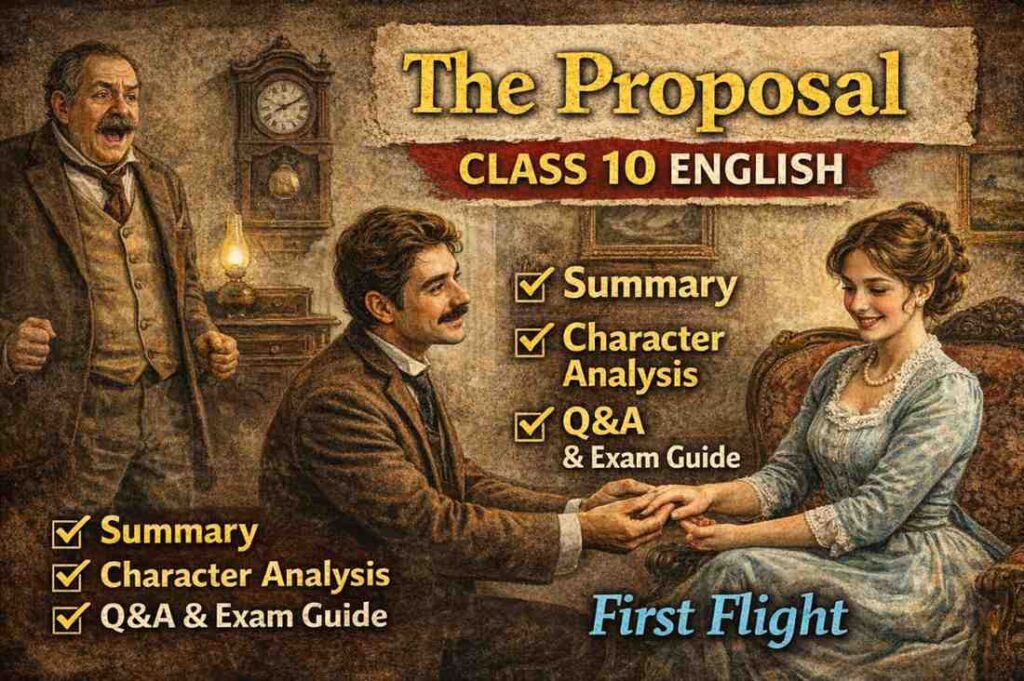
The moment Lomov opens his eyes and says I see stars… mist… where am I?, Chubukov grabs his hand, puts it into Natalya’s hand and says: Hurry up and get married and — well, to the devil with you! She’s willing!
He gives them his blessing right there. Only leave me in peace!
Lomov is confused. He barely knows what is happening. Eh? What? To whom?
Chubukov: She’s willing! Kiss and be damned to you!
Natalya, still wailing: He’s alive… Yes, yes, I’m willing.
They kiss. Lomov begins to understand. He is happy. He says I’m happy and kisses Natalya’s hand.
Chubukov sighs: What a weight off my shoulders!
So the proposal has been made. Not in a romantic, meaningful way. Not with poetry or declarations of love. It was made with Lomov half-conscious in an armchair, Natalya sobbing, and Chubukov practically pushing their hands together out of sheer desperation.
Scene 8 — The Curtain Falls on More Arguing
But Chekhov, being Chekhov, cannot let the play end peacefully.
The moment things settle, Natalya opens her mouth again. But still you will admit now that Guess is worse than Squeezer.
Lomov: Better!
Natalya: Worse!
And they are off again. Arguing about the dogs, now as an engaged couple.
Chubukov watches in despair. He tries to drown them out by calling for champagne. Well, that’s a way to start your family bliss! Have some champagne!
But they keep arguing. Lomov: He’s better! Natalya: Worse! Worse! Worse!
The curtain falls on Chubukov shouting Champagne! Champagne! while the two newly-engaged people argue over whose dog is superior.
The final joke is perfect. Nothing has changed. They are engaged now. But they are still exactly who they were. Still quarrelsome. Still petty. Still completely unable to stop fighting over nothing.
This is Chekhov’s statement. Marriage in this world is not about love or compatibility. It is about land and money. And so these two people, who cannot spend five minutes together without screaming, will now spend their entire lives together. And they will probably be arguing the whole time.
Key Facts Table — The Proposal Class 10 English
| Detail | Information |
|---|---|
| Author | Anton Chekhov |
| Original Title | A Marriage Proposal |
| Year Written | 1888–89 |
| Type of Play | One-act play / Farce |
| Setting | Drawing room of Chubukov’s house, Russia |
| Characters | Stepan Chubukov, Natalya Stepanovna, Ivan Lomov |
| First Quarrel | Ownership of Oxen Meadows |
| Second Quarrel | Which dog is better — Guess or Squeezer |
| Lomov’s Age | 35 years |
| Natalya’s Age | 25 years |
| Price Lomov paid for Guess | 125 roubles |
| Price Chubukov paid for Squeezer | 85 roubles |
| Oxen Meadows worth | Five dessiatins / approximately 300 roubles |
| Lomov’s health problems | Palpitations, excitability, sleeplessness, numb limbs |
| Chapter | Class 10 English, First Flight, Chapter 9 |
| Central Theme | Quarrelsome nature, marriage for economic interest, petty pride |
Important Vocabulary — Every Word You Must Know
This is a play written in translation from Russian. It uses some old-fashioned expressions. Here are all the important words with clear, simple explanations.
Farce — A type of comedy that uses ridiculous, over-the-top situations and exaggerated characters to make people laugh.
Drawing room — The formal sitting room of a wealthy house, used to receive and entertain guests.
Aside — In a play, when a character speaks directly to the audience in a way the other characters cannot hear.
Palpitations — An irregular, rapid, or forceful heartbeat. Lomov mentions this constantly as one of his health complaints.
Hypochondriac — A person who constantly believes they are ill, or worries excessively about their health.
Perpetuity — Forever. Lomov says his aunt’s grandmother gave the Meadows for the free use of the peasants — but not in perpetuity.
Dessiatins — An old Russian unit of land measurement, roughly equal to 2.7 acres.
Roubles — Russian currency. The Oxen Meadows were worth about 300 roubles.
Pedigree — A record of an animal’s ancestors, proving its pure breeding. Natalya claims Squeezer has a known pedigree while Guess does not.
Thoroughbred — An animal of pure, documented breed. Natalya calls Squeezer a thoroughbred.
Overshot — A jaw defect in dogs where the lower jaw is shorter than the upper jaw. Lomov claims Squeezer has this defect.
Verst — An old Russian unit of distance, roughly one kilometre.
Embezzlement — The crime of stealing money that has been entrusted to you for a different purpose. Lomov accuses Chubukov’s grandfather of this.
Pettifogger — Someone who makes unnecessary, petty arguments about trivial legal points.
Intriguer — Someone who plots and schemes secretly for their own benefit.
Impudent — Rude, disrespectful, shamelessly bold.
Cajole — To gently persuade someone to do something, often using flattery or repeated requests.
Excruciating — Extremely intense or painful. Lomov describes his palpitations as excruciating.
Hysterics — A state of uncontrolled emotional outburst, with crying, screaming, or loss of composure.
Egad — An old-fashioned exclamation of surprise, similar to “good God!” or “wow.”
Heaps — Informal way of saying “much more.” Natalya says Squeezer is heaps better than Guess.
Neglige — A loose, casual dress or house clothing. Natalya apologises for being in her neglige when Lomov arrives.
Complete NCERT Q&A — The Proposal Class 10 English
Here are full, board-exam-ready answers for every question in your Class 10 English textbook.
Q1. What does Chubukov at first suspect that Lomov has come for? Is he sincere when he later says “And I’ve always loved you, my angel, as if you were my own son”?
Answer:
When Lomov first arrives dressed formally, Chubukov is immediately suspicious. He assumes Lomov has come to borrow money. He says to himself in an aside: He’s come to borrow money. Shan’t give him any! This tells us that Chubukov’s outward warmth does not always match his inner thoughts.
As for whether his later declaration of love is sincere — it is partially sincere, but heavily coloured by self-interest.
When Lomov actually proposes to Natalya, Chubukov’s joy is explosive. He embraces Lomov, kisses him, sheds a tear, and says he has always loved Lomov like his own son and that this has been his continual desire. These are strong words.
But we should be careful. Chubukov is a practical man. He knows that a marriage between Lomov and Natalya would join two wealthy neighbouring families. It would be excellent for both their estates. His joy is real — but it is the joy of a man who has just seen a very good business opportunity come to life.
The fact that he so easily turns on Lomov the moment the Oxen Meadows dispute starts — calling him names and throwing him out of the house — shows that his affection is not unconditional. It is tied to whether Lomov is being cooperative. True love for someone like a son would survive a quarrel. Chubukov’s “love” evaporates the instant Lomov becomes an inconvenience.
So: partly sincere, but largely driven by practical and economic interest.
Q2. Chubukov says of Natalya: “…as if she won’t consent! She’s in love; egad, she’s like a lovesick cat…” Would you agree? Find reasons for your answer.
Answer:
This is a tricky question. And the answer is — not quite, or at least not in the way Chubukov means it.
Chubukov says Natalya is in love with Lomov. But from the play, there is very little evidence that Natalya has deep romantic feelings for Lomov specifically. She does not behave like someone who is in love. She greets him casually, talks about hay and weather, and almost immediately gets into a furious argument with him about land.
What the play does show us is that Natalya desperately wants to get married. She is twenty-five years old — which in nineteenth-century Russian society meant she was approaching the age where marriage opportunities might become scarce. When she finds out Lomov came to propose, and that he has left, she completely falls apart. She wails. She has hysterics. She demands he be brought back.
But this reaction is less about love for Lomov specifically and more about the terror of losing a marriage opportunity. The moment he returns, she immediately concedes about the Oxen Meadows — something she would never have done in any other circumstance. This is not the behaviour of a woman in love. It is the behaviour of a woman who understands the stakes of the situation.
So Chubukov’s statement is an exaggeration, probably said partly to reassure Lomov. Natalya is not a lovesick cat. She is a practical woman who wants — and perhaps needs — to get married. The distinction matters.
Q3(i). Find all the words and expressions that the characters use to speak about each other — the accusations and insults they hurl at each other.
Answer:
The play is enormously rich in insults. Here is a comprehensive list:
What Chubukov and Natalya say about Lomov:
- Villain
- Scarecrow
- Monster
- Rascal
- Stuffed sausage
- Wizen-faced frump
- Malicious, doublefaced intriguer
- Pettifogger
- Boy / Pup / Milksop / Fool
- His grandfather was a drunkard; his aunt ran away with an architect; lunacy in his family; his father was a guzzling gambler
What Lomov says about Chubukov and Natalya’s family:
- Land-grabber (said to Chubukov)
- Intriguer (said to Chubukov)
- Old rat
- Jesuit
- Chubukov’s grandfather was tried for embezzlement; his mother was hump-backed; his late wife used to beat him
What Lomov says about Natalya initially (complimentary):
- An excellent housekeeper
- Not bad-looking
- Well-educated
What Lomov says about Natalya’s dog:
- Squeezer is overshot
- Worth only 25 roubles
- You can find a dog like Squeezer under every bush
What Natalya says about Lomov’s dog:
- Old and ugly as a worn-out cab-horse
- No proper pedigree
- Half-dead already
- Should be shot
Q3(ii). Five adjectives to describe each character.
Answer:
Chubukov: Greedy, hypocritical, short-tempered, practical, dramatic.
Natalya: Quarrelsome, fierce, practical, impulsive, desperate.
Lomov: Nervous, anxious, hypochondriac, principled (in a petty way), pompous.
Q3(iii). What will these characters quarrel about next?
Answer:
The play ends with Lomov and Natalya already arguing about whose dog is better — even as they have just become engaged. This tells us clearly that their quarrelling will never stop.
Their next argument could easily be about which of their estates has better land, who should manage the household budget, or whose relatives they should visit first during the holidays. Given their personalities, any topic — no matter how small — is likely to become a battlefield.
Chekhov’s joke is precisely this: the quarrelling is not a temporary obstacle to their relationship. It is the relationship. This is simply who they are.
Themes — What The Proposal Is Really About
Understanding the themes of The Proposal is essential for your Class 10 English board exam. These questions come up every year.
Theme 1 — Marriage as an Economic Transaction
This is the central theme of the play. None of the three characters is motivated primarily by love.
Lomov is thirty-five. He lists Natalya’s qualities as a housekeeper and educated woman. He has thought about this practically, like a business decision.
Chubukov wants the marriage because joining two wealthy neighbouring estates makes economic sense. The moment the proposal is on the table, all his warmth towards Lomov is genuine — but it is the warmth of a man who has just seen his financial interest secured.
Natalya, once she knows the proposal has been made, drops all her principles and concedes even about the Oxen Meadows — land she was willing to go to court over moments before.
Chekhov is critiquing — that means finding fault with and mocking — the wealthy Russian society of his time, where marriage was a financial and social arrangement, not a romantic one.
Theme 2 — The Absurdity of Petty Quarrels
Both quarrels in the play — about the Oxen Meadows and about the dogs — are about nothing of real significance.
Natalya herself says the Meadows are worth only 300 roubles and five dessiatins. She also admits it is not the money she cares about — it is fairness. And Lomov says he does not even want the Meadows. He is fighting on principle.
This is Chekhov’s brilliant observation: most human quarrels are not about the surface issue. They are about pride. About the need to be right. About ego. Neither Lomov nor Natalya can back down, not because the stakes are high, but because their pride will not allow it.
Similarly, the quarrel about the dogs is pure ego. Both dog-owners are convinced their dog is superior. Neither has objective, measurable evidence. They just believe their own dog is better, and they fight about it with the same intensity as if their lives depended on it.
Theme 3 — Characters Ruled by Their Temperament
All three characters are completely controlled by their emotions. None of them can pause, think, and respond calmly. Chubukov switches from warmth to fury in seconds. Natalya goes from arguing to hysteria to apologising and back to arguing. Lomov’s anxiety makes him physically ill under the slightest pressure.
Chekhov is showing us that emotional immaturity — being unable to control how you react — leads to chaos. These three people create disasters out of simple situations, entirely because of who they are.
Theme 4 — The Power of Economic Interest Over Everything Else
Notice that no matter how bad the quarrel gets, the marriage happens. No matter how many insults are exchanged, no matter how many times people are thrown out of the house or told never to return — in the end, economic interest wins.
Chubukov drags Lomov back because he needs this marriage. Natalya immediately concedes the land dispute. Lomov accepts the engagement even though he has just been insulted, called a lunatic, and had his family history attacked.
Why? Because all three of them know that this marriage makes sense. Financially. Practically. And so all the drama and noise and insults are, in the end, just noise. The deal gets done.
Exam Strategy — What Examiners Really Test
If you are preparing for your Class 10 English board exam, here is exactly what you need to know.
Most Frequently Asked Questions
Long answer questions (5–6 marks):
- Write a brief character sketch of any one character from The Proposal.
- How does the play satirise the institution of marriage? Or: What does the play reveal about the society it depicts?
- Trace the events that lead from Lomov’s arrival to the final proposal.
- What is the dramatic significance of the two quarrels in the play?
Short answer questions (2–3 marks):
- Why does Chubukov initially think Lomov has come to visit?
- What triggers the first quarrel in the play?
- What triggers the second quarrel?
- How does Natalya react when she finds out the true purpose of Lomov’s visit?
- What does the ending of the play suggest?
Extract-based questions: Examiners frequently pick Lomov’s monologue when he is left alone before meeting Natalya (where he talks about his reasons for wanting to marry and his health problems). They also pick the scene where Chubukov reveals the proposal to Natalya. Be prepared to answer comprehension and inference questions on these passages.
How to Write a Character Sketch
For board exams, a character sketch should cover: physical description, personality traits, how they behave in the play, and what they represent thematically.
For Lomov: Mention his nervousness, his health anxieties, his practical reasons for marriage, his inability to back down in arguments, and his symbolic role as a representative of a society where marriage is a transaction.
For Natalya: Mention her fierceness, her quarrelsome nature, her practical interest in marriage, her dramatic reaction when she finds out about the proposal, and her symbolic role as a woman of strong will living in a society that still values her primarily as a marriage partner.
For Chubukov: Mention his over-the-top warmth, his practical greed, his sudden temper, and his role as a father who will do anything — including drag a half-dead man back into his drawing room — to secure his daughter’s marriage.
The Reported Speech Exercise
Your textbook also includes a reported speech exercise based on lines from the play. Here are the key rules to remember:
- To report a question, use the reporting verb asked.
- To report a statement, use the reporting verb said or told.
- The adverb of place here changes to there in reported speech.
- Present tense in direct speech becomes past tense in reported speech.
- Present continuous tense becomes past continuous in reported speech.
- When direct speech contains a word of respect (like “honoured”), we add the adverb respectfully in the reporting clause.
- First person pronouns (I, me, my, mine) change to third person (he, him, his) in reported speech, depending on the subject of the reporting verb.
A Closing Thought — What Chekhov Is Really Saying to You
Here is what I want you to carry away from this chapter.
The Proposal is very funny. There is no question about that. Lomov clutching his heart every five minutes, Natalya going from furious to hysterical to conciliatory all in one scene, Chubukov screaming about shooting himself — it is pure comedy.
But Chekhov was never just funny. He always had something real to say.
And what he is saying here is this: when human beings let their pride, their pettiness, and their inability to listen to each other run unchecked, they create chaos out of what could have been simple, beautiful moments.
A proposal of marriage should be one of the most meaningful conversations two people ever have. But in this play, it is buried under arguments about meadows and dogs and grandfathers and drinking.
And still — the proposal happens. Because the practical, economic logic of it is too strong to be destroyed, even by the most spectacular human foolishness.
That is both the joke and the tragedy of the play.
Think about the arguments in your own life. How many of them are really about the surface issue? How many are about pride, about needing to be right, about ego?
Chekhov wrote this in 1888. But it could have been written yesterday.
That is the mark of great literature.
Also Read — More Class 10 English Chapter Guides
Here are the other chapters in this NCERT Class 10 English First Flight series:
- A Letter to God — Class 10 English Chapter 1 — Faith, irony, and a farmer’s unshakeable belief.
- Nelson Mandela: Long Walk to Freedom — Class 10 English Chapter 2 — Courage, sacrifice, and the birth of a nation.
- Two Stories About Flying — Class 10 English Chapter 3 — A seagull’s first flight and a pilot’s mysterious rescue in a storm.
- From the Diary of Anne Frank — Class 10 English Chapter 4 — A young girl’s voice from one of history’s darkest moments.
- Glimpses of India — Class 10 English Chapter 5 — Three beautiful portraits of India: the Baker from Goa, Coorg, and Tea from Assam.
- Madam Rides the Bus — Class 10 English Chapter 7 — A little girl’s first solo adventure and what she learns about life and death.
- The Sermon at Benares — Class 10 English Chapter 8 — The Buddha’s timeless lesson about grief and the universality of loss.
This guide was written to help you understand The Proposal, Class 10 English, completely and confidently. If you found it helpful, share it with a classmate who needs it too.