
There is a moment in this chapter — a single sentence — that hits like a closed fist.
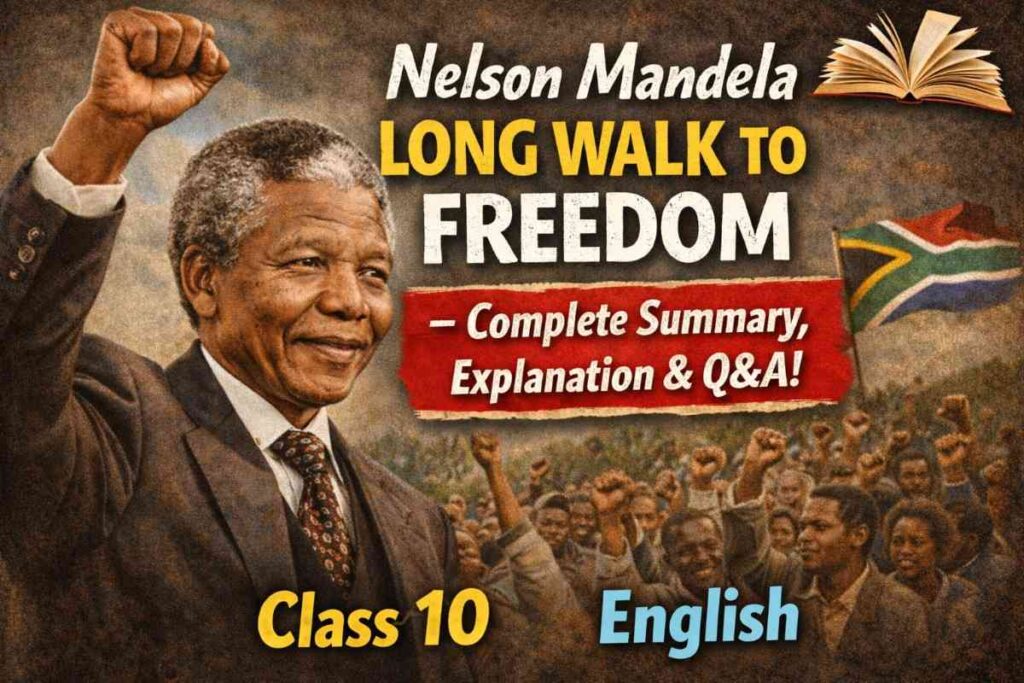
Mandela is standing at the inauguration ceremony. He has just been sworn in as the first Black President of South Africa. The highest generals of the South African defence force and police are standing before him — their chests bedecked with ribbons and medals — and they salute him and pledge their loyalty.
And Mandela writes: “I was not unmindful of the fact that not so many years before they would not have saluted but arrested me.”
That one sentence contains thirty years of prison, a lifetime of persecution, and an entire nation’s history of cruelty — and Mandela writes it in the middle of his greatest triumph, without drama, without bitterness, without even raising his voice. He notes it. He is conscious of it. And then he moves on.
That is the man. That is the chapter. And that is why Nelson Mandela: Long Walk to Freedom — Class 10 English, First Flight Chapter 2 is not just an autobiography extract but one of the most important pieces of writing your Class 10 English textbook ever asks you to read.
By the time you finish this blog post, you will understand not just what happened on 10 May 1994 — but why it mattered, what it cost, and what Mandela’s definition of freedom means for every single one of us.
🌅 10th May — A Morning That Changed a Century
“Tenth May dawned bright and clear.”
That is the first sentence of the Class 10 English extract. It sounds simple. It is anything but.
The date is 10 May 1994. The place is Pretoria, South Africa. For the past few days, Mandela tells us, he had been pleasantly besieged — surrounded — by dignitaries and world leaders coming to pay their respects before the inauguration (the formal ceremony of being sworn into power). This was going to be the largest gathering of international leaders ever on South African soil.
The ceremony took place in the sandstone amphitheatre formed by the Union Buildings in Pretoria. And here is the detail that makes your Class 10 English textbook pause to let you absorb it: for decades this had been the seat of white supremacy. The very building where apartheid’s rulers had governed — the very symbol of racial domination — was now the site where South Africa’s first democratic, non-racial government was being installed.
The Class 10 English text calls it “a rainbow gathering of different colours and nations.” That phrase is not just beautiful — it is intentional. South Africa had been a nation that sorted people by their colour for three centuries. Now, on this one morning, colour had become cause for celebration instead of oppression.
🎙️ The Oath — And the Speech
On the podium, three people were sworn in. Mr de Klerk first, as second deputy president. Then Thabo Mbeki, as first deputy president. Then Mandela — who pledged to obey and uphold the Constitution and to devote himself to the well-being of the Republic and its people.
Then he spoke.
To the assembled guests and the watching world, he said that their presence there conferred glory and hope to “newborn liberty.” He said that out of an extraordinary human disaster that had lasted too long, a society must be born of which all humanity would be proud. He acknowledged that South Africa had once been a nation of outlaws — because of apartheid, many countries had broken off diplomatic relations with it — and he thanked the world for coming to share in what he called “a common victory for justice, for peace, for human dignity.”
Then came the lines that the Class 10 English NCERT text specifically highlights:
“We have, at last, achieved our political emancipation. We pledge ourselves to liberate all our people from the continuing bondage of poverty, deprivation, suffering, gender and other discrimination.”
“Never, never, and never again shall it be that this beautiful land will again experience the oppression of one by another.”
“The sun shall never set on so glorious a human achievement. Let freedom reign. God bless Africa!”
Notice that he does not stop at the political victory. He says they have achieved emancipation — freedom from restriction — but they still need to be free from poverty, deprivation, discrimination. Freedom, for Mandela, is not one thing. It is many things. And winning the election was only the first of them.
✈️ The Military Salute — And What It Really Meant
A few moments later, South African jets, helicopters, and troop carriers roared in perfect formation over the Union Buildings.
The Class 10 English text describes this carefully: it was not only a display of military precision and force, but a demonstration of the military’s loyalty to democracy — “to a new government that had been freely and fairly elected.”
And then, that sentence we began with. The generals saluted Mandela. And Mandela was “not unmindful” — not unaware, not unconscious — of the fact that not long before, those same generals would not have saluted but arrested him.
That is the weight of history in one moment. Not dramatised. Not mourned. Simply noted, with clear eyes, and moved past.
Also: the two national anthems were played. Whites sang Nkosi Sikelel-iAfrika (God Bless Africa — the anthem of the Black freedom movement). Blacks sang Die Stem (The Call — the old anthem of the apartheid Republic). Neither group knew the other’s anthem yet. But Mandela writes that they would soon know the words by heart.
That is how a nation heals. Not by erasing the past. But by learning it — all of it — until it belongs to everyone.
📖 Overwhelmed With a Sense of History
Mandela writes that on the day of the inauguration, he was overwhelmed with a sense of history.
He traces the arc: In the first decade of the twentieth century, the white-skinned peoples of South Africa had patched up their differences after the Anglo-Boer War and erected a system of racial domination against the dark-skinned peoples of their own land. The structure they built became “one of the harshest, most inhumane, societies the world has ever known.”
Now, in the last decade of the twentieth century — and his own eighth decade as a man — that system had been overturned forever and replaced by one that recognised the rights and freedoms of all people, regardless of the colour of their skin.
A century opened with oppression. The same century closes with liberation. And Mandela stood at the hinge point between the two, in the same sandstone building that had once housed the architects of apartheid.
🙏 The Sum of All Who Came Before
Here is the passage from the Class 10 English extract that is most important for exams — and for life.
“That day had come about through the unimaginable sacrifices of thousands of my people, people whose suffering and courage can never be counted or repaid. I felt that day, as I have on so many other days, that I was simply the sum of all those African patriots who had gone before me. That long and noble line ended and now began again with me.”
Mandela does not take credit for the victory. He says he is simply the sum — the total, the embodiment — of all those who struggled and sacrificed before him. Names like Oliver Tambo, Walter Sisulu, Chief Luthuli, Yusuf Dadoo, Bram Fischer, Robert Sobukwe — men of extraordinary courage, wisdom, and generosity — men whose like, Mandela says, may never be known again.
And then comes one of the most profound observations in the Class 10 English chapter:
“Perhaps it requires such depths of oppression to create such heights of character.”
Think about that slowly. Apartheid was so brutal, so relentless, so dehumanising — and yet it produced human beings of such extraordinary moral stature that the world stood in awe. Mandela is not saying oppression is good. He is saying that when human beings are pushed beyond all endurance, some of them — not all, but some — rise to a greatness that comfort and safety never could have created.
“My country is rich in the minerals and gems that lie beneath its soil, but I have always known that its greatest wealth is its people, finer and truer than the purest diamonds.”
💪 What Courage Really Means — Mandela’s Definition
From his comrades in the struggle, Mandela says, he learned the meaning of courage. Not from books. Not from theory. From watching men and women risk and give their lives for an idea.
“I learned that courage was not the absence of fear, but the triumph over it. The brave man is not he who does not feel afraid, but he who conquers that fear.”
This is one of the most quoted lines in the Class 10 English curriculum — and it deserves to be. Because it removes the impossible standard of fearlessness and replaces it with the achievable truth of courage. You don’t have to stop feeling afraid. You have to act in spite of the fear. That is what all the anti-apartheid fighters did. They were afraid. And they acted anyway.
❤️ Love vs. Hate — Which Is Natural?
“No one is born hating another person because of the colour of his skin, or his background, or his religion.”
This is perhaps the single most important philosophical statement in the entire Class 10 English chapter. No one is born hating. Hate is learned. It is taught — by systems, by structures, by repetition, by fear.
“People must learn to hate, and if they can learn to hate, they can be taught to love, for love comes more naturally to the human heart than its opposite.”
Mandela believed — and lived — this. He spent thirty years in prison at the hands of men who hated him for his skin colour. And he emerged without bitterness. Not because he was not human. But because he had understood something deeper: that the hate was the sickness, not the man.
Even in the grimmest times in prison, when Mandela and his comrades were pushed to their absolute limits, he would see “a glimmer of humanity” in one of the guards — perhaps just for a second — and that was enough to reassure him and keep him going.
“Man’s goodness is a flame that can be hidden but never extinguished.”
⚖️ The Twin Obligations — The Price Mandela Paid
This is the part of the Class 10 English extract that is hardest to read, and most important to understand.
Mandela says that every man has twin obligations: to his family — to his parents, wife, and children — and to his people, his community, his country. In a civil and humane society, a man can fulfil both.
But not in apartheid South Africa.
In South Africa, a man of colour who attempted to live simply as a human being was punished and isolated. A man who tried to fulfil his duty to his people was inevitably — unavoidably — ripped from his family and forced to live a twilight existence — a half-secret life of secrecy and rebellion.
Mandela did not choose to place his people above his family. He was forced to. And the cost was devastating: he could not fulfil his obligations as a son, a brother, a father, or a husband.
He was not a saint. He was not performing sacrifice. He was a man who loved his family and loved his people — and was made, by an unjust system, to choose between them over and over again, every day of his life, for decades.
That is what apartheid took from him. Not just his freedom. His family. His fatherhood. His ordinary life.
🧒 Freedom — From Boy to President
The most personal passage in the Class 10 English chapter is also the most philosophically complex. It traces the evolution of Mandela’s understanding of freedom through his own life.
As a boy: He was born free. He didn’t know it, but he was. Free to run in the fields near his mother’s hut. Free to swim in the clear stream through his village. Free to roast mealies under the stars and ride the broad backs of slow-moving bulls. As long as he obeyed his father and abided by his tribe’s customs, the laws of man or God didn’t trouble him.
As a young man: He discovered that his boyhood freedom was an illusion — something that appeared real but wasn’t. His freedom had already been taken from him before he knew it existed. And that was when he first began to hunger for it. At first he wanted only transitory (not permanent) freedoms — to stay out at night, read what he pleased, go where he chose. Small, individual liberties.
In Johannesburg: He yearned for what he calls “the basic and honourable freedoms” — of achieving his potential, earning his keep (earning enough to live on), marrying and having a family. The freedom not to be obstructed in a lawful life.
Then — the turn: He slowly saw that it was not just his freedom that was curtailed (reduced). It was the freedom of everyone who looked like him. Every Black person in South Africa was unfree. And that was the moment that changed everything. He joined the African National Congress — and the hunger for his own freedom became the greater hunger for the freedom of his people.
“It was this desire for the freedom of my people to live their lives with dignity and self-respect that animated my life, that transformed a frightened young man into a bold one, that drove a law-abiding attorney to become a criminal, that turned a family-loving husband into a man without a home, that forced a life-loving man to live like a monk.”
That series of transformations — frightened to bold, law-abiding to criminal, family man to homeless, life-loving to monk-like — is Mandela describing the full cost of what he became. And he says he did not choose it out of virtue or heroism. He chose it because he could not enjoy even the poor, limited freedoms he was allowed when he knew his people were not free.
Freedom is indivisible. The chains on any one of his people were the chains on all of them. The chains on all of them were the chains on him.
🔓 The Oppressor Is Also Not Free
And then Mandela says something that many Class 10 English students are surprised by, and which is among the most profound things ever written about the nature of oppression:
“I knew that the oppressor must be liberated just as surely as the oppressed.”
Why? Because “a man who takes away another man’s freedom is a prisoner of hatred; he is locked behind the bars of prejudice and narrow-mindedness.”
You are not truly free if you are taking away someone else’s freedom. The oppressor — the person doing the oppressing — has lost their humanity in the act. They have made themselves a prisoner of their own hatred.
“The oppressed and the oppressor alike are robbed of their humanity.”
This is why Mandela did not emerge from prison wanting revenge. He understood — with crystal clarity — that revenge would simply create a new oppressor and a new oppressed. The only real freedom was the freedom of everyone. Or it wasn’t freedom at all.
📊 Key Facts Table — Nelson Mandela Class 10 English Exam Essentials
| Detail | Fact |
|---|---|
| Chapter | 2, First Flight (Class 10 English NCERT) |
| Author | Nelson Rolihlahla Mandela |
| Source | Autobiography: Long Walk to Freedom |
| Date of Inauguration | 10 May 1994 |
| Venue | Union Buildings amphitheatre, Pretoria |
| Occasion | Installation of South Africa’s first democratic, non-racial government |
| Mandela’s position | First Black President of South Africa |
| Deputy Presidents sworn in | Mr de Klerk (2nd), Thabo Mbeki (1st) |
| Two National Anthems | Nkosi Sikelel-iAfrika (Black anthem) + Die Stem (old Republic anthem) |
| Mandela accompanied by | His daughter Zenani |
| “Extraordinary human disaster” | Apartheid — system of racial domination |
| “Glorious human achievement” | Democratic elections; liberation of South Africa |
| Definition of courage | Not absence of fear, but triumph over it |
| Twin obligations | To family + to people/country |
| Mandela’s boyhood freedom | Running in fields, swimming in streams, roasting mealies, riding bulls |
| When Mandela joined ANC | When he saw it was not only his freedom that was curtailed |
| Mandela’s time in prison | 30 years (approximately) |
| What apartheid produced | Men of extraordinary character — Oliver Tambo, Walter Sisulu, Chief Luthuli, Yusuf Dadoo, Bram Fischer, Robert Sobukwe |
📝 Important Vocabulary for Class 10 English Exams
Inauguration — The formal ceremony of being officially sworn into a position of authority. The chapter is an account of Mandela’s inauguration as President.
Besieged — Surrounded closely by. Mandela was “pleasantly besieged” by dignitaries and world leaders coming to pay respects.
Amphitheatre — A roofless building with rows of seats rising in steps, typical of ancient Greece and Rome. The Union Buildings in Pretoria contain such an amphitheatre.
Seat of white supremacy — The centre or headquarters of the belief in racial superiority of white people. The Union Buildings were this seat; now they hosted the first democratic government.
Rainbow gathering — A beautiful coming together of various peoples, like the colours of a rainbow. Mandela uses this phrase to describe the inauguration crowd.
Emancipation — Freedom from restriction. Mandela uses it to describe the political freedom won on 10 May 1994.
Deprivation — The state of not having one’s rightful benefits or basic needs. Mandela pledges to free people from poverty, deprivation, and discrimination.
Confer — To give or bestow (a formal word). The world leaders “confer glory and hope to newborn liberty” by their presence.
Discrimination — Being treated differently or unfavourably based on race, gender, religion, etc.
Wrought — An old-fashioned, formal word meaning done or achieved. Mandela uses it to describe what the sacrifices of patriots had accomplished.
Profound — Deep and strong. The wound that apartheid created in South Africa is described as profound.
Resilience — The ability to deal with any kind of hardship and recover from its effects. Mandela saw resilience in his comrades that defied imagination.
Not unmindful — Conscious of; aware of. Mandela was not unmindful that the generals would once have arrested him.
Chevron — A pattern in the shape of a V. The Impala jets flew in a chevron formation.
Despised — Had a very low opinion of. Neither group knew the lyrics of the anthem they once despised.
Illusion — Something that appears to be real but is not. Mandela’s boyhood freedom was an illusion — it was never truly there.
Transitory — Not permanent. The small personal freedoms Mandela first wanted (to stay out at night, read freely) were transitory ones.
Curtailed — Reduced. Mandela saw that not just his freedom but everyone’s freedom was curtailed.
Inevitably — Unavoidably; certainly. A man who tried to fulfil his duty to his people was inevitably ripped from his family.
Twilight existence — A half-secret life, lived in the fading light between day and darkness — a life of secrecy and rebellion.
Inclinations — Natural tendencies of behaviour. In a civil society, a man can fulfil his obligations according to his own inclinations.
Prejudice — A strong dislike without any good reason. The oppressor is locked behind the bars of prejudice.
Pushed to our limits — Pushed to the last point of one’s ability to bear pain or suffering.
📝 Complete Q&A — Class 10 English Board Exam Ready
Q: Where did the inauguration ceremonies take place? What is its significance?
The ceremonies took place in the sandstone amphitheatre formed by the Union Buildings in Pretoria. The significance is profound: for decades, these buildings had been the seat of white supremacy — the headquarters of apartheid rule. Now, the same buildings became the site of South Africa’s first democratic, non-racial government’s installation. The location itself represents the transformation of the nation — what was once the centre of oppression becoming the birthplace of freedom.
Q: What does Mandela mean by “an extraordinary human disaster”? What is the “glorious human achievement” he refers to?
The “extraordinary human disaster that lasted too long” refers to the system of apartheid — the policy of racial domination and separation that kept Black South Africans oppressed for over three centuries. It was a disaster because it dehumanised both the oppressed and the oppressor, and caused immeasurable suffering. The “glorious human achievement” he speaks of at the end of his speech is the establishment of South Africa’s first democratic, non-racial government — the liberation of the country from apartheid — achieved without a catastrophic civil war and with the participation of the entire world community.
Q: What do the military generals do at the inauguration? Why is this significant?
The highest generals of the South African defence force and police, their chests bedecked with ribbons and medals, saluted Mandela and pledged their loyalty. This is deeply significant because these same men, not many years before, would not have saluted Mandela — they would have arrested him. The fact that they now saluted him was a demonstration of the military’s loyalty to democracy and to a government freely and fairly elected. It represented the complete reversal of the power structure that had persecuted Mandela for decades.
Q: Why were two national anthems sung at the inauguration?
Two national anthems were sung to symbolise the coming together of the two previously divided communities of South Africa. The whites sang Nkosi Sikelel-iAfrika — the anthem of the Black freedom movement — and the Blacks sang Die Stem, the old anthem of the apartheid Republic. Although neither group knew the other’s anthem at the time, Mandela says they would soon know the words by heart. The singing of both anthems was a powerful act of reconciliation — honouring both the painful past and the hopeful future, and refusing to erase either.
Q: What does Mandela mean when he says he is “simply the sum of all those African patriots who had gone before him”?
Mandela means that he does not claim personal credit for the victory. He sees himself as the accumulation — the embodiment — of the sacrifices, courage, and struggles of all the freedom fighters who came before him: Oliver Tambo, Walter Sisulu, Chief Luthuli, Yusuf Dadoo, Bram Fischer, Robert Sobukwe, and thousands of unnamed others. Their suffering and sacrifice made this day possible. Mandela could not thank them because they were gone. But he carried their legacy forward. The line of patriots ended with them and began again with him.
Q: “Perhaps it requires such depths of oppression to create such heights of character.” What does Mandela mean by this?
Mandela is reflecting on the extraordinary men that the anti-apartheid struggle produced — men of such extraordinary courage, wisdom, and generosity that their like may never be seen again. He is suggesting that it was precisely the brutality and relentlessness of the oppression they faced that forged these heights of character. Suffering of this magnitude, when it does not break a person, can create an almost superhuman strength, resilience, and moral clarity. He is not glorifying oppression — he is observing the paradox that the worst systems can sometimes produce the best human beings. He connects this to his famous observation that his country’s greatest wealth is not its minerals and diamonds, but its people.
Q: What does courage mean to Mandela?
According to Mandela, courage is not the absence of fear but the triumph over it. The brave man is not he who does not feel afraid, but he who conquers that fear. Mandela learned this not from theory but from watching his comrades in the anti-apartheid struggle — men and women who stood up to attacks and torture without breaking, who gave their lives for an idea. They were not fearless. They were afraid, and they acted anyway. This definition of courage is important because it makes courage accessible — it means every person who acts rightly despite being afraid is courageous.
Q: What are the “twin obligations” Mandela mentions? Why could he not fulfil both in South Africa under apartheid?
The twin obligations are: first, the obligation to one’s family (to parents, wife, children); and second, the obligation to one’s people, community, and country. In a civil and humane society, a man can fulfil both. But in apartheid South Africa, it was almost impossible for a man of colour to do so. A man of colour who attempted to live simply as a human being was punished and isolated. A man who tried to fulfil his duty to his people was inevitably ripped from his family and forced to live a twilight existence of secrecy and rebellion. Mandela did not choose to place his people above his family — but in attempting to serve his people, he found himself unable to fulfil his obligations as a son, a brother, a father, and a husband.
Q: How did Mandela’s understanding of freedom change with age and experience?
As a boy, Mandela was born free and did not know it — free to run in fields, swim in streams, roast mealies under stars. This freedom was an illusion. As a student, he first wanted transitory freedoms — to stay out at night, read freely, go where he chose. As a young man in Johannesburg, he yearned for the basic and honourable freedoms: achieving his potential, earning his keep, having a family. Then he realised it was not just his freedom but everyone’s that was curtailed — and that was when his personal hunger for freedom became the greater hunger for the freedom of all his people. Freedom, for Mandela, evolved from a personal desire into a collective mission.
Q: Does Mandela think the oppressor is free? Why or why not?
No, Mandela does not think the oppressor is free. He says that a man who takes away another man’s freedom is a prisoner of hatred — locked behind the bars of prejudice and narrow-mindedness. He is not truly free if he is taking away someone else’s freedom. The oppressed and the oppressor alike are robbed of their humanity by the act of oppression. This is why Mandela believed the oppressor must be liberated just as surely as the oppressed. Real freedom could only come when everyone was free — not when one group had simply replaced another as the ruling power.
Q: Why did such a large number of international leaders attend the inauguration? What did it signify?
The inauguration of Mandela as South Africa’s first Black President was attended by politicians and dignitaries from more than 140 countries worldwide — the largest gathering of international leaders on South African soil. This happened because the world recognised the inauguration as the triumph not merely of one man or one party, but of democracy, justice, human dignity, and the non-racial ideal over one of the harshest systems of oppression the world had ever known. Mandela described the victory as a “common victory” for justice, peace, and human dignity — belonging to all of humanity.
🌿 Themes — What Class 10 English Asks You to Think About
Freedom as a many-layered concept — The central theme of the Class 10 English chapter is freedom, but Mandela shows us that freedom is not one thing. There is the freedom of a child running in fields. There is political emancipation. There is freedom from poverty and discrimination. There is the freedom of dignity and self-respect. Winning an election was only the beginning.
The cost of conscience — Mandela’s personal sacrifice — his family, his fatherhood, his ordinary life — shows the Class 10 English student what it actually costs to act on one’s principles. He did not sacrifice lightly. He was forced to sacrifice by an unjust system. And he never pretended it did not hurt.
Courage as triumph over fear — The redefinition of courage from fearlessness to the triumph over fear is one of the most teachable moments in Class 10 English. It applies not just to political struggle but to every difficulty in every person’s life.
Love is more natural than hate — Perhaps the most hopeful theme in the chapter. No one is born hating. Hate must be learned. And if it can be learned, it can be unlearned. Love is the default. It is the natural state of the human heart. This is what allows Mandela — after thirty years in prison — to emerge without bitterness.
The indivisibility of freedom — You cannot be free while others are not free. The chains on any one person are the chains on all. This theme connects the personal to the political and shows why the struggle against apartheid was a struggle for everyone’s humanity — including the oppressor’s.
History as both wound and witness — Mandela writes with an overwhelming sense of history — conscious that the Union Buildings themselves once housed the architects of oppression, that the generals before him once would have arrested him. He does not deny the past. He holds it alongside the present and lets the contrast speak.
🔑 Exam Strategy — What Class 10 English Examiners Really Look For
The inauguration scene is almost always tested through comprehension questions. Remember: Union Buildings amphitheatre, Pretoria, 10 May 1994. De Klerk sworn in as second deputy, Mbeki as first deputy, then Mandela as President.
“Extraordinary human disaster” and “glorious human achievement” — A classic paired question. Disaster = apartheid. Achievement = democratic liberation. Never reverse them.
Mandela as “sum of all those African patriots” — This is a favourite long-answer topic. Your answer should mention: he does not claim personal credit, he sees himself as the embodiment of all who struggled before him, he names some (Tambo, Sisulu, Luthuli, Dadoo, Fischer, Sobukwe), and he was pained that they could not see what their sacrifices had achieved.
“Depths of oppression create heights of character” — Connect this directly to the anti-apartheid freedom fighters. The examiner wants you to explain the paradox and then illustrate it with names from the chapter.
Definition of courage — Always quote it in full in your answer: courage is not the absence of fear but the triumph over it. Then explain it in your own words.
Love vs. hate — The key point: no one is born hating. Hate is learned. Love is natural. Use the example of the glimmer of humanity in the prison guards.
Twin obligations — Family vs. people. And why Mandela could not fulfil both under apartheid. This is often a 3–4 mark question.
Evolution of freedom — Boy → student → young man → leader. Each stage has a different definition of freedom. Know all four stages.
💭 What This Chapter Is Really Saying to You
Nelson Mandela: Long Walk to Freedom is, in the Class 10 English curriculum, officially an autobiography extract about a political inauguration. It is also — if you read it carefully — a letter from a man who paid the highest possible personal price for his principles, to every person who will read his words after him.
He is telling you that freedom is not free. Not the freedom that matters. The freedom that matters costs something. It costs fear overcome. It costs ordinary life sacrificed. It costs thirty years in a cell on Robben Island. It costs learning the anthem of the people who imprisoned you.
He is telling you that hate is not natural. It is a choice — a taught choice — and it can be untaught.
He is telling you that courage is not the absence of fear. You are allowed to be afraid. You are allowed to feel the full weight of what you are facing. And then — if you can — you act anyway.
He is telling you that no victory belongs to one person. That he was simply the sum of all who came before. That the long and noble line ended and began again with him. And that one day, for each of us, it will end with us and begin again with someone else.
He is telling you that the greatest wealth of any country is not in the ground. It is in its people.
He is telling you that freedom is indivisible. That you cannot look away from the chains on someone else and call yourself free.
And at the end — quietly, without drama — he is telling you that man’s goodness is a flame that can be hidden but never extinguished.
He saw it in a prison guard. For just a second.
It was enough.
📣 Before You Go
The next time you think about freedom — what it means, what it costs, who pays for it — remember 10th May, 1994. Remember the sandstone amphitheatre. Remember the generals who would once have arrested the man they now saluted. Remember two groups singing each other’s anthems in a language they didn’t yet know.
Remember that “love comes more naturally to the human heart than its opposite.”
That is what Nelson Mandela: Long Walk to Freedom — your Class 10 English chapter — is actually about. Not just South Africa. Not just 1994. But you, and me, and what we choose to do with the freedom we have.
Share this with your Class 10 English class group. Leave a comment about the line that hit you hardest. And if you haven’t read the original autobiography — Long Walk to Freedom by Nelson Mandela — it is one of the books worth reading in your lifetime.
📌 Also Read: A Letter to God Class 10 — Complete Story Explained | From the Diary of Anne Frank Class 10 — Explained | Glimpses of India Class 10 — All 3 Parts Explained | Madam Rides the Bus Class 10 — The Story That Will Break Your Heart