
When did you first understand what death actually means?
Not “know” — you’ve probably known about death since you were small. Someone told you. A grandparent passed away. A pet died. You understood the word.
But when did you first truly understand it? Feel it hit you somewhere deeper than your brain? Realise that the world could contain something beautiful one moment and have it simply… not be there the next?
For most of us, that moment comes in childhood. And it comes unexpectedly — not from a funeral, not from a lesson — but from something ordinary. Something we weren’t expecting to teach us anything at all.
That is the story of “Madam Rides the Bus” — Chapter 7 of your Class 10 English textbook, First Flight, written by Vallikkannan and originally in Tamil. It is, on the surface, the story of a little girl who plans a bus trip. It is, underneath, one of the most quietly devastating stories in the entire Class 10 English curriculum.
By the time you finish reading this post — and this story — you won’t think about bus journeys the same way again.
🪟 Valli at the Doorway — The Whole World in One Street
Valliammai — called Valli for short — is eight years old. She lives in a village in Tamil Nadu. She has no playmates her own age on her street.
Her entire entertainment is standing at the front doorway of her house and watching the street.
That’s it. That’s her world.
Now before you feel sorry for her, consider this: the Class 10 English text tells us that for Valli, standing at the door was “every bit as enjoyable as any of the elaborate games other children played.” Watching the street gave her “many new unusual experiences.”
She is not bored. She is watching. There is a difference. A bored child stares at nothing. A curious child like Valli stares at everything — and sees it.
And the most fascinating thing she sees, day after day, is the bus.
It travels between her village and the nearest town, passing through her street every hour. Once going, once coming. Each time it passes, it carries a new set of passengers — new faces, new stories, a slice of a world larger than hers.
“The sight of the bus, filled each time with a new set of passengers, was a source of unending joy for Valli.”
Day after day, she watches. And slowly, quietly, a wish grows. She wants to ride that bus. Just once.
“This wish became stronger and stronger, until it was an overwhelming desire.”
📊 The Plan: How a Village Girl with No Money Outsmarted the Adults
Here is the part of Madam Rides the Bus Class 10 English that earns Valli every bit of the reader’s respect. She doesn’t just dream about the bus. She researches it.
Over many months, she listens carefully to conversations between neighbours and regular bus passengers. She asks a few discreet questions (careful, deliberately placed questions that don’t give away what she’s planning). And from this patient gathering of information, she assembles a complete picture:
The town is six miles from her village. The fare is thirty paise one way. The journey takes forty-five minutes. If she stayed in her seat at the town end and paid another thirty paise, she could return on the same bus.
That means: the one o’clock afternoon bus would get her to town by one forty-five, and she’d be home by two forty-five — before her mother’s afternoon nap ended. Total cost: sixty paise.
She had no money. She saved it. Thriftily — carefully, spending nothing — she collected whatever stray coins came her way. She resisted peppermints, toys, balloons. She even resisted the merry-go-round at the village fair, standing there with money in her pocket and saying no to herself.
That is the kind of determination most adults don’t manage with things they actually want.
She also figured out how to slip out of the house. Her mother napped every afternoon from one to four. Valli used to spend those hours in her doorway “excursions” — and today those same hours would carry her on her first real one.
The plan was perfect. The execution was perfect. The eight-year-old had done everything right.
🚌 “Stop the Bus! Stop the Bus!” — The Entrance of Madam
One fine spring afternoon, as the bus was just about to turn from the village into the main highway, a small voice rang out:
“Stop the bus! Stop the bus!”
And a tiny hand was raised — commandingly.
The conductor, sticking his head out the door, saw an eight-year-old girl. He was amused. He stretched out a hand to help her up.
“Never mind,” she said. “I can get on by myself. You don’t have to help me.”
And just like that, the tone of the entire Class 10 English story is set. Valli is not a passive child. She does not accept help she hasn’t asked for. She does not need a hand just because one is offered. She gets on the bus herself.
The conductor, who was a jolly sort fond of joking, called her “madam” — and the nickname stuck for the entire journey. It was teasing, yes, but it was also weirdly accurate. Valli carried herself like someone twice her age.
It was the slack time of day — not many passengers. The few on board all laughed at the tiny girl who had commandeered the bus. Valli, overcome with shyness, avoided their eyes and sat down quickly.
“May we start now, madam?” the conductor asked.
He blew his whistle twice. The bus moved forward with a roar.
🌿 The View From the Window — Green, Green, Green
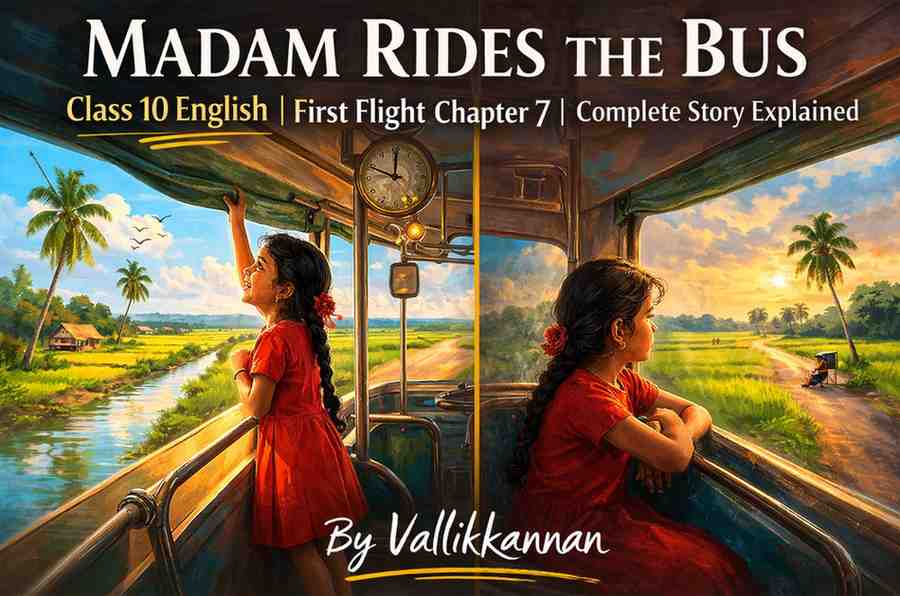
The bus was new. Gleaming white outside with green stripes. Inside, the overhead bars shone like silver. There was a beautiful clock above the windshield. The seats were soft and luxurious.
Valli “devoured everything with her eyes.”
That phrase — devoured — is one of the most precise and wonderful things in this Class 10 English story. She didn’t just look. She consumed the world around her, taking it in with a hunger that comes from having been confined to a doorway for so long.
But when she looked outside, the canvas blind blocked the lower part of the window. So she stood on the seat and peered over it.
The bus was going along the bank of a canal. On one side: the canal, palm trees, grassland, distant mountains, and the blue, blue sky. On the other side: a deep ditch, and then acres and acres of green fields — “green, green, green, as far as the eye could see.”
“Oh, it was all so wonderful!”
The triple repetition of “green” is not accidental. The Class 10 English author is showing us that for Valli, who has spent her whole life at a single doorway, this landscape is not scenic backdrop — it is revelation. She is seeing the world for the first time, and it is more than she imagined.
😤 “I’m Not a Child, I Tell You” — Valli vs. The Passengers
An elderly man told her to sit down. She was annoyed.
“There’s nobody here who’s a child,” she said, haughtily (proudly, dismissively). “I’ve paid my thirty paise like everyone else.”
The conductor chimed in with mock admiration — “Oh sir, but this is a very grown-up madam” — and Valli immediately turned on him too: “I am not a madam. Please remember that. And you’ve not yet given me my ticket.”
She is simultaneously rejecting both “child” and “madam.” She doesn’t want condescension from either direction. She is not a child who needs looking after. She is also not a joke. She is a passenger. Equal to everyone else on this bus.
The conductor mimicked her tone. Everyone laughed. And gradually — this is the detail that makes Valli fully human — she laughed too. She couldn’t help it.
When an elderly woman sat next to her and began asking intrusive questions — “Are you all alone, dear?” — Valli found her repulsive (causing strong dislike). Not just because of the woman’s appearance and the betel juice threatening to spill, but because she was doing exactly what the elderly man had done: treating Valli as someone who needed supervision.
“You needn’t bother about me. I can take care of myself,” Valli said, turning to look out the window.
🏙️ The Town — And the Moment She Turned Back
The bus passed through the landscape — cutting across bare countryside, rushing through tiny hamlets, past wayside shops. Sometimes it seemed about to swallow oncoming vehicles whole, but always passed smoothly. Trees seemed to run toward the bus and then stand helplessly as it went by.
Then: a cow. A young cow with its tail high in the air, running right in the middle of the road in front of the bus. The more the driver honked, the more frightened it became, and the faster it ran — always in front of the bus.
Valli found this hilarious. She laughed until tears came.
At last, the bus reached town. It stopped. Everyone got off — except Valli.
The conductor: “Hey, lady — aren’t you ready to get off? This is as far as your thirty paise takes you.”
Valli: “No. I’m going back on this same bus.”
She handed him another thirty paise.
She had never planned to get off. She had saved sixty paise exactly because the round trip was all she wanted. She didn’t want to explore the town alone — that would be frightening. She didn’t want a cold drink from the stall — she didn’t have money for luxuries. She had wanted the bus ride. She had it. That was enough.
The conductor offered to buy her a drink. She refused, firmly: “No, no. Please, no.”
It is a small moment but an important one. Valli does not take things she hasn’t earned. She has her sixty paise, her plan, and her dignity. She wants nothing she cannot pay for herself.
💔 The Return Journey — When Joy Became Something Else
The bus began the return journey. Valli settled in, greeted everything she’d seen before with the same excitement. The canal. The palm trees. The green fields. The blue sky.
And then.
“But suddenly she saw a young cow lying dead by the roadside, just where it had been struck by some fast-moving vehicle.”
Valli knew immediately. “Isn’t that the same cow that ran in front of the bus on our trip to town?” she asked the conductor.
He nodded.
The cow that had made her laugh until she cried — the cow with its tail high in the air, galloping comically, invincible and alive — was now lying at the side of the road with “legs spreadeagled, a fixed stare in its lifeless eyes, blood all over.”
“What had been a lovable, beautiful creature just a little while ago had now suddenly lost its charm and its life.”
The Class 10 English text gives us a sentence that hits with the quiet force of something true: she was “overcome with sadness.”
The memory of the dead cow haunted her — returned repeatedly to her mind, impossible to forget — and it dampened her enthusiasm. She no longer wanted to look out the window. She sat glued to her seat for the rest of the journey, the world outside suddenly uninteresting, even threatening.
The same world that had been green, green, green and wonderful and full of mango trees and blue sky — that same world had just shown her what it also contained.
🏠 Coming Home — The Smile Nobody Would Understand
Valli arrived home at three forty. She jumped down from the bus, ran straight home, and found her mother awake and chatting with an aunt — the talkative one from South Street.
Her aunt asked casually, “And where have you been?” — not really expecting an answer. Valli just smiled.
She sat listening as her mother and aunt talked. At one point, her mother said something that stopped Valli:
“So many things in our midst and in the world outside. How can we possibly know about everything? And even when we do know about something, we often can’t understand it completely, can we?”
Valli, who had just that afternoon discovered exactly this truth — that she could know about death but could not yet fully understand it — breathed a quiet “Oh, yes.”
Her mother was startled. “What? What’s that you say?”
“Oh,” said Valli carefully. “I was just agreeing with what you said about things happening without our knowledge.”
Her aunt dismissed her: “Just a chit of a girl, she is. Look how she pokes her nose into our conversation, just as though she were a grown lady.”
And Valli smiled to herself. She didn’t want them to understand her smile.
“But, then, there wasn’t much chance of that, was there?”
That final line is one of the most perfectly crafted endings in all of Class 10 English literature. Valli smiles a smile that no one around her can see. She has crossed a threshold that cannot be crossed back. She went to town and came home. She left a child who wanted adventure and returned someone who had seen that the world contains loss.
She is still eight. But something in her has changed quietly, forever.
🎭 Who Is Valli? — The Most Complete Character Portrait in Class 10 English
What makes Valli so extraordinary as a character in Class 10 English literature is that she is not a symbol or a lesson. She is a person, with contradictions and textures.
She is independent — “I can get on by myself. You don’t have to help me.” She refuses the conductor’s hand, refuses the elderly man’s advice, refuses the old woman’s concern. She insists on doing everything herself, without help she hasn’t requested.
She is self-sufficient — she saved her own money, made her own plan, executed it perfectly. She asked for nothing except a ticket.
She is proud but not arrogant — she objects to being called a child, but she is also capable of laughing at herself. The conductor mimics her and she eventually joins the laughter.
She is curious without being reckless — she wants the bus ride but she doesn’t get off alone in an unfamiliar town. She knows her limits. She wanted a specific experience and she got exactly that experience, no more, no less.
She is perceptive — at eight years old, she connects the dead cow to the living one she had laughed at. She draws the conclusion adults often refuse to draw: that the same world contains both joy and death.
And she is private — she smiles a smile she doesn’t want understood. She has had an experience that belongs entirely to herself, and she chooses not to share it. Not because she is hiding something wrong, but because she has become, in one afternoon, slightly more interior. Slightly more her own person.
📊 Key Facts Table — Madam Rides the Bus Class 10 English Exam Essentials
| Detail | Fact |
|---|---|
| Chapter | 7, First Flight (Class 10 English NCERT) |
| Author | Vallikkannan (translated from Tamil by K. S. Sundaram) |
| Protagonist | Valliammai, called Valli |
| Valli’s age | Eight years old |
| Distance — Village to Town | Six miles |
| One-way fare | Thirty paise |
| Total money saved | Sixty paise (for return trip) |
| Journey time one way | Forty-five minutes |
| Bus Valli takes | One o’clock afternoon bus |
| Returns home by | Three forty / 3:40 PM |
| What makes Valli laugh | A young cow running in front of the bus |
| What breaks her joy | The same cow, dead on the return journey |
| Central themes | Curiosity, independence, life and death, knowledge vs. understanding |
| Nickname given by conductor | Madam |
| Originally written in | Tamil |
| Illustrated by | R. K. Laxman |
📝 Important Vocabulary for Class 10 English Exams
Wistfully — Longingly, with a gentle sadness and hope. Valli watches the bus passengers wistfully, wanting what they have.
Kindle — To set alight (a fire); here used for feelings. The faces of passengers kindle longings and hopes in Valli.
Discreet questions — Careful, strategically placed questions that don’t reveal what you’re really planning. Valli gathers all her information through discreet questions.
Haughtily — Proudly, with an attitude of superiority. Valli says “I’ve paid my thirty paise like everyone else” haughtily — asserting her equality.
Mimicking — Copying someone’s tone or manner. The conductor mimics Valli’s tone playfully.
Repulsive — Causing strong dislike or disgust. Valli finds the elderly woman repulsive because of her appearance and habit.
Curtly — Briefly and rudely, showing displeasure. Valli answers the old woman curtly to shut down the unwanted questions.
Drivel — Silly nonsense. Valli considers the old woman’s concerned questions as drivel.
Thriftily — In a careful, saving way with money. Valli thriftily saves every coin she gets.
Resolutely stifled — Suppressed or controlled something with strong determination. She resolutely stifled her desire to ride the merry-go-round.
Ventured out — Went somewhere carefully and courageously, usually somewhere new or slightly risky.
Haunted — Returned repeatedly to the mind; impossible to forget. The image of the dead cow haunted Valli.
Spreadeagled — With arms and legs spread out. The dead cow lay spreadeagled by the roadside.
Thoroughfare — A busy public road. The bus entered a wider thoroughfare in the town.
Merchandise — Things for sale. The town shops had glittering displays of merchandise.
Slack time — A quiet time with not much work or activity. There were few passengers because it was the slack time of day.
📝 Complete Q&A — Class 10 English Board Exam Ready
Q: What was Valli’s favourite pastime? What was her strongest desire?
Valli’s favourite pastime was standing in the front doorway of her house and watching the street outside. Unlike other children, she found this as enjoyable as any elaborate game. Her strongest desire — which grew from a tiny wish into an overwhelming longing — was to ride the bus that passed through her street each hour, travelling between her village and the nearest town. She watched it day after day until she could no longer simply watch it.
Q: What did Valli find out about the bus journey, and how?
Valli discovered that the town was six miles away, the one-way fare was thirty paise, and the trip took forty-five minutes. She also worked out that by paying sixty paise in total she could take the one o’clock bus, arrive by one forty-five, and return on the same bus to be home by two forty-five. She gathered all this information over many months by carefully listening to conversations between neighbours and regular passengers, and by asking a few discreet, strategically casual questions — never revealing what she was actually planning.
Q: Why does the conductor call Valli “madam”?
The conductor calls Valli “madam” partly as a joke — she is a tiny eight-year-old who stopped a bus commandingly and refuses help boarding. The title is meant humorously, acknowledging the gap between her small size and her very grown-up manner. However, it is also oddly respectful — the conductor recognises that Valli carries herself with a dignity and self-sufficiency unusual for a child. She pays her own fare, refuses assistance, corrects him, and demands her ticket. She earns the word, even if it was first offered as teasing.
Q: Why did Valli stand up on the seat? What did she see?
Valli’s view outside the window was blocked by a canvas blind covering the lower part of the window. Since she was small, sitting normally meant seeing nothing. So she stood on the seat and peered over the blind. From this vantage point she saw the bus going along the bank of a canal — on one side the canal, palm trees, grassland, distant mountains, and the blue sky; on the other side a ditch and acres of green fields stretching as far as the eye could see. She found it wonderful.
Q: How did Valli save money for the journey? Was it easy?
Valli saved thriftily — carefully collecting every stray coin that came her way. She resisted every temptation: no peppermints, no toys, no balloons. Most impressively, at the village fair she stood in front of the merry-go-round with the money in her pocket and resolutely stifled — suppressed with strong determination — her desire to ride it. It was not easy, but she was patient and disciplined. Eventually she saved exactly sixty paise.
Q: Why didn’t Valli get off the bus at the town? Why didn’t she want a drink?
Valli had never planned to get off the bus. Her purpose was the bus ride itself — not sightseeing, not exploring the town. She was honest about it: exploring the town alone would have frightened her. As for the drink — she had only sixty paise, calculated to the last coin for her return fare. She had not budgeted for anything extra. Even when the conductor offered to treat her, she refused firmly. She would not take what she had not earned and planned for. This refusal reveals Valli’s strong sense of self-respect and financial pride.
Q: What did Valli see on the return journey? How did it affect her?
On the return journey, Valli saw a young cow lying dead by the roadside — struck by a fast-moving vehicle. She recognised it as the same cow that had run comically in front of the bus and made her laugh on the way to town. The contrast was devastating: the animal that had been so lively and funny just an hour ago was now lying with legs spreadeagled, lifeless eyes staring, blood all over. Valli was overcome with sadness. The image haunted her. She no longer wanted to look out the window and sat glued to her seat for the rest of the journey, all enthusiasm dampened.
Q: What does the story say about the theme of life and death?
The story, as described in the NCERT “Before You Read” section, is about “an eight-year-old girl’s first bus journey into the world outside her village which is also her induction into the mystery of life and death.” Valli knows that death exists — every child knows this. But the dead cow forces her to understand it in a way she hadn’t before. She sees the same creature that was full of life and made her laugh reduced to something horrible. Her mother’s words at the end — “even when we do know about something, we often can’t understand it completely” — echo exactly what Valli has experienced. There is a gap between knowing that death exists and truly understanding what it means when something alive becomes not-alive. Valli has crossed from the first into the second.
Q: What does Valli’s final smile mean? Why doesn’t she want anyone to understand it?
Valli’s final smile is the smile of someone who has had an experience that cannot be shared. She overheard her mother say that we cannot always understand everything that happens in the world around us — and Valli, who has just discovered this truth from inside a bus, breathes a quiet yes of recognition. She doesn’t want her mother or aunt to understand the smile because the experience belongs entirely to her. No adult helped her get on that bus, and no adult was present when the dead cow changed the afternoon. She carries it alone. The smile is private — the first truly adult thing she has done, and the first truly adult feeling she has had.
Q: How does the author describe things from an eight-year-old’s point of view?
The author consistently describes the world through Valli’s inexperienced but deeply observant eyes. The bus’s gleaming silver bars, the beautiful clock, the soft luxurious seats — these details reveal someone encountering them for the first time, cataloguing every feature with fresh wonder. The description of the cow running in front of the bus — comical, tail in the air — is pure childhood delight. The description of the town — “such big, bright-looking shops! what glittering displays!” — is the exclamation of someone who has never seen a shopping street before. And the dead cow is described with brutal, specific clarity from a child’s unfiltered perception: legs spreadeagled, fixed stare, blood all over. An adult might look away. Valli sees everything, because she doesn’t yet know that you can.
🌿 Themes — What Class 10 English is Asking You to Think About
Curiosity and the desire for experience — Valli’s entire journey is driven by the purest form of wanting: she sees something, she wants to understand it from the inside, she makes it happen. This chapter of Class 10 English celebrates that impulse — the desire to know the world firsthand, not through descriptions or secondhand accounts.
Independence and self-reliance — Valli plans alone, saves alone, executes alone. She refuses every form of unsolicited help. The Class 10 English text celebrates not her recklessness (she stays on the bus when she’d be frightened in the town) but her careful, disciplined autonomy. She does exactly what she can manage, no more.
The gap between knowing and understanding — This is the central philosophical theme of the Class 10 English story. Valli knows about death. Every child does. But understanding — truly feeling the weight of it, the loss of it, the random cruelty of it — that is something different. The dead cow gives her the second kind of knowledge, and she carries it home in silence.
The loss of innocence — Valli does not lose innocence in a dramatic way. There is no tragedy in her life. She goes on a bus trip. But in that bus trip she crosses a threshold — from pure joy in the world to an awareness that the world contains endings. The story shows us how this happens: not through grief, but through a cow with its tail in the air.
The secret interior life of children — The story ends with Valli having a private smile that no adult in her house can access. The Class 10 English text invites us to consider how much is happening inside children that adults dismiss with “just a chit of a girl.” Valli’s interior life — her longing, her planning, her discovery — is richer than anything the aunt sees when she says that.
🔑 The Exam Secret: What Examiners Actually Want
For Madam Rides the Bus Class 10 English board exam questions, the most commonly tested areas are:
Character of Valli — Don’t just list traits. Connect each trait to a specific moment. Independent: she boards the bus herself. Mature: she refuses the conductor’s help and asserts her right as a paying passenger. Curious: she researched the journey over months. Dignified: she refuses the free drink because she hasn’t budgeted for it.
Theme of life and death — Always connect the cow on the way (alive, funny, joyful) with the cow on the way back (dead, frightening, muted). The contrast is the entire theme. The Class 10 English examiner wants you to articulate what changes for Valli — she doesn’t just feel sad. She understands something for the first time.
Valli’s final smile — This is a favourite Class 10 English long answer question. Your answer should mention: she overheard her mother’s words, she recognised the truth of them from her own experience, and she smiled because she now holds knowledge adults don’t know she has. The smile is the symbol of her private, interior growth.
“Madam” as a title — Questions about why the conductor uses this word are common. Your answer: it starts as a joke about her commanding manner, but it becomes oddly fitting because Valli does carry herself like someone older — paying her own fare, making her own decisions, refusing charity.
💭 What This Chapter Is Really Telling You
Madam Rides the Bus is a Class 10 English story about a bus ride the same way that A Letter to God is a story about a letter. The bus is the container. The real story is what happens to a human being when the world shows them something true.
Valli stands at her doorway day after day. She watches the bus go by. She wants to know what’s on the other side of the road.
She finds out.
She finds the canal and the palm trees and the green fields and the silver interior bars and the talkative passengers and the cow that made her laugh. She finds a town with glittering shops and big crowds and a cold drink she doesn’t accept. She finds that she can navigate the world by herself when she needs to.
And she finds a dead cow by the roadside.
She finds the thing that every human being eventually finds — that the world doesn’t only give. It also takes. That the things you love are not permanent. That a living, laughing creature can become, in one hour, nothing but blood and still legs on a roadside.
She comes home. She runs straight for home. She smiles a smile nobody understands.
The bus goes on. The world keeps going. And Valli is eight years old and has just become, quietly, slightly larger on the inside than she was this morning.
📣 Before You Go
Here is one last thought about Madam Rides the Bus Class 10 English, and it is not for your exam. It is just for you.
The next time you are on a bus — any bus, any route, any city — look at the people around you. The man with the briefcase. The woman with the shopping bags. The child with their nose pressed to the glass.
Every single one of them is on their own version of Valli’s journey. They have their own canal and green fields and dead cows by the roadside. They have their own private smiles that nobody understands.
The bus, filled each time with a new set of passengers — was, for a small girl at a doorway, a source of unending joy.
Maybe it still should be, for all of us.
Tell me in the comments: Did you have a moment like Valli’s? A moment where something ordinary suddenly showed you something true about the world? I’d love to know.
Share this with your Class 10 English batch group — not just for exam prep, but because Valli deserves to be read with this kind of attention. She’s been standing at that doorway long enough.
📌 Also Read: A Letter to God Class 10 — Complete Story Explained | From the Diary of Anne Frank Class 10 — The Story Nobody Tells You Right | Glimpses of India Class 10 — Baker, Coorg and Tea Explained