
Let me ask you something uncomfortable.
You’re reading this right now, probably on your phone or laptop. Maybe you’re bored, maybe you’re procrastinating. Maybe you just had a bad day — a teacher was unfair, a friend said something that stung, your parents were on your case about something.
And somewhere in the back of your mind, you’re thinking: Nobody really understands me.
Now I want you to meet a thirteen-year-old girl who wrote those exact words — in a hidden room, in a city under Nazi occupation, while the world outside was literally at war.
Her name was Anne Frank.
And her diary — the one that became Chapter 4 of your Class 10 English textbook, First Flight — is not just a story. It’s not just literature that you study for board exams. It is the most honest, warm, funny, heartbreaking document a teenager has ever written. And the fact that you’re reading it in your Class 10 English class is one of the best decisions NCERT ever made.
So put away the summary notes. Forget the question-answer format for a moment. Let’s actually read this together — the way Anne Frank deserved to be read.
🌍 Before the Diary: The World Anne Frank Was Born Into
To understand this chapter of Class 10 English literature, you first need to understand where Anne Frank was, and why.
Anne was born on 12 June 1929 in Frankfurt, Germany, to a Jewish family. She was bright, funny, opinionated, and probably the kind of girl who would’ve been insufferable at quiz competitions and absolutely delightful at everything else.
In 1933 — when Anne was just four years old — the Nazis came to power in Germany under Adolf Hitler. The Nazi regime believed Jewish people were inferior and systematically stripped them of rights, jobs, homes, and eventually their lives. The Holocaust — the mass murder of six million Jewish people — was not an accident of history. It was a deliberate, organized atrocity.
Anne’s father, Otto Frank, saw the danger early. He moved the family to Amsterdam, Netherlands, hoping to be safe. And for a while, they were. Anne went to school. She had friends. She had a normal life.
Then in 1940, the Nazis invaded the Netherlands too.
By July 1942, the persecution of Jewish people had become so severe that the Frank family went into hiding — in a secret set of rooms in Otto Frank’s office building in Amsterdam. They lived there for two years, along with four other people, barely daring to make a sound during office hours, afraid of every footstep they heard.
Anne Frank was thirteen years old when she went into hiding.
She carried her diary with her.
📔 The Diary: Why She Started Writing — And Why It Still Matters to Class 10 Students
The extract in your Class 10 English First Flight textbook begins not with war, not with fear, not with darkness — but with something startlingly ordinary: a teenage girl wondering if anyone will ever read what she writes.
“Writing in a diary is a really strange experience for someone like me. Not only because I’ve never written anything before, but also because it seems to me that later on neither I nor anyone else will be interested in the musings of a thirteen-year-old schoolgirl.”
If you’ve ever hesitated before writing something — a poem, a journal entry, a message — because you thought who would even care, Anne Frank felt exactly the same thing.
She was wrong, of course. Spectacularly, historically wrong. Her “musings” have been translated into over 70 languages and read by more than 30 million people worldwide. Her diary is one of the most widely read books ever written — not by a novelist, not by a historian, but by a thirteen-year-old girl who wasn’t sure anyone would care.
But she wrote anyway. Because, as she says, “I have an even greater need to get all kinds of things off my chest.”
That impulse — to say something, to be heard, to release the weight of feeling — is one of the most human things there is. And in your Class 10 English curriculum, this chapter is here to remind you of it.
💬 “Paper Has More Patience Than People” — The Line That Explains Everything
At some point — one of those days when she felt listless (drained, lacking energy), bored, sitting with her chin in her hands not knowing what to do with herself — Anne thought of something that stopped her.
“Paper has more patience than people.”
Four words that could have been the title of the entire diary.
Think about what that really means. When you talk to people — even your best friend, even your parents — there is always a reaction you have to manage. They get defensive. They give advice you didn’t ask for. They change the subject. They misunderstand. They judge, even gently. They can only hold so much of what you give them before they start to overflow.
But paper? Paper holds everything. It doesn’t interrupt. It doesn’t get tired of your problems. It doesn’t tell you to move on. It just receives.
This is why Anne decided to keep the diary in the first place. And this brings us to the real reason — the one she admits quite bluntly, in a way that takes real courage:
“I don’t have a friend.”
👥 The Loneliness That Every Student Will Recognize
Here is where the Class 10 English literature extract becomes uncomfortably, beautifully personal.
Anne has parents. She has a sister, Margot, who is three years older. She has about thirty people she can call friends. She has loving aunts and a comfortable home. By every visible measure, she is not alone.
But she says: “On the surface I seem to have everything, except my one true friend.”
She is not talking about being physically isolated. She is talking about something much harder to explain — the loneliness you feel when you are surrounded by people but still somehow unreachable. When you can have fun with friends, laugh, make plans, share snacks — but cannot have a real conversation. When nobody seems interested in what’s underneath the surface.
“All I think about when I’m with friends is having a good time. I can’t bring myself to talk about anything but ordinary everyday things. We don’t seem to be able to get any closer, and that’s the problem.”
If you’re a Class 10 student reading this, I want you to sit with that for a second. Because I’d bet that a significant number of you have felt this — the gap between your public self and your private self, the exhaustion of performing “fine” when you’re not quite fine, the wish that there was just one person you could be completely honest with.
Anne Frank, in 1942, in a world on fire, felt the same thing.
And her solution was both simple and brilliant: she created the friend herself.
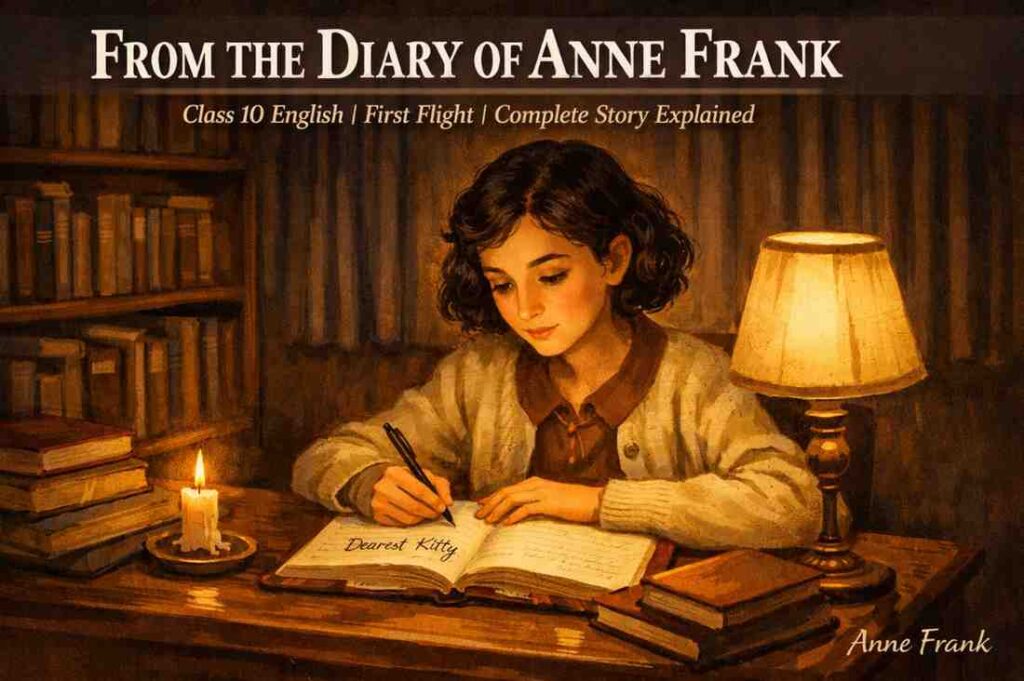
She named her diary Kitty.
🐱 Who is Kitty — And Why This Choice Matters in Class 10 Literature
Most people keep diaries where they write facts. “Today I went to school. Had lunch. Came home.” Boring. Forgettable. Anne wanted something different — she wanted a friend, not a record.
So she made a decision that completely changed how she wrote: she would address every entry to Kitty, as if writing a letter to a best friend who had no idea what Anne’s life looked like. That meant Anne had to explain everything — her family background, her school, her thoughts — as if to a total outsider.
This is why the diary reads the way it does. It’s warm. It’s personal. It has jokes and opinions and observations that feel like they’re meant for you. Because in a way, they are — Anne was writing for someone she had never met, someone patient and kind and always available. She was writing for Kitty. And eighty years later, she’s writing for you.
In your Class 10 English exam, if you’re asked “Does Anne treat Kitty as an insider or an outsider?” — the answer is: Anne treats Kitty like a dear friend who is new to her life. She provides context lovingly, not coldly. Kitty is an outsider by information but an insider by trust.
📖 The Story So Far: Anne’s Brief Family Sketch
Because “Kitty” doesn’t know anything about Anne’s life, Anne gives a brief sketch of her family before getting into her diary entries. She does this with characteristic charm — warmly, a little playfully, occasionally with a flash of something deeper underneath.
Her father Otto Frank she describes as “the most adorable father I’ve ever seen” — and coming from a thirteen-year-old, that is about the highest praise available. He was thirty-six when he married her mother, who was twenty-five. Older sister Margot was born in 1926 in Frankfurt, Anne herself in 1929.
When the family moved to Holland in 1933, Anne gives us one of the funniest throwaway lines in the entire extract: she says she arrived in February and was “plunked down on the table as a birthday present for Margot.” She is describing herself as a gift — casually, with zero self-importance. This is exactly the kind of self-deprecating, dry humour that makes Anne’s writing feel so immediate and alive even in Class 10 English classrooms in 2025.
She talks about school — the Montessori nursery, the first form, the sixth form where her teacher was Mrs. Kuperus, the headmistress. When they said goodbye at the end of the year, “we were both in tears.” In the world of Class 10 literature, characters are often described in broad strokes — but Anne in two sentences tells you everything about the kind of student she was: the kind who made her teacher cry at the farewell.
She mentions her grandmother, who died in January 1942: “No one knows how often I think of her and still love her.” Simple. Devastating. Real.
This is what separates Anne’s diary from every other text in your Class 10 English syllabus: the emotion is never performed. It is never inflated for effect. It just is.
🏫 Saturday, 20 June 1942 — Dearest Kitty: School Life During the War
Now we get to the actual diary entries — and this is where the Class 10 English extract does something very clever.
Rather than showing us Anne’s life in hiding (which would be dark, terrifying, and overwhelming), NCERT has chosen to show us Anne at school — anxious about exams, annoyed by classmates, cleverly navigating a difficult teacher. It is deliberately light. It is deliberately relatable.
Because the most important thing for you to understand about Anne Frank is not that she was a victim of the Holocaust. It is that she was a person. A teenager with opinions and a sense of humour and academic anxiety and petty grievances — just like you.
The entry begins: “Our entire class is quaking in its boots.”
The class is terrified about result day — the day teachers decide who moves up to the next form and who gets kept back. Half the class is betting on each other’s fate. Two boys behind Anne — C.N. and Jacques — have staked their entire holiday savings on the bet. Anne and her friend laugh at them. If you ask Anne, about a quarter of the class should be held back — “but teachers are the most unpredictable creatures on earth.”
Raise your hand if you have thought this exact thought at least once in Class 10 English or any other subject. Go on.
The key word here is “quaking in its boots” — an idiom meaning to be extremely scared and nervous. The image is almost comic: the whole class shaking in their shoes over exam results, just like students in every country, every decade, every school — including yours.
😤 Mr. Keesing and the Art of Outsmarting a Teacher
Now we arrive at the most entertaining episode in this entire Class 10 English chapter — and one of the most satisfying in all of First Flight literature.
Anne has a maths teacher named Mr. Keesing. She calls him an “old fogey” — an old-fashioned person who is set in his ways. He has been annoyed with Anne for one very specific reason: she talks too much in class.
After several warnings that Anne cheerfully ignored, Mr. Keesing assigned her punishment homework: write an essay on “A Chatterbox.”
Anne’s first reaction is exactly what yours would be: What can you even write about that?
But then — and this is the part that reveals who Anne Frank truly is — she doesn’t complain. She doesn’t give up. She doesn’t write a flat, defensive essay. She sits down, chews the tip of her fountain pen, and comes up with something actually clever.
Her argument? Talking is a student’s trait. She would try her best to control it, but she could never fully cure herself — because her mother talked just as much, and there’s nothing you can do about inherited traits.
She blamed her mother. With evidence. In a school essay. To a teacher.
Mr. Keesing laughed. He genuinely had a good laugh at her arguments. And then — because teachers love to get the last word — he immediately assigned her a second essay, this time on “An Incorrigible Chatterbox.”
Incorrigible — a brilliant word meaning something that cannot be corrected, that is beyond fixing. He was essentially calling her an unsalvageable case.
Anne handed that one in too. Two whole lessons of peace.
Then came the third offence. And this time Mr. Keesing was done being reasonable. He assigned her: “Quack, Quack, Quack, Said Mistress Chatterbox.”
The whole class burst out laughing. Anne admits she had to laugh too — but then something clicked. If he wanted to make a joke of her, she would write the joke. And she would win it.
She turned to her friend Sanne, who was good at poetry, and together they wrote the entire essay as a poem — a beautiful one, about a mother duck and a father swan whose three baby ducklings were bitten to death by the father because they quacked too much.
Let that image sit for a second. She took the punishment topic and made it into a fable about excessive punishment killing those you love. Whether intentional or not, that is layered writing from a thirteen-year-old.
Mr. Keesing read the poem aloud — not just to their class, but to several other classes. From that day forward, Anne was allowed to talk. And Mr. Keesing? He became the one making jokes.
🎭 What This Episode Really Tells Us About Anne — And About Class 10 Literature
In every Class 10 English textbook, literature characters are often defined by one quality. But Anne Frank breaks that rule because she is genuinely multidimensional, and this episode shows it perfectly.
She is defiant but not disrespectful. She never directly argues with Mr. Keesing. She works within the system — she writes the essays — but she does so with such originality and wit that she transforms the punishment into something he can only admire.
She is creative under pressure. She doesn’t have days to prepare. She writes on the evening the assignment is given. And yet the output is brilliant.
She is self-aware without being self-pitying. She says she cannot cure herself of talking. She doesn’t promise to change. She is honest about who she is and argues for the right to remain that way.
She is funny. Genuinely, laugh-out-loud funny. “Teachers are the most unpredictable creatures on earth” is a sentence that deserves to be in every Class 10 English anthology forever.
This is why the NCERT Class 10 literature extract ends here — on a note of laughter, of wit, of a young girl winning a small, delightful battle against the world. Because two years after writing this diary entry, Anne Frank would be arrested by the Nazis. She would be sent to Bergen-Belsen concentration camp. She would die of typhus in February or March of 1945 — just weeks before the camp was liberated.
She was fifteen years old.
NCERT doesn’t tell you this in the extract. But you need to know it. Because only when you know how the story ends do you understand what the story means.
💔 The Context That Changes Everything: Why She Wrote, How She Lived
The diary was given to Anne on 12 June 1942 — her 13th birthday. She wrote in it for the last time on 1 August 1944. Three days later, the secret hideout was betrayed to the Nazis and the family was arrested.
Of the eight people hiding in those rooms, only Otto Frank survived.
He returned to Amsterdam after the war. And he found that his friend Miep Gies — a woman who had helped hide the family — had saved Anne’s diary. She had kept it, planning to return it to Anne when the war ended. When Otto Frank learned that Anne had not survived, Miep gave him the diary.
Otto spent months reading what his daughter had written — the thoughts, the feelings, the humour, the longing, the faith in humanity even in darkness — all of it written by a thirteen-year-old girl who thought no one would ever care.
He had it published. The world read it. And has never stopped reading it.
📊 Anne Frank vs. The Textbook: Why This Is Unlike Any Other Class 10 Literature Chapter
| Factor | Other Class 10 English Stories | From the Diary of Anne Frank |
|---|---|---|
| Author | Adult, professional writers | A 13-year-old writing for herself |
| Intent | Written to be literature | Written to survive emotionally |
| Style | Formal narration | Conversational, intimate diary entries |
| Themes | Mostly fictional conflicts | Real loneliness, real war, real loss |
| Impact | Tells a story | Is a story — lived and felt |
| Legacy | Academic | 30 million readers, films, operas, museums |
🔍 Important Words You Must Know for Class 10 English Exams
Listless — Having no energy or interest. Anne uses this to describe herself on the sad, bored days when she first thought about keeping a diary.
Confide — To share personal things privately with someone you trust. This is the heart of what Anne wanted — someone she could confide in, which she couldn’t find among people.
Musings — Thoughts, reflections, inner contemplation. When Anne says nobody will be interested in her “musings,” she is being self-deprecating about her own deep thinking.
Incorrigible — Something that cannot be corrected or changed. Mr. Keesing essentially gives up trying to fix Anne’s talking habit and declares her incorrigible.
Ingenuity — Originality and inventiveness. Anne uses her ingenuity to turn every punishment essay into something clever and creative.
Inherited traits — Qualities or characteristics passed down from parents. Anne uses this concept brilliantly in her first essay — she argues she can’t stop talking because her mother is the same way, and inherited traits can’t be cured.
Quaking in its boots — An idiom meaning extremely scared and nervous.
Old fogey — An informal expression for a person who is old-fashioned and set in their ways.
📝 Complete Q&A — Written Like a Class 10 English Topper
Q: What makes writing in a diary a strange experience for Anne Frank?
Anne says writing in a diary is strange for two reasons. First, she has never written anything before — she lacks the habit or experience of expressing herself on paper. Second, and more interestingly, she doubts whether anyone — including herself in the future — would ever want to read the thoughts of a thirteen-year-old schoolgirl. She finds it strange to write knowing it might never be read. Yet she writes anyway, because she needs to express what she feels, and because she has discovered that paper holds what people cannot.
Q: Why does Anne want to keep a diary?
The real reason, which Anne states plainly and courageously, is that she does not have a true friend. She has family, acquaintances, and classmates — but no one she can fully confide in, no one she can have genuine, deep conversations with. She finds that with people, she can only discuss ordinary things. She cannot get closer. The diary, therefore, becomes the friend she cannot find in real life. She names it Kitty and addresses every entry to her, turning the notebook into a relationship.
Q: Why did Anne think she could confide more in her diary than in people?
Anne articulates this through one of the most memorable phrases in Class 10 English literature: “Paper has more patience than people.” People react, judge, advise, change the subject, or grow tired of listening. Paper receives everything without reaction. It holds her words exactly as she gives them, without modifying them with discomfort or distraction. For someone who felt emotionally isolated even among friends, this was not just comfort — it was the only form of complete honesty available to her.
Q: Was Anne right when she said the world wouldn’t be interested in the musings of a thirteen-year-old girl?
History says no — spectacularly. The Diary of a Young Girl has been translated into over 70 languages and read by more than 30 million people. It has been adapted into films, plays, and an opera. Anne Frank is one of the most recognised names in the world. Her “musings” became a document of the Holocaust, a testimony of Jewish life under Nazi occupation, and a monument to the resilience and humanity of one young girl. Her doubt about her own relevance makes the diary’s actual impact even more extraordinary.
Q: Why was Mr. Keesing annoyed with Anne? What did he ask her to do?
Mr. Keesing, the maths teacher, was annoyed with Anne because she talked constantly in class, disrupting lessons. After several warnings went unheeded, he assigned her extra homework: first an essay on “A Chatterbox,” then “An Incorrigible Chatterbox,” and finally — in exasperation and mockery — “Quack, Quack, Quack, Said Mistress Chatterbox.” Each assignment was meant as a punishment and a way to embarrass Anne into silence.
Q: How did Anne justify being a chatterbox in her essays?
In her first essay, Anne argued that talking is a student’s natural trait and that while she would try to control it, she could never fully cure herself — because her mother talked just as much, if not more, and inherited traits cannot be changed. This was clever: she acknowledged the problem, showed willingness to improve, but shifted the responsibility to genetics rather than character — making it impossible for Mr. Keesing to argue against without seeming unreasonable.
In her third essay, she worked with her friend Sanne to write a poem about a mother duck and father swan whose ducklings were killed for quacking too much — a pointed (and funny) fable about excessive punishment.
Q: Do you think Mr. Keesing was a strict teacher?
Mr. Keesing is called an “old fogey” by Anne, and he does issue repeated punishments. But the Class 10 English extract reveals his real character in how he responds to Anne’s poem: he doesn’t punish her for it. He reads it aloud to multiple classes, enjoys the joke, and from then on allows Anne to speak freely. A truly strict teacher would have reacted with anger. Mr. Keesing reacted with humour — which tells us he was, underneath the gruff exterior, fair and quite human. He and Anne had reached an understanding, and he respected her creativity even if he had been exasperated by her behaviour.
Q: What does the statement “teachers are the most unpredictable creatures on earth” tell us about Anne?
It tells us that Anne has a sharp, observational sense of humour. She is not afraid to have opinions about adults in authority. She sees the world clearly and is willing to say what she sees, even if it’s a little cheeky. This quality — of honest, unafraid observation — is exactly what makes her diary the literary masterpiece it became. It also tells us she is relatable across every generation of Class 10 English students who have ever thought the same thing.
🌿 The Themes of This Chapter — What Class 10 English Is Really Teaching You
Loneliness in the middle of company — The most resonant theme in this chapter is not the war, not the Holocaust, but the very specific loneliness of feeling unseen even when surrounded by people. Anne’s experience is universal — it is the experience of every teenager who ever felt like nobody really got them.
Writing as survival — For Anne, the diary was not a hobby. It was how she survived emotionally. Class 10 literature uses this chapter to introduce students to the idea that expression — writing, speaking, creating — is not decorative. It is necessary. It keeps people alive in ways that have nothing to do with food or shelter.
Resilience and humour — The Keesing episode in particular shows that resilience doesn’t always look like grim determination. Sometimes it looks like a poem about ducks. Anne’s ability to find humour in difficult situations — to transform punishment into performance, to win without fighting — is one of the most meaningful examples of resilience in Class 10 English literature.
The value of bearing witness — Anne Frank wrote because she needed to. But in doing so, she also documented a world that was being erased. Her descriptions of daily life — the exam anxiety, the classroom dynamics, the complex friendships — are the only record of what ordinary Jewish life looked and felt like in that moment. To write is sometimes to remember for everyone who might forget.
🎯 The Exam Strategy: How to Stand Out in Class 10 English Board Answers
For Class 10 English board exams, questions on this chapter tend to fall into two categories: factual recall (easy if you’ve read this post) and character/theme analysis (where most students lose marks).
For character analysis questions — “What kind of person was Anne Frank?” — don’t list adjectives. Show them through specific moments. Anne is creative: see how she handled Keesing’s punishment. Anne is self-aware: see how she admits her loneliness honestly. Anne is funny: see how she describes being “plunked down on the table as a birthday present for Margot.”
For value-based questions — “What does this story teach us?” — always connect the historical context to a present-day truth. Anne’s story teaches us that every human life has dignity and depth, that keeping records of ordinary experience is its own form of courage, and that the impulse to connect — to be truly known by someone — is universal across time, place, and circumstance.
One more thing: the question “Was Anne right when she said nobody would be interested in her musings?” is a favourite in Class 10 English papers. Your answer should acknowledge the irony fully — that the girl who doubted her own relevance became one of the most read authors in human history.
💭 What This Chapter Is Really Asking You to Do
Here’s something your Class 10 English teacher might not say explicitly but is absolutely true: this chapter is not asking you to feel sorry for Anne Frank.
It is asking you to recognize her. To look at a thirteen-year-old girl writing about exam results and a chatty habit and a teacher who assigns duck-themed essays — and see yourself. To realize that what separates your life from hers is not personality, or depth, or worth. It is only circumstance.
Anne Frank was funny and flawed and brilliant and lonely and brave and ordinary and extraordinary, all at once. She was, in every way that mattered, a person.
And if there is one thing this chapter of Class 10 English literature asks of you — it is to remember that. To remember her not as a symbol of tragedy, but as a person who lived, who thought, who loved, who laughed, who wrote, and who deserved so much more than she was given.
📣 Before You Leave
Anne Frank once wrote: “Despite everything, I believe that people are really good at heart.”
She wrote that in hiding. Under occupation. Having lost nearly everything.
If a thirteen-year-old girl in the most frightening circumstances imaginable could still believe that — I think the least we can do is try to live like she was right.
Tell me in the comments: Did you have a diary at some point? Did you ever stop writing in it? After reading this, do you want to start again?
Share this with your Class 10 English batch group — not just because it’ll help for the exam, but because Anne Frank deserved to be read this carefully. She still does.
And if you want the same treatment for every chapter in First Flight — the full story, the real meaning, the exam edge — subscribe. There’s a lot more to this textbook than most people realise.
📌 Also Read: A Letter to God Class 10 — Complete Story Explained | Nelson Mandela: Long Walk to Freedom — What Your Textbook Doesn’t Tell You | How to Write a Perfect Class 10 English Board Exam Answer