
📚 Introduction: Why This Topic Matters
Let’s be honest—you’ve probably asked your teacher at least once: “Why do we need to learn all these tenses? When will I ever use this in real life?”
Great question. And today, we’re going to answer it properly.
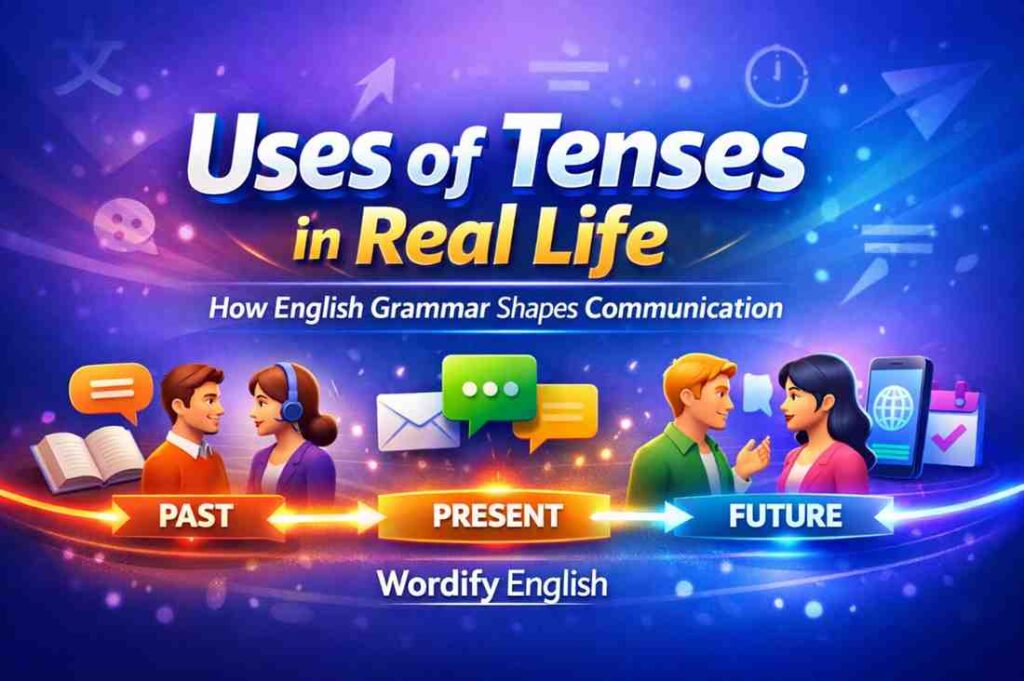
Tenses aren’t just exam topics. They’re the tools you use every single day—when you tell your friend about a movie you watched, when you explain what you’re doing right now, or when you share your dreams for the future. Without tenses, your words would have no time frame. People wouldn’t know if something already happened, is happening now, or hasn’t happened yet.
Think about it:
- “I eat pizza” (I do this regularly—it’s a habit)
- “I am eating pizza” (I’m doing it right now)
- “I ate pizza” (I did it yesterday)
- “I will eat pizza” (I’ll do it tomorrow)
Same action—pizza eating—but FOUR different meanings. That’s the power of tenses.
In this learning guide, we’ll explore the real-life applications of every tense. No boring theory. Just practical examples you can use today.
📖 PART 1: PRESENT TENSE – LIVING IN THE NOW
The present tense is your most-used tool. It handles everything happening around you right now.
1. Simple Present Tense
Structure: Subject + V1 (+ s/es)
When do we use it in real life?
| Situation | Real-Life Example | Why We Use It |
|---|---|---|
| Daily routines | “I wake up at 6 AM every day.” | Talking about habits |
| Facts/truths | “The Sun rises in the east.” | Universal statements |
| Permanent situations | “My father works at a bank.” | Jobs, locations |
| Sports commentary | “Kohli hits a six!” | Live action (shortcuts) |
| Instructions | “First, you mix the flour and water.” | Recipes, directions |
🎯 Real-Life Application Scenarios:
Scenario 1: Morning Conversation
Mother: “What time do you leave for school?”
You: “I usually leave at 7:30. The bus comes at 7:45.”
Scenario 2: Introducing Yourself
“Hi, I’m Rahul. I live in Delhi and study in Class 9. My hobbies include reading and cricket.”
Scenario 3: At a Restaurant
Waiter: “What do you recommend?”
You: “The chicken biryani tastes amazing here.”
📝 Student Note:
Simple present = habits + facts + routines. If it happens regularly or is always true, use this tense.
2. Present Continuous Tense
Structure: Subject + is/am/are + V1 + ing
When do we use it in real life?
| Situation | Real-Life Example | Why We Use It |
|---|---|---|
| Actions happening NOW | “I am studying for my exams.” | Right at this moment |
| Temporary situations | “I am living with my aunt this month.” | Not permanent |
| Near future plans | “We are going to Mumbai tomorrow.” | Already decided |
| Trends/changes | “More people are using UPI these days.” | Changing situations |
| Annoying habits (with ‘always’) | “He is always leaving his cup here!” | Complaint/frustration |
🎯 Real-Life Application Scenarios:
Scenario 1: Phone Call
Friend: “What are you doing?”
You: “I am waiting for the bus. It’s late again.”
Scenario 2: Explaining a Temporary Situation
“I’m not sleeping well these days because of exam stress.”
Scenario 3: Future Plan Confirmation
Parent: “Are you coming home for lunch?”
You: “No, I’m eating with friends today.”
⚠️ Important Exception:
Some verbs are NEVER used in continuous form (even if action is happening now). These are stative verbs:
- ❌ “I am wanting a new phone” → ✅ “I want a new phone”
- ❌ “She is knowing the answer” → ✅ “She knows the answer”
Common stative verbs: love, hate, know, believe, need, understand, belong, seem, prefer, realize
3. Present Perfect Tense
Structure: Subject + has/have + V3
When do we use it in real life?
| Situation | Real-Life Example | Why We Use It |
|---|---|---|
| Life experiences | “I have visited Goa twice.” | No specific time needed |
| Recent actions with results | “I have finished my homework.” | Result matters now |
| Actions continuing to present | “I have lived here for 10 years.” | Started past, still true |
| With ‘just/already/yet’ | “She has just left.” | Very recent events |
| News/announcements | “The government has announced new rules.” | Breaking news |
🎯 Real-Life Application Scenarios:
Scenario 1: Job Interview
Interviewer: “Have you worked with computers before?”
You: “Yes, I have completed two internships in software.”
Scenario 2: At the Doctor’s Clinic
Doctor: “Have you taken any medicine?”
You: “No, I haven’t taken anything yet.”
Scenario 3: Sharing Experiences
Friend: “Have you ever tried sushi?”
You: “No, I have never eaten it. But I want to try!”
🔑 Key Rule to Remember:
Present Perfect = PAST + PRESENT connection. The action happened in the past, but it’s connected to NOW.
❌ Wrong: “I have seen that movie yesterday.” (Yesterday = specific time)
✅ Correct: “I saw that movie yesterday.” (Simple Past for specific time)
✅ Correct: “I have seen that movie before.” (Present Perfect for experience)
4. Present Perfect Continuous Tense
Structure: Subject + has/have + been + V1 + ing
When do we use it in real life?
| Situation | Real-Life Example | Why We Use It |
|---|---|---|
| Emphasizing duration | “I have been waiting for an hour!” | Focus on HOW LONG |
| Action recently stopped | “You look tired. Have you been studying?” | Visible result now |
| Ongoing action still continuing | “It has been raining since morning.” | Started past, still happening |
🎯 Real-Life Application Scenarios:
Scenario 1: Late to Meeting
You arrive sweating: “Sorry I’m late! I have been running to catch the bus!”
Scenario 2: Asking About Activities
Mother: “Your hands are dirty. What have you been doing?”
You: “I have been playing in the garden.”
Scenario 3: Duration Emphasis
Friend: “Why are you so sleepy?”
You: “I have been studying for five hours straight.”
🆚 Present Perfect vs Present Perfect Continuous:
| Present Perfect | Present Perfect Continuous |
|---|---|
| Focus on completion | Focus on duration |
| “I have written 5 pages.” (Result matters) | “I have been writing for 3 hours.” (Time matters) |
| “She has visited London.” (Experience) | “She has been traveling for weeks.” (Ongoing activity) |
📖 PART 2: PAST TENSE – SHARING MEMORIES AND STORIES
The past tense is your storytelling tool. Every memory, every “remember when” moment lives here.
1. Simple Past Tense
Structure: Subject + V2
When do we use it in real life?
| Situation | Real-Life Example | Why We Use It |
|---|---|---|
| Completed past actions | “I visited my grandma yesterday.” | Specific time known/implied |
| Series of past events | “I woke up, ate breakfast, and left.” | Storytelling |
| Past habits | “I played cricket every day as a child.” | No longer true |
| Historical facts | “India won independence in 1947.” | Historical events |
🎯 Real-Life Application Scenarios:
Scenario 1: Talking About Your Day
“Today was hectic. I woke up late, missed the bus, and reached school after the bell.”
Scenario 2: Sharing a Memory
“Remember when we got lost during the school trip? We were so scared!”
Scenario 3: Explaining What Happened
Teacher: “Why didn’t you submit your homework?”
You: “I forgot it at home, ma’am.”
📝 Student Note:
Simple Past = finished actions at a finished time. If you know WHEN it happened, use Simple Past.
2. Past Continuous Tense
Structure: Subject + was/were + V1 + ing
When do we use it in real life?
| Situation | Real-Life Example | Why We Use It |
|---|---|---|
| Interrupted past action | “I was watching TV when the power went out.” | Longer action interrupted |
| Background scene in stories | “The sun was setting. Birds were singing.” | Setting the scene |
| Two actions simultaneously | “While I was cooking, my brother was playing.” | Both in progress |
| Specific time in past | “At 8 PM last night, I was studying.” | Exactly at that time |
🎯 Real-Life Application Scenarios:
Scenario 1: Describing an Accident
“I was crossing the road when a bike suddenly came out of nowhere.”
Scenario 2: Setting the Scene
“It was raining heavily, and we were waiting for the bus, getting completely drenched.”
Scenario 3: Explaining Why You Missed a Call
“Sorry I didn’t pick up. I was taking a shower.”
3. Past Perfect Tense
Structure: Subject + had + V3
When do we use it in real life?
| Situation | Real-Life Example | Why We Use It |
|---|---|---|
| Earlier past action | “The train had left before we reached.” | Showing which happened FIRST |
| Cause and effect in past | “I was tired because I had not slept well.” | Explaining reason |
| Reported speech | “She said she had finished the work.” | Reporting past words |
🎯 Real-Life Application Scenarios:
Scenario 1: Late to Movie
“When we reached the cinema, the movie had already started. We missed the beginning!”
Scenario 2: Explaining a Mistake
“I didn’t know she was angry because she hadn’t told me anything.”
Scenario 3: Regret
“I wish I had studied harder for that test.”
🔑 The Golden Rule:
Past Perfect = the action that happened FIRST
Simple Past = the action that happened LATER
Example: When I reached the station (LATER), the train had left (FIRST).
4. Past Perfect Continuous Tense
Structure: Subject + had + been + V1 + ing
When do we use it in real life?
| Situation | Real-Life Example | Why We Use It |
|---|---|---|
| Duration before past event | “I had been waiting for an hour when the bus came.” | How long it lasted |
| Cause of past result | “She was tired because she had been traveling.” | Reason for past state |
🎯 Real-Life Application Scenarios:
Scenario 1: Tired After Travel
“By the time we reached the hotel, we had been traveling for 12 hours. No wonder we were exhausted!”
Scenario 2: Explaining Anger
“I was so annoyed. I had been standing in the rain for 20 minutes before you showed up.”
Scenario 3: Before an Achievement
“She had been practicing for months before she won the competition.”
📖 PART 3: FUTURE TENSE – DREAMS, PLANS, AND PROMISES
The future tense is how you share your aspirations and make arrangements.
1. Simple Future Tense
Structure: Subject + will + V1
When do we use it in real life?
| Situation | Real-Life Example | Why We Use It |
|---|---|---|
| Spontaneous decisions | “The phone’s ringing. I’ll get it.” | Deciding NOW |
| Promises | “I will help you with your project.” | Making commitment |
| Predictions | “I think it will rain tomorrow.” | Guessing future |
| Offers | “I’ll carry your bag for you.” | Helping |
Alternative: “Going to” Future
| Situation | Real-Life Example | Why Different |
|---|---|---|
| Planned intentions | “I’m going to buy a new phone next month.” | Planned BEFORE |
| Evidence-based predictions | “Look at those clouds! It’s going to rain.” | Seeing proof now |
🎯 Real-Life Application Scenarios:
Scenario 1: WILL (Spontaneous)
Friend: “I forgot my pen.”
You: “Don’t worry, I’ll lend you one.”
Scenario 2: GOING TO (Planned)
“We’re going to visit the Taj Mahal during winter break. We booked the tickets last week!”
Scenario 3: Both in One Conversation
A: “Why are you carrying an umbrella?” (Evidence)
B: “It’s going to rain. The sky is dark.”
A: “Oh! Then I’ll take my umbrella too.” (Spontaneous decision)
2. Future Continuous Tense
Structure: Subject + will be + V1 + ing
When do we use it in real life?
| Situation | Real-Life Example | Why We Use It |
|---|---|---|
| Action at specific future time | “This time tomorrow, I’ll be flying to Goa.” | Vivid future picture |
| Polite inquiries | “Will you be using the car tonight?” | More polite than “Will you use?” |
| Routine in future | “I’ll be working on my project all weekend.” | Expected duration |
🎯 Real-Life Application Scenarios:
Scenario 1: Describing Future Moment
“Don’t call me at 8 PM. I’ll be having dinner with my family then.”
Scenario 2: Polite Question
“Will you be attending the meeting tomorrow?” (More polite than “Are you coming?”)
Scenario 3: Future Scene
“This time next year, I’ll be studying in college. Can you believe it?”
3. Future Perfect Tense
Structure: Subject + will have + V3
When do we use it in real life?
| Situation | Real-Life Example | Why We Use It |
|---|---|---|
| Completion by future time | “By 2026, I will have graduated.” | Action FINISHED by then |
| Before another future action | “I will have finished homework before you arrive.” | Order in future |
🎯 Real-Life Application Scenarios:
Scenario 1: Academic Goals
“By the end of this year, I will have completed all my pending courses.”
Scenario 2: Project Deadline
“Don’t worry about the report. I will have submitted it by Friday evening.”
Scenario 3: Life Milestones
“When I turn 25, I will have been working for five years and will have saved enough for a car.”
4. Future Perfect Continuous Tense
Structure: Subject + will have been + V1 + ing
When do we use it in real life?
| Situation | Real-Life Example | Why We Use It |
|---|---|---|
| Duration up to future point | “Next month, I will have been studying here for 3 years.” | Focus on HOW LONG |
🎯 Real-Life Application Scenarios:
Scenario 1: Work Experience
“By 2025, I will have been working at this company for a decade.”
Scenario 2: Long-term Projects
“When we finally finish construction, we will have been building this house for two years.”
📝 Note: This tense is rare in casual conversation. Use it when duration is IMPORTANT to emphasize.
📋 QUICK REFERENCE CHART: ALL 12 TENSES
| Tense | Structure | Real-Life Use | Example |
|---|---|---|---|
| Simple Present | V1 (+s/es) | Habits, facts | “I eat breakfast at 7 AM.” |
| Present Continuous | is/am/are + V1+ing | Now, temporary | “I am eating right now.” |
| Present Perfect | has/have + V3 | Past connected to now | “I have eaten already.” |
| Present Perfect Continuous | has/have + been + V1+ing | Duration till now | “I have been eating for an hour.” |
| Simple Past | V2 | Completed past | “I ate pizza yesterday.” |
| Past Continuous | was/were + V1+ing | Interrupted past | “I was eating when you called.” |
| Past Perfect | had + V3 | Earlier past | “I had eaten before you arrived.” |
| Past Perfect Continuous | had + been + V1+ing | Duration before past | “I had been eating for an hour when you called.” |
| Simple Future (will) | will + V1 | Spontaneous, promise | “I will eat with you.” |
| Simple Future (going to) | is/am/are + going to + V1 | Planned | “I am going to eat out tonight.” |
| Future Continuous | will be + V1+ing | In progress future | “I will be eating at 8 PM.” |
| Future Perfect | will have + V3 | Completed by future | “I will have eaten by 8 PM.” |
| Future Perfect Continuous | will have been + V1+ing | Duration up to future | “I will have been eating for an hour by 8 PM.” |
🎯 REAL-LIFE SITUATIONS: PUTTING IT ALL TOGETHER
Situation 1: Morning Routine (Multiple Tenses)
“I usually wake up at 6 AM. (Simple Present – habit)
This morning, I woke up late because I had slept poorly. (Simple Past + Past Perfect)
Right now, I am getting ready for school. (Present Continuous)
Tomorrow, I will wake up early to finish my homework. (Simple Future)
Situation 2: At a Family Gathering
“Hi everyone! I am so happy to see you all! (Simple Present – state)
I haven’t seen some of you for years! (Present Perfect – experience)
Actually, I was just telling mom that we should do this more often. (Past Continuous)
By next year, I will have finished school, so I’ll have more time. (Future Perfect)
Situation 3: In an Exam Hall (Student Thinking)
“I have studied all night for this test. (Present Perfect)
But now I am staring at this question, and my mind is going blank. (Present Continuous)
I wish I had practiced more numericals. (Past Perfect – regret)
Okay, I will try the next question first. (Simple Future – decision)
📝 PRACTICE EXERCISES
Exercise 1: Identify the Tense
Tell which tense is used in each sentence:
- “I have been waiting for you since morning.” → ________________
- “She will have completed her project by Monday.” → ________________
- “They were playing cricket when it started raining.” → ________________
- “We visit the temple every Sunday.” → ________________
- “By next year, I will have been working here for 5 years.” → ________________
(Answers at the end)
Exercise 2: Fill in the Blanks
- Every morning, she __________ (wake) up at 6 AM.
- Listen! Someone __________ (cry) outside.
- I __________ (finish) my homework, so I can go out now.
- When I reached the station, the train __________ (already/leave).
- By 2026, I __________ (complete) my graduation.
- She __________ (study) for three hours when I called her.
- We __________ (go) to Mumbai next weekend. (planned)
- The phone is ringing—I __________ (get) it.
- I __________ (live) here since 2015.
- This time tomorrow, we __________ (fly) to London.
(Answers at the end)
✅ ANSWERS TO EXERCISES
Exercise 1 Answers:
- Present Perfect Continuous
- Future Perfect
- Past Continuous + Simple Past
- Simple Present
- Future Perfect Continuous
Exercise 2 Answers:
- wakes (Simple Present – habit)
- is crying (Present Continuous – happening now)
- have finished (Present Perfect – result matters now)
- had already left (Past Perfect – earlier past action)
- will have completed (Future Perfect – completion by future time)
- had been studying (Past Perfect Continuous – duration before past action)
- are going (Present Continuous – fixed future plan)
- will get (Simple Future – spontaneous decision)
- have been living (Present Perfect Continuous – started past, still continuing)
- will be flying (Future Continuous – action in progress at future time)
🌟 FINAL TIPS FOR MASTERING TENSES
Do’s ✅
- Practice daily – Use tenses when speaking, not just writing
- Listen to English content – Movies, news, songs (notice how natives use tenses)
- Keep a diary – Write 5 sentences daily about your day (practice past tense)
- Make plans aloud – Tell someone your future plans (practice future tense)
- Record yourself – Speak for 2 minutes daily and check your tense usage
Don’ts ❌
- Don’t translate from your mother tongue – Think in English
- Don’t memorize rules without examples – Examples matter more
- Don’t be afraid to make mistakes – Mistakes = learning
- Don’t ignore irregular verbs – They’re common, learn them
- Don’t rush – Master one tense before moving to the next
📚 MASTER ALL TENSES WITH WORDIFY ENGLISH
This learning guide is part of our complete tense learning series at Wordify English. We’ve created this specifically for students like you who want to understand not just the “what” but the “why” and “how” of English grammar.
What Next?
✅ Present Tense Deep Dive – All 4 types with 50+ examples
✅ Past Tense Complete Guide – Storytelling techniques
✅ Future Tense Mastery – Expressing dreams and plans
✅ Tense Practice Sets – 100+ MCQ questions with explanations
✅ One-on-One Doubt Clearing – Get your specific questions answered
👉 Explore all tense learning guides: Wordify English Tense Series
👉 Join complete English courses: Wordify English Courses
💬 YOUR TURN!
Which tense do you find most difficult? Which one do you use most in daily life?
Drop your answers in the comments below! And if this learning guide helped you, share it with a friend who’s also struggling with tenses.
Remember: Tenses aren’t just grammar—they’re how you share your world with others. Master them, and you master communication.
Happy Learning! 🚀
Team Wordify English



Pingback: Prepositions in English: The Complete Easy Guide (With Examples) - Wordify English
Pingback: Complete Guide to English Tenses (With Charts, Structure, Examples & Easy Rules) - Wordify English