
Introduction: Why Time Matters Tense
Have you ever found yourself in the middle of a story, suddenly realizing you don’t know if you should say, “I was walking,” “I walked,” or “I have walked”? You are not alone. The concept of tense in English often feels like a complicated math problem rather than a way to express yourself.
I remember my first few months teaching English in a new country. A student once told me, “Yesterday, I am going to the market, and I see my friend.” I understood him perfectly, but the tense collision made his story sound like it was happening in a dream. That moment taught me something crucial: mastering tense isn’t about being grammatically perfect; it’s about painting a clear picture of when things happen.
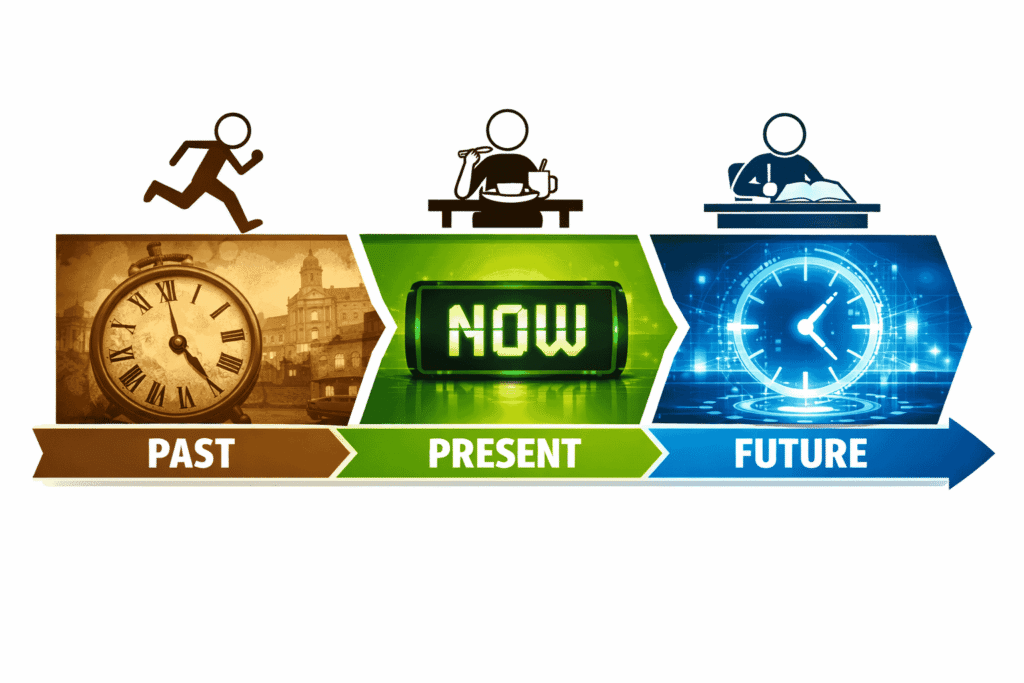
In English, verb tenses are our time machines. They tell the listener if we are talking about a finished story (Past), a current reality (Present), or a dream (Future). In this guide, we aren’t just going to list rules. We are going to walk through the logic of all tenses, break them down into simple pieces, and give you the tools to use them naturally.
Let’s dive into the four dimensions of time.
The Foundation: Time vs. Aspect
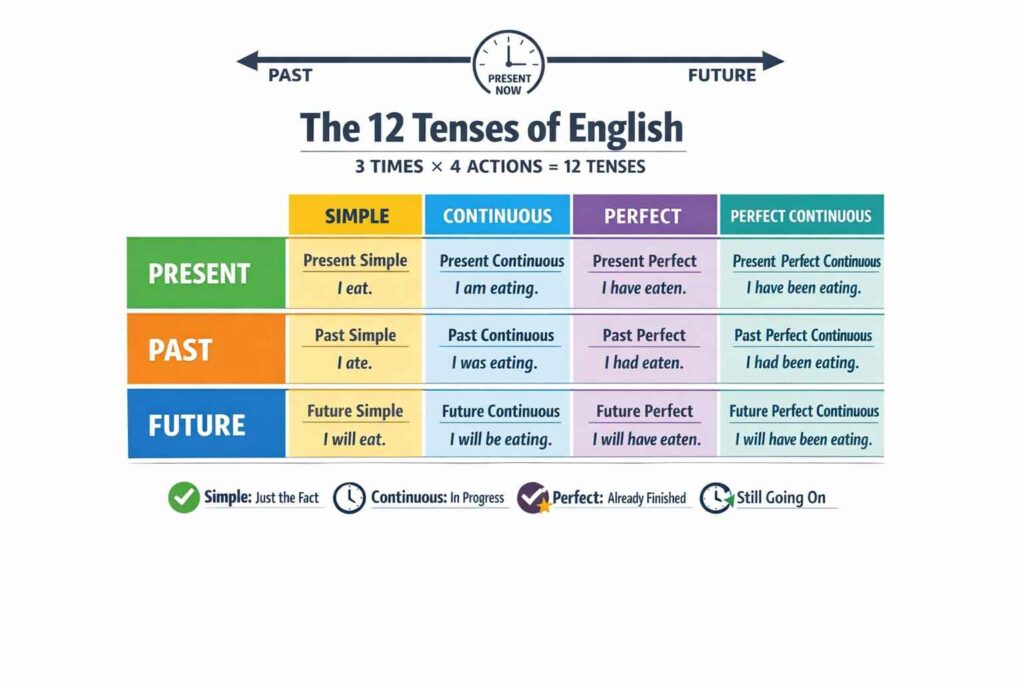
Before we list all tenses, we need to understand that English tenses are made of two parts: Time (Present, Past, Future) and Aspect (Simple, Continuous, Perfect, Perfect Continuous).
Think of it like this: Time tells you when, and Aspect tells you how.
- Simple: A fact or a habit. (How often?)
- Continuous: An action in progress. (How long in the moment?)
- Perfect: A connection between two times. (How has this affected now?)
- Perfect Continuous: The duration of an action up to a point. (How long has this been going on?)
Let’s build your timeline, brick by brick.
The Present Tense: The World of Now
The Present Tense is the most versatile in English. We use it not only for what is happening right now but also for general truths and even future plans.
1. Present Simple
Definition: Used for actions that are habitual, general facts, and permanent situations.
Structure: Subject + Base Form of Verb (add ‘s/es’ for he/she/it)
- Example: I walk; She walks.
Uses & Examples:
- Habits: “I drink coffee every morning.”
- Facts: “The sun rises in the east.”
- Schedules: “The train leaves at 8 PM tonight.”
💡 Personal Tip:
I used to tell my students to think of the Present Simple as the “Normal Button” on a remote control. It’s your default setting. When you meet someone new, you talk about your job and hobbies in the Present Simple because they are stable parts of your identity.
2. Present Continuous (Progressive)
Definition: Used for actions happening right now, or around now (temporary situations), and definite future plans.
Structure: Subject + am/is/are + Verb(-ing)
- Example: I am walking; He is walking.
Uses & Examples:
- Right Now: “Please don’t call now, I am cooking dinner.”
- Temporary Situations: “I am living with my parents until I find an apartment.”
- Near Future: “We are meeting Sarah for lunch tomorrow.”
💡 Personal Tip:
If Present Simple is the “Normal Button,” Present Continuous is the “Behind-the-Scenes” footage. It’s what is happening in the moment, even if the moment is a long one (like living with your parents for a few weeks).
3. Present Perfect
Definition: Links the past to the present. It is used for actions that happened at an unspecified time in the past or have a result now.
Structure: Subject + has/have + Past Participle (Verb 3)
- Example: I have walked; He has walked.
Uses & Examples:
- Life Experiences: “I have visited Japan three times.” (You can do it again; time is not specified).
- Recent Events with Results: “She has lost her keys.” (Result: She can’t open the door now).
- Unfinished Actions: “We have lived here for ten years.” (We still live here now).
💡 Personal Tip:
I struggled with this until a student described it perfectly: “Teacher, it’s the ‘Bridge Tense.'” It’s a bridge connecting Past Island to Present Island. You stand on the Present side, but you’re looking back at the Past.
4. Present Perfect Continuous
Definition: Focuses on the duration of an action that started in the past and is still continuing or has just stopped.
Structure: Subject + has/have been + Verb(-ing)
- Example: I have been walking; She has been walking.
Uses & Examples:
- Actions Continuing: “It has been raining all day.” (It’s still raining).
- Actions Just Stopped with Evidence: “You look tired. Have you been working out?” (I can see the sweat).
💡 Personal Tip:
Use this tense when you want to emphasize the duration of the action, not just the fact that it happened. If someone asks, “Do you know Mumbai?” you say “I have lived there” (Present Perfect—fact). If they ask, “Why are you so sunburned?” you say “I have been lying on the beach all morning” (Present Perfect Continuous—the activity causing the result).
Quick Reference: Present Tenses
| Tense | Key Question | Example Sentence |
|---|---|---|
| Simple | What do you do? | I work in a bank. |
| Continuous | What are you doing now? | I am working on a report. |
| Perfect | What have you done? | I have finished the report. |
| Perfect Cont. | How long have you been doing it? | I have been writing it for 3 hours. |
The Past Tense: The World of Memory
Moving into the Past Tense, we leave the present behind. The key difference here is that everything is finished. The question is simply: How was it happening?
1. Past Simple
Definition: An action that started and finished at a specific time in the past.
Structure: Subject + Past Form of Verb (Verb 2)
- Example: I walked; He ate.
Uses & Examples:
- Completed Actions: “I bought a car yesterday.”
- Past Habits: “When I was a child, I played football every day.”
- Sequences: “She woke up, brushed her teeth, and left.”
💡 Personal Tip:
The Past Simple is the “Storyteller.” When you see a movie or read a book, the narrator uses this tense. It moves the plot forward. “First this happened, then that happened.”
2. Past Continuous
Definition: An action that was in progress at a specific time in the past. It sets the scene.
Structure: Subject + was/were + Verb(-ing)
- Example: I was walking; They were walking.
Uses & Examples:
- Interrupted Action: “I was watching TV when the phone rang.” (Long action interrupted by short action).
- Background Scene: “The sun was shining, and the birds were singing.”
💡 Personal Tip:
Think of the Past Continuous as the background music in a movie. The music (Past Continuous) plays while the main character (Past Simple) walks in. “The music was playing (background) as he entered the room (main event).”
3. Past Perfect
Definition: The “past in the past.” It shows which of two past events happened first.
Structure: Subject + had + Past Participle (Verb 3)
- Example: I had walked before you arrived.
Uses & Examples:
- Clarifying Order: “When I arrived at the party, Tom had already gone home.” (First: Tom left. Second: I arrived).
💡 Personal Tip:
This is a polite tense. It keeps your timeline tidy. Without it, if you say, “I arrived and Tom went home,” it sounds like your arrival caused Tom to leave. Using Past Perfect clarifies the sequence.
4. Past Perfect Continuous
Definition: An action that was in progress for a duration before another action in the past.
Structure: Subject + had been + Verb(-ing)
- Example: I had been walking for an hour before I realized I was lost.
Uses & Examples:
- Cause & Effect in the Past: “He was tired because he had been running.” (The running happened first and caused the tiredness).
💡 Personal Tip:
This tense is very specific. You rarely need it in casual conversation, but it adds precision to writing. It’s the “why” behind the “what happened.”
The Future Tense: The World of Possibility
The Future Tense is interesting because English has no single future form (we don’t add “-ed” or “-ing” to make it future). Instead, we use helpers like will and going to.
1. Future Simple
Definition: Decisions made at the moment of speaking, promises, and predictions based on opinion.
Structure: Subject + will + Base Verb
- Example: I will call you tomorrow.
Uses & Examples:
- Spontaneous Decisions: “The phone is ringing. I will get it.”
- Promises: “I will always love you.”
- Predictions: “I think it will rain later.”
2. Future Continuous
Definition: An action that will be in progress at a specific time in the future.
Structure: Subject + will be + Verb(-ing)
- Example: This time tomorrow, I will be flying to Paris.
Uses & Examples:
- Future Interruptions: “Don’t call me at 8 PM; we will be having dinner.”
- Parallel Actions: “While you are shopping, I will be cleaning the house.”
3. Future Perfect
Definition: An action that will be completed before a specific time in the future.
Structure: Subject + will have + Past Participle (Verb 3)
- Example: By 2028, I will have graduated from university.
Uses & Examples:
- Deadlines: “The builders will have finished the work by Friday.”
4. Future Perfect Continuous
Definition: The duration of an action up to a certain point in the future.
Structure: Subject + will have been + Verb(-ing)
- Example: Next year, I will have been working here for 10 years.
Uses & Examples:
- Emphasizing Duration: “On Saturday, we will have been dating for six months.”
The Secret to Fluency: Don’t Think, Feel
When I first started learning languages, I tried to memorize the structure of all tenses like a dictionary. It didn’t work. Fluency came when I started associating tenses with feelings and images.
- Past Simple feels like a closed book.
- Present Perfect feels like an open window—you can see the past from the present.
- Future Continuous feels like a daydream.
Here is a simple table to help you decide which verb form to use when you are speaking:
| If you want to… | Use this Tense |
|---|---|
| State a fact about yourself | Present Simple |
| Describe what you’re doing right now | Present Continuous |
| Share a life achievement or experience | Present Perfect |
| Tell a story about last weekend | Past Simple |
| Set the scene in a story | Past Continuous |
| Make a quick decision | Future Simple (will) |
| Talk about a plan | Future (going to) or Present Continuous |
All 12 Tenses: Summary
| Tense | Structure | Example |
|---|---|---|
| Present Simple | S + V1 | I play |
| Present Continuous | S + am/is/are + Ving | I am playing |
| Present Perfect | S + has/have + V3 | I have played |
| Present Perfect Continuous | S + has/have been + Ving | I have been playing |
| Past Simple | S + V2 | I played |
| Past Continuous | S + was/were + Ving | I was playing |
| Past Perfect | S + had + V3 | I had played |
| Past Perfect Continuous | S + had been + Ving | I had been playing |
| Future Simple | S + will + V1 | I will play |
| Future Continuous | S + will be + Ving | I will be playing |
| Future Perfect | S + will have + V3 | I will have played |
| Future Perfect Continuous | S + will have been + Ving | I will have been playing |
Conclusion: Your Journey Through Time
Mastering tense in English is not about perfection on the first try. It is about clarity. Every time you speak, you are directing a small movie in the listener’s mind. By choosing the right tense, you control the setting, the lighting, and the plot.
When I started teaching, I realized that my student who said, “Yesterday, I am going,” wasn’t making a mistake; he was simply using the tense that felt most comfortable—the Present Tense. The journey from there to correctly using Past Continuous is a journey of learning to see time differently.
Don’t be afraid to make mistakes. Use the Present Tense to talk about your day, experiment with the Past Tense to share memories, and dream aloud using the Future Tense.
Now it’s your turn!
Which tense do you find the most confusing in English? Is it the Present Perfect or the Past Perfect? Let me know in the comments below, and I’ll help you untangle it. If you found this guide helpful, share it with a friend who is also on this journey through time. Subscribe to Our Newsletters.



Pingback: 200 English Tense Practice Questions (Complete Practice Set) - Wordify English