
Have You Ever Been Too Scared to Take the First Step?
Think about the first time you tried something really hard.
Maybe it was your first day at a new school. Or the first time you tried to ride a bicycle. You stood there, heart pounding, and something inside you said — I can’t do this.
That feeling? That is exactly what this chapter is about.
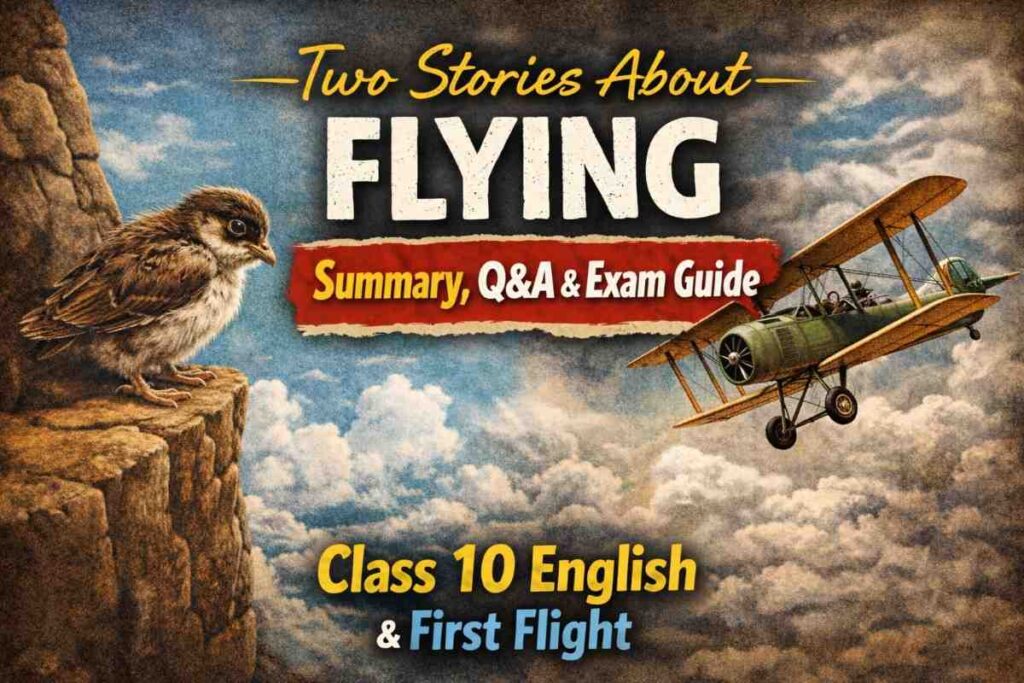
Two Stories About Flying Class 10 English gives you two stories. One is about a young seagull who refuses to jump off a cliff. The other is about a pilot who gets completely lost inside a storm. Both face fear. Both find a way through it.
And here is the thing — when you finish reading this chapter, you will see that it is not really about birds or aeroplanes at all. It is about you. It is about every human being who has ever been afraid to try something new.
So let us dive in. This is your complete guide to Two Stories About Flying, Class 10 English, First Flight Chapter 3.
About the Authors — Who Wrote These Stories?
Story 1 — Liam O’Flaherty
Liam O’Flaherty was an Irish writer born in 1896. He grew up on the Aran Islands, a group of small islands off the west coast of Ireland. Those islands are surrounded by the sea. Seagulls are everywhere there.
That is why he could write about a young seagull with such detail and feeling. He knew that world. He understood it.
O’Flaherty wrote novels, short stories, and essays. His writing is known for being simple, powerful, and deeply connected to nature. His First Flight is one of his most beloved short stories.
Story 2 — Frederick Forsyth
Frederick Forsyth is a British author born in 1938. He is best known for writing thrillers — exciting, tense stories full of suspense.
He was also a pilot. So when he writes about flying a Dakota aeroplane through a storm, he is writing from real experience. That is what makes The Black Aeroplane feel so real and so unsettling.
Forsyth’s most famous works include The Day of the Jackal and The Odessa File. But for Class 10 English students, The Black Aeroplane is the story that matters most right now.
Story 1 — His First Flight: A Complete Walkthrough
This is the story you need to understand paragraph by paragraph. Let us go through it together.
The Young Seagull and His Fear
The story opens on a cliff ledge — a narrow, rocky shelf on the side of a cliff, high above the sea.
A young seagull is sitting there. Alone.
His brothers and his sister had already flown away the day before. But he did not go with them. He was too scared.
Now, think about this. His wings are actually longer than his siblings’ wings. He is physically capable of flying. The problem is not his body. The problem is his mind.
Every time he walked to the edge and looked down, he saw the huge expanse — the wide, endless stretch — of sea far below. And he froze. He convinced himself his wings would never hold him up. So he ran back to his little hole and hid.
This is a very human feeling, is it not? Have you ever talked yourself out of doing something you were perfectly capable of doing?
His Family Tries Everything
His parents did not give up on him easily. They tried everything.
First, they called to him. They screamed. They scolded him sharply, upbraiding — meaning insulting and criticising — him loudly. They even threatened to leave him there to starve unless he flew.
But he still could not move.
So the whole family went on with their lives. His brothers and sister practised flying. His father taught them how to skim — glide low and fast — over the waves. His older brother caught his first herring (a type of sea fish) and devoured it proudly on a rock.
And the young seagull watched all of this from his lonely ledge. Hungry. Afraid. Ashamed.
By the next morning, he had not eaten since the previous night. The sun blazed down on his ledge. He was exhausted — completely drained — by heat and hunger.
The Mother’s Clever Trick
Only his mother kept watching him. She stood on the plateau — a flat area on the opposite cliff — with a piece of fish at her feet. She kept tearing at it, sharpening her beak on the rock.
And the young seagull? He was losing his mind watching her.
He called out to her. “Ga, ga, ga,” he cried — begging, pleading for food.
She called back derisively. That means she mocked him — she called back in a way that made him feel stupid for being afraid.
But then, something changed.
She picked up a piece of fish in her beak and flew towards him. He leaned out eagerly, tapping the rock, reaching as far as he dared.
She stopped. Just opposite him. Wings motionless. The fish dangling almost — almost — within reach of his beak.
He waited. He was confused. Why wasn’t she coming closer?
Then hunger took over completely. He dove at the fish.
And fell.
The Moment of Flight
With a loud scream, he fell outwards and downwards into the open air. A monstrous terror — a huge, overwhelming fear — seized him. His heart stopped.
But only for a moment.
Because the next moment, he felt his wings spread wide. The wind rushed against his chest. It pushed up under his belly. His wingtips cut through the air.
He was not falling anymore. He was soaring. Gliding beautifully downwards and outwards over the sea.
And just like that — the fear was gone.
His whole family came swooping around him, screaming with joy. His mother flew past. His father circled overhead. His brothers and sister curveted — leaped and turned — and banked and dived around him, celebrating.
He joined them. He dived and soared and curved across the sky, shrieking joyfully. He completely forgot that he had ever been afraid.
Then he spotted something below — a huge green surface. His family had landed on it. They were calling him down.
He dropped his legs to land. His feet sank into it. He screamed with fright — he thought he was sinking!
But he was not sinking. He was floating. It was the sea. He was floating on the ocean, his belly resting on the water, his family all around him, offering him pieces of dog-fish to eat.
He had made his first flight.
Story 2 — The Black Aeroplane: A Complete Walkthrough
Now we move to the second story. And this one has a mystery that will stay with you long after you finish reading it.
A Perfect Night Flight
The narrator — the person telling the story, a pilot — is flying his old Dakota aeroplane. He is flying over France, heading home to England.
It is one-thirty in the morning. The moon is rising behind him. Stars fill the clear sky above. There is not a single cloud to be seen.
He is happy. Relaxed. He is dreaming about his holiday, about being with his family, about a good big English breakfast waiting for him at home.
Everything is perfect. This is an easy flight.
He contacts Paris Control — the air traffic control centre — and adjusts his course by twelve degrees west towards England. He switches to his second and last fuel tank. He feels confident. He even thinks, I’ll be in time for breakfast.
The Storm Appears
Then — without warning — he sees them.
Storm clouds. Enormous, terrifying storm clouds. They rise in front of him like black mountains filling the entire sky.
He quickly realises he cannot fly over them. They are too tall. And he does not have enough fuel to fly around them — either north or south. The only options are to go back to Paris or go through.
He knows he should go back. He thinks it clearly: I ought to go back to Paris.
But he wants to get home. He wants his family. He wants that breakfast.
So he takes the risk. He flies the Dakota straight into the storm.
Lost in the Storm
Inside the clouds, everything goes black instantly. He cannot see anything outside the aeroplane. The plane jumps and twists violently in the dark.
He checks his compass. And his stomach drops.
The compass is spinning uselessly — round and round. It is dead. It has completely stopped working.
Then he checks his other instruments. Dead. All of them, dead.
He tries the radio. “Paris Control? Paris Control? Can you hear me?”
Nothing. The radio is dead too.
He is alone. In total darkness. Inside a violent storm. With no compass, no radio, and no working instruments. He has no idea where he is or which direction he is flying.
He is completely, utterly lost.
The Strange Black Aeroplane
And then — he sees it.
In the black clouds nearby, another aeroplane appears. It has no lights on its wings. But he can see it clearly. It is flying right next to him.
He can even see the pilot’s face, turned towards him.
The pilot raises one hand and waves. Follow me. That is what the gesture says. Follow me.
The narrator feels an enormous wave of relief. He follows the strange black aeroplane like — in his own words — an obedient child. The mysterious pilot turns north, making it easy for the Dakota to follow.
For half an hour, the black aeroplane leads him through the storm. But by now, the Dakota’s fuel tanks are almost empty. There is only five or ten minutes of flying left.
And then — the black aeroplane starts to descend.
The narrator follows it down through the clouds. And suddenly — he bursts out below the clouds into clear air.
Two long lines of lights stretch out in front of him. A runway. An airport.
He is safe.
The Unanswered Mystery
He lands. He walks away from the Dakota on shaking legs. He goes to the woman in the control centre and asks two questions: Where am I? And — Who was the other pilot?
The woman looks at him strangely. Then she laughs.
Another aeroplane? she says. In this storm? No other aeroplanes were flying tonight. Yours was the only one on the radar.
And the story ends there. With a question that has no answer.
Who was the pilot in the black aeroplane? How did he appear in the storm? How did he disappear the moment the runway came into view? How did the radar not see him?
The narrator asks it directly: So who helped me to arrive there safely without a compass, a radio, or any fuel in my tanks?
The story does not answer. And that is the point.
Key Facts Table — Two Stories About Flying Class 10 English
| Detail | His First Flight | The Black Aeroplane |
|---|---|---|
| Author | Liam O’Flaherty | Frederick Forsyth |
| Main Character | A young seagull | A Dakota pilot (narrator) |
| Setting | A cliff ledge above the sea | Sky over France, heading to England |
| Central Fear | Fear of flying / first flight | Getting lost in a storm |
| The Turning Point | Mother dangles fish just out of reach | A mysterious black aeroplane appears |
| Resolution | Seagull flies and lands on the sea | Pilot follows mystery plane to an airport |
| Mystery/Question | Will he ever fly? | Who was the mystery pilot? |
| Theme | Courage, fear, family support | Trust, mystery, the unknown |
| Tone | Warm, hopeful | Tense, mysterious |
| Chapter | Class 10 English, First Flight, Chapter 3 | Class 10 English, First Flight, Chapter 3 |
Important Vocabulary — Every Word You Need to Know
This section covers every difficult word from both stories. These words appear in your Class 10 English board exams regularly.
Ledge — A narrow horizontal shelf sticking out from a cliff or wall.
Expanse — A wide, open area stretching far in every direction.
Muster — To gather up courage or strength to do something.
Upbraiding — Scolding someone harshly. Criticising them loudly and angrily.
Herring — A small, soft-finned sea fish. Common in the North Atlantic.
Skim — To move lightly and quickly just above a surface, like a bird gliding low over water.
Preening — When a bird carefully cleans and arranges its feathers with its beak.
Derisively — In a mocking way. Laughing at someone to make them feel foolish.
Plaintively — In a sad, sorrowful way. When you beg or cry for something miserably.
Whet — To sharpen. A bird whets its beak by scraping it on a rock.
Maddened — Driven wild. Made desperate or frantic by something.
Dizzy — The uncomfortable feeling that everything is spinning around you.
Curveting — Leaping and turning in the air, like a horse prancing.
Banking — In flying, tilting one wing higher than the other to turn.
Soaring — Flying very high and smoothly, without flapping wings.
Obedient — Following instructions without question or resistance.
Compass — An instrument that shows direction — North, South, East, West.
Radar — Technology that uses radio waves to detect and track aircraft.
Dakota — A type of old propeller-driven aeroplane. Also known as the Douglas DC-3.
Runway — The long strip of ground that aeroplanes use to take off and land.
NCERT Questions and Answers — His First Flight
These are full, board-exam-ready answers for every question in your Class 10 English textbook.
Q1. Why was the young seagull afraid to fly? Do you think all young birds are afraid to make their first flight?
Answer:
The young seagull was afraid because the sea below looked terrifyingly far away. When he stood at the edge of the ledge and tried to flap his wings, the vast expanse of water stretching beneath him made him feel that his wings would never hold him up. He was convinced he would fall and drown. So even when his brothers and sister — whose wings were shorter than his — flew away without hesitation, he could not gather the courage to take that first leap.
As for whether all young birds feel this fear — it is likely that many do. Learning to fly is an enormous challenge. The instinct may be there, but translating instinct into action requires courage. Some birds may be bolder, others more cautious. Just as in humans, individual temperament plays a role.
And yes, human babies face a very similar challenge when learning to walk. They fall many times. They are uncertain. But with encouragement and practice, they learn.
Q2. “The sight of the food maddened him.” What does this suggest? What compelled the young seagull to finally fly?
Answer:
This line tells us that the young seagull was desperately hungry. He had not eaten since the previous night. When his mother flew towards him with a piece of fish, dangling it just out of his reach, the hunger overwhelmed his fear completely.
What compelled him to fly was not courage in the traditional sense. It was hunger. He was so maddened — driven wild — by the sight and smell of food that he forgot his fear for one crucial second. He dove at the fish. And in that moment of forgetting, he fell off the ledge and discovered he could fly.
This is a beautiful idea. Sometimes we do not overcome fear through willpower. We overcome it because something else — hunger, love, necessity — becomes stronger than the fear.
Q3. “They were beckoning to him, calling shrilly.” Why did the seagull’s father and mother threaten him and cajole him to fly?
Answer:
The parents threatened and encouraged — cajoled means gently persuaded — their young one because they knew he had to fly. It was not a choice. It was survival.
A seagull must fly to find food, to live, to be what it is meant to be. Staying on the ledge forever was not an option. The parents understood this. So they used every tool available to them: scolding, threatening to withhold food, ignoring him, mocking him from a distance, and finally — the mother’s brilliant trick of holding food just out of reach.
All of it came from love. Tough love, but love. They pushed him because they believed he could do it — even when he did not believe it himself.
Q4. Have you ever had a similar experience where your parents encouraged you to do something you were scared to try?
Answer (model answer for exam):
Yes. Many students can relate to this experience. Parents often encourage — and sometimes push — their children to try things they fear. It could be learning to swim, speaking on stage, joining a new school, or attempting a difficult exam.
At first, the encouragement can feel like pressure. But looking back, most people realise that their parents were right. They pushed because they saw potential that the child could not yet see in themselves.
The seagull’s story mirrors this beautifully. His fear was real. His parents’ faith in him was also real. And in the end, the leap of faith — literally — was the best thing that happened to him.
Q5. In the case of a bird flying, success seems guaranteed. Was your success guaranteed in your own experience?
Answer (model answer for exam):
For a bird, flying is a biological certainty. The wings are built for it. The body knows it. Success is almost inevitable — as long as the bird takes the leap.
But for humans, success is never guaranteed. When we try something new — whether it is learning a skill, pursuing a dream, or facing a fear — we might fail. And that is a harder situation.
However, the lesson from the seagull’s story still applies. Trying is essential, regardless of whether success is certain. Without the attempt, there is definitely no success. With the attempt, there is at least a chance.
The important thing is not to let the fear of failure stop you from ever trying at all.
NCERT Questions and Answers — The Black Aeroplane
Q1. “I’ll take the risk.” What is the risk? Why does the narrator take it?
Answer:
The risk is flying directly into a massive storm. The narrator is flying his Dakota aeroplane from France to England when he sees enormous storm clouds ahead. He knows he cannot fly over them. He does not have enough fuel to fly around them.
The logical, safe choice would be to turn back to Paris.
But he does not want to. He wants to go home. He is dreaming of his family and a big English breakfast. He is driven by longing and impatience.
So he takes the risk. He flies straight into the storm. And things immediately go very wrong — his instruments fail, his compass stops working, his radio goes dead, and he becomes completely lost in the dark.
The story teaches us that when we ignore caution for the sake of desire, we can end up in serious danger.
Q2. Describe the narrator’s experience as he flew the aeroplane into the storm.
Answer:
The moment the Dakota entered the storm clouds, everything turned pitch black. It was impossible to see anything outside the aircraft.
The plane jumped and twisted violently in the turbulence — the rough, churning air inside the storm. The narrator checked his compass and found it spinning uselessly. It was dead. All his other instruments had also stopped working. He tried the radio — dead too.
He was completely alone in the dark. No tools. No direction. No communication with the outside world. He was lost inside the storm with no way to know where he was or which way to fly.
Then he saw the strange black aeroplane. He followed it for half an hour through the darkness. His fuel was almost gone. And then the mystery pilot led him downward, out of the clouds, to an airport runway.
The experience was a terrifying combination of helplessness, fear, confusion, and then — unexpected rescue.
Q3. Why does the narrator say, “I landed and was not sorry to walk away from the old Dakota”?
Answer:
This line shows us just how frightened and exhausted the narrator was after his ordeal.
During the flight through the storm, the old Dakota had lost all its instruments. It had jumped and twisted dangerously in the turbulence. The fuel tanks were almost completely empty when he finally landed. The plane had taken him through one of the most terrifying experiences of his life.
Walking away from it was a relief. He was not sad to leave it behind. He was simply glad to be alive, on solid ground, safe.
There is also perhaps a sense that the old Dakota — with its failing instruments and second-hand fuel tanks — had put him in that dangerous situation in the first place. So walking away from it felt like leaving a danger behind.
Q4. What made the woman in the control centre look at the narrator strangely?
Answer:
The narrator asked the woman in the control centre about the other pilot — the one in the black aeroplane who had guided him safely through the storm.
The woman looked at him strangely because there was no other pilot. There was no other aeroplane. She told him that his was the only aircraft on the radar that night. No other planes had been flying during the storm.
So from her perspective, the narrator was asking about something that did not exist. He was describing a pilot who had no plane, no radar signature, no lights — someone who had guided him out of an impossible situation and then simply vanished.
Her strange look is understandable. To her, it made no sense. And in a way, it makes no sense to us either. That is precisely what makes the story so haunting.
Q5. Who do you think helped the narrator to reach safely? Discuss and give reasons.
Answer:
This question has no single correct answer, and that is intentional. The story is written as a mystery.
Interpretation 1 — A hallucination: The narrator was under extreme stress, fear, and exhaustion. In such states, the human mind can create visions. Perhaps he imagined the black aeroplane as a way of coping with his terror, and his own flying instincts — guided by a sudden break in the clouds — led him to the runway.
Interpretation 2 — A guardian angel or supernatural being: The story strongly hints at something beyond the natural world. The aeroplane had no lights and left no radar signature. It appeared exactly when needed and vanished the moment the pilot was safe. Many readers interpret this as a divine or supernatural protector.
Interpretation 3 — A real pilot on an unregistered flight: Some suggest a more practical explanation — that the mystery pilot was simply a pilot whose plane was not being tracked, perhaps for unknown reasons. But the story gives us no evidence for this.
The deliberate ambiguity — the fact that we are not given an answer — is the most powerful thing about the story. Forsyth wants us to wonder. He wants us to sit with the mystery.
Themes — What These Stories Are Really About
Both stories in this Class 10 English chapter carry deep, meaningful themes. Here is what you need to understand and write about in your Class 10 English board exam.
Theme 1 — Overcoming Fear
This is the central theme of His First Flight. The young seagull’s fear is not a character flaw. It is completely understandable. But it is holding him back from the life he is meant to live.
The story shows us that fear is often conquered not through a grand act of bravery — but through a moment of distraction. The seagull was not being heroic. He was just hungry. And in chasing the food, he accidentally discovered he could fly.
This is a powerful message. Sometimes we do not need to “conquer” fear head-on. Sometimes we just need to take one small step — and fear falls away by itself.
Theme 2 — Parental Love and Guidance
The seagull’s parents may seem cruel. They scold him, mock him, and threaten to let him starve. But their actions come entirely from love.
They know what their son needs. They know he cannot stay on that ledge forever. And they know — because they are older and wiser — that he is fully capable of flying. They just need to get him off that ledge.
The mother’s trick with the fish is a perfect example of wise, loving guidance. She does not force him. She does not push him off. She creates a situation where he makes the decision — driven by his own hunger and desire.
That is great parenting. And great teaching.
Theme 3 — Mystery, Faith, and the Unknown
The Black Aeroplane explores something different — what happens when we are in a situation completely beyond our control?
The narrator had no compass, no radio, no fuel, no visibility. He was helpless. And then — help came from nowhere. From someone or something he could not explain.
The story asks us to think about faith. About trust. About whether there are forces at work in the universe that we cannot fully understand or see.
It does not give us answers. But it asks us beautiful questions.
Theme 4 — Courage and Risk
Both stories involve characters who take risks. The seagull risks the leap off the ledge. The pilot risks flying into the storm.
One risk is forced by hunger and circumstance. The other is taken by choice — and almost leads to disaster.
The Class 10 English chapter subtly shows us the difference between these two kinds of risk. Not all risk-taking is equal. Sometimes necessity forces our hand. Other times, impatience leads us into danger we could have avoided.
Exam Strategy — What Examiners Really Test
If you are preparing for your Class 10 English board exam, here is exactly what you need to know about this chapter.
What Gets Asked Most Often
Long answer questions (5–6 marks):
- Describe the young seagull’s first flight in detail.
- Describe the narrator’s experience inside the storm.
- What do both stories teach us about fear and courage?
Short answer questions (2–3 marks):
- Why was the seagull afraid to fly?
- What is the risk the narrator takes, and why?
- What did the woman at the control centre say?
- What compelled the seagull to finally fly?
Extract-based questions: Examiners often pick the paragraph where the seagull falls off the ledge, or the paragraph where the narrator discovers all his instruments are dead. Be ready to answer comprehension questions on these passages.
How to Write Better Answers
Always start your answer with a direct response to the question. Do not start with “In this story…” — that wastes words and marks.
Use evidence from the text. Mention specific details — the ledge, the herring, the spinning compass — to show you have actually read the chapter.
For the theme questions, name the theme clearly, explain it briefly, and give one or two examples from the text. That structure gets full marks every time.
Key Phrases to Remember
For His First Flight: “monstrous terror,” “maddened by hunger,” “obedient child,” “He had made his first flight.”
For The Black Aeroplane: “the compass was turning round and round,” “yours was the only one I could see on the radar,” “without a compass or a radio, and without any more fuel.”
These are the phrases that appear in extract-based questions. Know them well.
The Vocabulary Exercise on “Black”
Your Class 10 English textbook also includes a vocabulary exercise on different meanings of the word “black.” Here are the answers:
- “Your hands and face are absolutely black” — Very dirty, covered in grime.
- “A black look” — An angry, disapproving stare.
- “Blackest crimes against humanity” — Most evil, most wicked.
- “Black comedy” — Humour about dark or morbid subjects; dark humour.
- “Sell these in black” — Sell illegally, on the black market.
- “Beat him black and blue” — Beat very severely, leaving bruises everywhere.
A Closing Thought — What Both Stories Are Really Saying to You
Here is what I want you to take away from this chapter.
The seagull and the pilot are very different characters. One is a bird who has never flown. The other is an experienced aviator. One is afraid of the unknown. The other is in a crisis he walked into with open eyes.
But they share something.
Both of them, at the darkest moment, were helped.
The seagull was helped by his mother’s love — disguised as a trick. The pilot was helped by something mysterious — perhaps a guardian, perhaps his own deepest instinct, perhaps something beyond explanation.
And both of them made it through.
This chapter, in your Class 10 English First Flight textbook, is ultimately a message of hope. It says: you will face fear. You will sometimes be lost. You will sometimes run out of fuel, or instruments, or courage.
But there is always a way through.
Sometimes help comes from your family. Sometimes it comes from a stranger. And sometimes — in the most mysterious and beautiful moments — it comes from somewhere you cannot even name.
Trust the journey. Take the leap. Follow the light.
Also Read — More Class 10 English Chapter Guides
Here are the other chapters in this NCERT Class 10 English First Flight series:
- A Letter to God — Class 10 English Chapter 1 — Faith, irony, and a farmer’s unshakeable belief.
- Nelson Mandela: Long Walk to Freedom — Class 10 English Chapter 2 — Courage, sacrifice, and the birth of a nation.
- From the Diary of Anne Frank — Class 10 English Chapter 4 — A young girl’s voice from one of history’s darkest moments.
- Glimpses of India — Class 10 English Chapter 5 — Three beautiful portraits of India: the Baker from Goa, Coorg, and Tea from Assam.
- Madam Rides the Bus — Class 10 English Chapter 7 — A little girl’s first solo adventure and what she learns about life and death.
- The Sermon at Benares — Class 10 English Chapter 8 — The Buddha’s timeless lesson about grief and the universality of loss.
This guide was written to help you understand Two Stories About Flying, Class 10 English, completely and confidently. If you found it helpful, share it with a classmate who needs it too.