
Are you confused about when to use in, on, or at? Do you mix up for and since? Have you ever written “I will see you on Monday at the morning” and felt something was wrong but didn’t know why? You are not alone. Time prepositions are one of the biggest challenges for English learners worldwide — beginners and intermediate students alike.
But here is the truth: time prepositions in English follow clear, logical patterns. Once you see those patterns, everything clicks into place. This guide will teach you every time preposition in English — with simple rules, real-life examples, comparison tables, memory tricks, common mistakes, and practice exercises. No teacher needed. No extra guide needed. Just read this post from top to bottom, and by the end, you will feel 100% confident using time prepositions correctly.
Let’s go! 🚀
What Are Time Prepositions?
A time preposition is a word that tells us when something happens. It connects a time expression to the rest of the sentence.
Look at these sentences:
- I was born in 1998.
- The party is on Saturday.
- Class starts at 9 AM.
- She has been studying for two hours.
- He has lived here since 2015.
Every bold word above is a time preposition. They answer the question: WHEN?
Without time prepositions, your sentences become confusing or incomplete:
- ❌ I was born 1998. → confusing
- ✅ I was born in 1998. → clear and correct
The Full List of Time Prepositions in English
Here are all the time prepositions you need to know:
| Preposition | Primary Use |
|---|---|
| in | months, years, seasons, centuries, long periods |
| on | days, dates, special occasions |
| at | exact times, specific moments |
| for | duration (how long) |
| since | starting point (from when until now) |
| during | throughout a period |
| by | deadline (not later than) |
| until / till | up to a point in time |
| from … to / from … until | start and end point |
| before | earlier than something |
| after | later than something |
| ago | time in the past (from now) |
| within | inside a period of time |
| throughout | all through a period |
We will study every single one of these in detail. Let’s start with the Big Three.
PART 1: IN, ON, AT — The Big Three Time Prepositions
These three prepositions cause the most confusion. Let’s fix that right now.
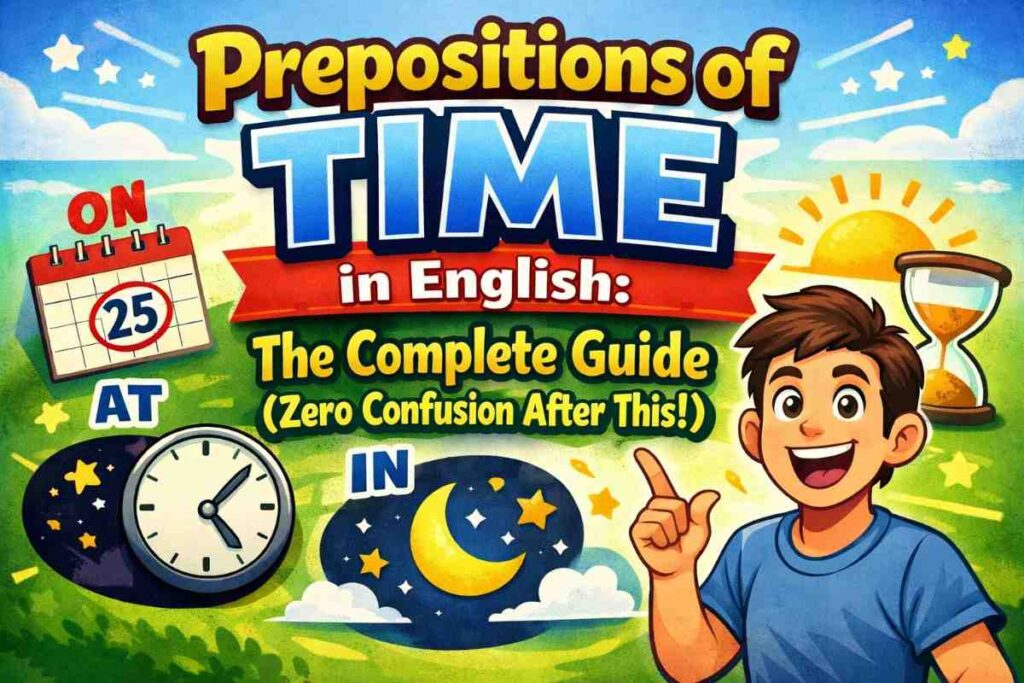
The Golden Rule: Think BIG → MEDIUM → SMALL
Here is the easiest way to remember in, on, at:
- IN = big / general time periods
- ON = medium / specific days and dates
- AT = small / exact points in time
Imagine zooming in on a calendar:
🗓️ IN a year → 📅 ON a day → ⏰ AT a time
IN — For Big, General Time Periods
Use IN when the time period is large or general. You cannot point to it on a clock.
Use IN with:
✅ Years
- I was born in 2001.
- The company was founded in 1995.
- What happened in 2020? (A lot!)
✅ Months
- My birthday is in March.
- School starts in September.
- It snows in January here.
✅ Seasons
- We go to the beach in summer.
- Leaves fall in autumn.
- It rains a lot in spring.
- I love hot chocolate in winter.
✅ Decades and Centuries
- Fashion was wild in the 1980s.
- Shakespeare lived in the 16th century.
- People didn’t have phones in the 1800s.
✅ Parts of the Day (except night)
- I drink coffee in the morning.
- She usually naps in the afternoon.
- We watch TV in the evening.
- ⚠️ BUT: at night (not “in the night” — this is a fixed exception!)
✅ Long, General Periods
- In the past, people traveled by horse.
- Things will be better in the future.
- In those days, life was simpler.
ON — For Specific Days and Dates
Use ON when you are talking about a specific day or date — something you can circle on a calendar.
Use ON with:
✅ Days of the Week
- I have a meeting on Monday.
- She was born on Friday.
- We rest on Sunday.
✅ Specific Dates
- My exam is on June 15th.
- He arrived on the 3rd of April.
- We got married on December 10, 2018.
✅ Special Days and Holidays
- We eat turkey on Thanksgiving.
- She always calls on my birthday.
- We watch fireworks on New Year’s Eve.
- Churches are full on Christmas Day.
✅ A Specific Day + Part of Day
When you combine a day with a part of the day, use ON — not in.
- I have a yoga class on Monday morning. (not “in Monday morning”)
- She called me on Friday evening.
- The match is on Sunday afternoon.
AT — For Exact Points in Time
Use AT when you are talking about an exact time — something you can see on a clock or a very specific moment.
Use AT with:
✅ Clock Times
- The train leaves at 8:45 AM.
- Dinner is served at 7 PM.
- The alarm rings at 6:30.
✅ Noon, Midnight, and Other Precise Moments
- We eat lunch at noon.
- The bells ring at midnight.
- The store opens at dawn.
✅ Mealtimes (when used as a time reference)
- I usually check my phone at breakfast.
- We discuss things at dinner.
✅ Special Time Phrases
- at the moment (= right now)
- at that time (= at that point in the past/future)
- at the same time
- at the end of the day
- at the beginning of the week
- at the weekend (British English — Americans say “on the weekend”)
✅ Night (fixed expression — always “at night”)
- I study at night.
- It gets cold at night.
- Strange things happen at night! 👻
The BIG Comparison Table: IN vs. ON vs. AT
| Time Expression | IN | ON | AT |
|---|---|---|---|
| 2024 | ✅ in 2024 | ||
| July | ✅ in July | ||
| summer | ✅ in summer | ||
| the morning | ✅ in the morning | ||
| Monday | ✅ on Monday | ||
| June 5th | ✅ on June 5th | ||
| my birthday | ✅ on my birthday | ||
| Christmas Day | ✅ on Christmas Day | ||
| Monday morning | ✅ on Monday morning | ||
| 3 PM | ✅ at 3 PM | ||
| midnight | ✅ at midnight | ||
| noon | ✅ at noon | ||
| night | ✅ at night | ||
| the weekend (BrE) | ✅ at the weekend |
Memory Trick for IN, ON, AT 🧠
Imagine a Russian nesting doll (Matryoshka):
- The biggest doll = IN (a whole year, month, season — big container of time)
- The medium doll = ON (a single day — smaller piece of time)
- The smallest doll = AT (one exact moment — the tiniest point)
Or remember this sentence:
“In April, on Monday, at 9 AM — I have my English exam!”
This one sentence uses all three correctly. Memorize it!
PART 2: FOR vs. SINCE — Another Classic Confusion
After in/on/at, the next biggest confusion is for vs. since. Students mix these up constantly. Let’s fix it permanently.
The Core Difference
- FOR = tells us how long (a duration, a length of time)
- SINCE = tells us from when (a starting point up to now)
Ask yourself:
- Am I saying how long? → Use FOR
- Am I saying from what point? → Use SINCE
FOR — Duration of Time
FOR answers the question: How long?
It is used with a period of time — a length, not a specific date.
Use FOR with:
| Expression | Example |
|---|---|
| for + minutes | I waited for 20 minutes. |
| for + hours | She slept for 10 hours. |
| for + days | He stayed for three days. |
| for + weeks | We traveled for two weeks. |
| for + months | She studied for six months. |
| for + years | They lived there for ten years. |
| for + a long time | I haven’t seen her for a long time. |
| for + ages | We haven’t spoken for ages. |
| for + a while | Let’s rest for a while. |
Sentence examples:
- I studied English for three years before moving abroad.
- She has been waiting for an hour.
- He worked at that company for fifteen years.
- Can you be quiet for five minutes?
- They haven’t visited for a very long time.
FOR can be used with any tense:
- I worked there for two years. (past simple)
- I have worked there for two years. (present perfect — still working)
- I will be there for three days. (future)
SINCE — Starting Point in Time
SINCE answers the question: From when?
It is used with a specific moment or date in the past — the point when something started.
Use SINCE with:
| Expression | Example |
|---|---|
| since + year | She has lived here since 2015. |
| since + month | I haven’t eaten meat since January. |
| since + day | He has been sick since Monday. |
| since + date | We’ve been friends since July 4th. |
| since + time | I’ve been awake since 5 AM. |
| since + event | Things changed since the accident. |
| since + clause | I’ve been happy since I moved here. |
Sentence examples:
- I have lived in this city since 2018.
- She has been a vegetarian since last year.
- He hasn’t called since Tuesday.
- We have known each other since we were children.
- Things have changed a lot since the pandemic.
⚠️ Important: SINCE is almost always used with the present perfect tense (have/has + past participle), because it describes something that started in the past and continues to now.
FOR vs. SINCE — Side by Side Comparison
| FOR | SINCE | |
|---|---|---|
| Answers | How long? | From when? |
| Followed by | A period of time | A specific point in time |
| Example | for 3 years | since 2020 |
| Example | for a week | since Monday |
| Example | for two hours | since 9 AM |
| Example | for a long time | since I was young |
| Tense | Any tense | Usually present perfect |
Quick Test: Which is correct?
- She has studied here _____ six months.
- She has studied here _____ September.
Answers: 1. for (six months = a duration) | 2. since (September = a starting point) ✅
Memory Trick for FOR vs. SINCE 🧠
- FOR = For a Fixed amount of time (how long = a fixed length)
- SINCE = Starting point (S for Start)
PART 3: DURING — Throughout a Period
DURING tells us that something happened at some point within a specific period. It does NOT say exactly when — just that it happened inside that time frame.
Use DURING with:
✅ Named events or periods
- I fell asleep during the movie.
- He lost his job during the recession.
- She met her husband during the war.
- We visited Rome during our holiday.
- The power went out during the storm.
The Key Difference: DURING vs. FOR
- FOR = how long something lasted
- DURING = at some point within a period (not the whole time necessarily)
| FOR | DURING |
|---|---|
| I slept for eight hours. | I woke up twice during the night. |
| He studied for the whole class. | He fell asleep during the class. |
| She cried for an hour. | She cried during the funeral. |
PART 4: BY — The Deadline Preposition
BY means not later than — it sets a deadline.
Examples:
- Please finish your homework by Friday. (= on Friday or before Friday — but not after)
- I need the report by 5 PM.
- She wants to be a doctor by the time she’s 30.
- Can you reply by tomorrow?
- Applications must be submitted by the end of the month.
BY vs. UNTIL — Very Important Difference!
This confuses many students. Here is the clear difference:
- BY = completed at some point before or at the deadline (a single action or result)
- UNTIL = something continues up to that point (an ongoing action)
| BY | UNTIL |
|---|---|
| Finish by 5 PM. (stop at 5) | Work until 5 PM. (keep working, stop at 5) |
| I need this by Monday. | I’ll wait until Monday. |
| She stayed by 10 PM. ❌ | She stayed until 10 PM. ✅ |
| He ran by the finish line. ❌ | He ran until he reached the finish line. ✅ |
Simple rule:
- Does the action continue up to that time? → Use UNTIL
- Is the action completed before or at that time? → Use BY
PART 5: UNTIL / TILL — Up to a Point
UNTIL (and its informal form TILL) means something continues and then stops at a certain time.
Examples:
- I will wait until you arrive.
- She studied until midnight.
- The shop is open until 9 PM.
- Let’s stay here until the rain stops.
- He didn’t wake up until noon.
- We talked till it got dark.
TILL is the informal/spoken version of UNTIL. In writing, use UNTIL.
With negatives:
- I didn’t understand until he explained it.
- She didn’t smile until the surprise was revealed.
- They didn’t arrive until 11 PM. (= they arrived late, at 11 PM)
PART 6: FROM … TO / FROM … UNTIL — Start and End Points
Use FROM … TO or FROM … UNTIL to show both the beginning and the end of a time period.
Examples:
- The office is open from 9 AM to 5 PM.
- I studied from Monday to Friday.
- She worked from January to March.
- The course runs from June until August.
- From now on, I will wake up early every day.
FROM … TO is used for completed periods. FROM … UNTIL often implies the end point is when something stopped.
Both are mostly interchangeable:
- The store is open from 8 AM to 10 PM. ✅
- The store is open from 8 AM until 10 PM. ✅
PART 7: BEFORE and AFTER
These are straightforward but very commonly used.
BEFORE — Earlier Than
BEFORE = at an earlier time than something else.
Examples:
- Please arrive before 10 AM.
- She had never been abroad before last year.
- Wash your hands before eating.
- I always read before going to bed.
- Before the meeting, we had coffee.
- He finished the project before the deadline.
AFTER — Later Than
AFTER = at a later time than something else.
Examples:
- Let’s meet after lunch.
- She felt much better after the medicine.
- After the storm, the sky was clear.
- I’ll call you after the meeting ends.
- He retired after 30 years of work.
- What do you do after school?
PART 8: AGO — Time in the Past (Counting Back from Now)
AGO tells us how far back in the past something happened. You count backward from the present moment.
Formula: time period + ago
Examples:
- I moved to this city two years ago.
- She called me an hour ago.
- He left ten minutes ago.
- We got married five years ago.
- The dinosaurs died out millions of years ago.
- I saw that movie a long time ago.
⚠️ AGO is always used with past simple tense — never with present perfect.
- ✅ I started learning English two years ago. (past simple)
- ❌ I have started learning English two years ago. (wrong!)
AGO vs. BEFORE:
- AGO = distance from now (present reference point)
- BEFORE = distance from another point in the past
- He left two years ago. (two years before NOW)
- He had left two years before. (two years before ANOTHER past event)
PART 9: WITHIN — Inside a Time Period
WITHIN means before the end of a period — it emphasizes that something will happen inside a given time frame.
Examples:
- I will reply within 24 hours.
- The package will arrive within three days.
- Please complete the form within two weeks.
- He recovered within a month.
- Results will be announced within the next few days.
- Within an hour of arriving, she already felt at home.
WITHIN vs. IN: Both can mean “after a period,” but there is a subtle difference:
- In three days = exactly three days from now
- Within three days = at any point during the next three days (could be sooner)
PART 10: THROUGHOUT — All Through a Period
THROUGHOUT means during the entire period — from beginning to end, without stopping.
Examples:
- It rained throughout the day.
- She worked hard throughout her career.
- He was calm throughout the whole interview.
- Throughout history, humans have loved music.
- The baby cried throughout the night.
- She smiled throughout the entire ceremony.
The Master Summary Table: All Time Prepositions
| Preposition | Meaning | Used With | Example |
|---|---|---|---|
| in | general period | years, months, seasons, centuries, parts of day | in 2023 / in summer / in the morning |
| on | specific day/date | days, dates, special occasions | on Monday / on July 4th / on my birthday |
| at | exact point | clock times, noon, midnight, night | at 5 PM / at noon / at night |
| for | duration (how long) | a period of time | for 3 years / for an hour |
| since | starting point | a specific past date/time | since 2018 / since Monday |
| during | within a period | named events, periods | during the meeting / during winter |
| by | deadline | a date or time | by Friday / by 6 PM |
| until/till | up to a point | a date or time | until midnight / till Sunday |
| from…to | start and end | two time points | from 9 to 5 / from Monday to Friday |
| before | earlier than | a time or event | before noon / before the exam |
| after | later than | a time or event | after dinner / after the class |
| ago | past (from now) | a past time period | two years ago / a week ago |
| within | inside a period | a time frame | within 24 hours / within a week |
| throughout | all through | entire periods | throughout the year / throughout history |
Common Mistakes with Time Prepositions (+ Fixes)
Let’s look at the most common errors students make and fix them once and for all.
| ❌ Incorrect | ✅ Correct | Why? |
|---|---|---|
| I was born on 1999. | I was born in 1999. | Year → use in |
| She called in Monday. | She called on Monday. | Day → use on |
| Class starts in 8 AM. | Class starts at 8 AM. | Clock time → use at |
| I sleep in night. | I sleep at night. | Night → always at |
| I’m here since two hours. | I’ve been here for two hours. | Duration → use for |
| She left for Monday. | She left since Monday. ❌ → She has been gone since Monday. | Starting point → use since + present perfect |
| I’ll finish until Friday. | I’ll finish by Friday. | Deadline → use by |
| She worked by 10 PM. | She worked until 10 PM. | Continuing action → use until |
| He left 2 years before. | He left 2 years ago. | From now = ago |
| I’m here from a week. | I’ve been here for a week. | Duration → use for |
| Call me in the Monday morning. | Call me on Monday morning. | Day + part of day → use on |
| He left at the morning. | He left in the morning. | Part of day → use in |
Special Fixed Expressions with Time Prepositions
Some time expressions are fixed phrases — they always use the same preposition. Memorize these:
Always use AT:
- at the moment (= right now)
- at present (= currently)
- at the same time
- at first (= in the beginning)
- at last (= finally)
- at night
- at noon / at midnight
- at the weekend (British English)
- at Christmas / at Easter (the holiday period — British English)
- at that time
- at the end of
Always use IN:
- in the morning / afternoon / evening
- in time (= not late)
- in the end (= finally, after a long time)
- in those days (= back then)
- in the past / in the future
- in a moment (= very soon)
- in no time (= very quickly)
- in due course (= at the right time)
- in the meantime
Always use ON:
- on time (= punctual, not late)
- on the day (= on that specific day)
- on holiday (British English)
- on the weekend (American English)
⚠️ “In time” vs. “On time” — a very common confusion!
- On time = punctual, as scheduled: The train arrived on time. (= not late)
- In time = early enough, not too late: We arrived in time for the show. (= before it started)
Practice Exercises — Test Yourself!
Exercise 1: Fill in IN, ON, or AT
- My mother was born _____ 1970.
- The lesson starts _____ 10 o’clock.
- We always celebrate _____ New Year’s Eve.
- She usually goes jogging _____ the morning.
- The store is closed _____ Sunday.
- I’ll see you _____ Friday _____ 3 PM.
- He likes to read _____ night.
- The Olympics happen _____ every four years. (hint: it’s about the year)
- What do you usually do _____ the weekend?
- She was promoted _____ her birthday.
Answers:
- in | 2. at | 3. on | 4. in | 5. on | 6. on / at | 7. at | 8. — (no preposition needed — “every four years”) | 9. at (BrE) / on (AmE) | 10. on
Exercise 2: Fill in FOR or SINCE
- I have been learning English _____ 2019.
- She waited _____ over an hour.
- They have been married _____ 25 years.
- He hasn’t eaten _____ this morning.
- We lived in that apartment _____ three years.
- I haven’t seen her _____ last summer.
- The baby slept _____ four hours.
- She has worked here _____ she was 22.
Answers:
- since | 2. for | 3. for | 4. since | 5. for | 6. since | 7. for | 8. since
Exercise 3: Choose the Correct Preposition
- Please submit your assignment _____ Monday. (by / until)
- I will wait here _____ you come back. (by / until)
- He became famous _____ his 30s. (in / on)
- The accident happened _____ a rainy night. (in / on)
- I finished the book three days _____. (ago / before)
- We need results _____ 48 hours. (within / during)
- She cried _____ the sad movie. (during / for)
- They worked _____ dawn _____ dusk. (from/to | since/until)
Answers:
- by | 2. until | 3. in | 4. on | 5. ago | 6. within | 7. during | 8. from / to
IN → years, months, seasons, morning/afternoon/evening, decades, centuries
ON → days, dates, special occasions, day + part of day
AT → clock times, noon, midnight, night, specific moments
FOR → How long? (a period: for 3 years, for an hour)
SINCE → From when? (a start point: since 2018, since Monday)
DURING → at some point within a named period
BY → deadline (no later than)
UNTIL → something continues up to this point
BEFORE → earlier than
AFTER → later than
AGO → time past, counting back from NOW
WITHIN → before the end of a time frame
THROUGHOUT → during the entire period
FAQ — Questions Students Always Ask
Q1: Can I say “in the night” or is it always “at night”?
It is almost always at night as a general expression. “In the night” is sometimes used to mean during a specific night or at some point during the night, but it sounds unnatural in most contexts. Stick with at night as your default.
- ✅ I study at night. (general habit)
- ✅ He woke up in the night. (at some point during a particular night)
Q2: I’ve heard both “at the weekend” and “on the weekend” — which is correct?
Both are correct — it depends on which variety of English you are using.
- British English: at the weekend → What are you doing at the weekend?
- American English: on the weekend → What are you doing on the weekend?
Neither is wrong. Just be consistent with your chosen variety.
Q3: When do I use “in the end” vs. “at the end”?
Great question — these mean different things!
- In the end = finally, after a long process (similar to “eventually”): We argued for hours, but in the end, we agreed.
- At the end = at the final point of something specific: At the end of the movie, I cried.
Q4: Can “FOR” be used with future tenses?
Yes! FOR can be used with any tense.
- I will be away for a week.
- She is going to study abroad for a year.
- We are staying here for three more days.
Q5: What’s the difference between “in time” and “on time”?
- On time = punctual, exactly as scheduled, not late: The bus arrived on time.
- In time = early enough, with time to spare: We arrived in time to get good seats.
You can remember it this way: ON time = the schedule (ON the schedule), IN time = there is time to spare (you have time, you are inside the time limit).
Q6: Is “ago” used with present perfect?
No! AGO is used with past simple only, never with present perfect.
- ✅ She left two hours ago. (past simple)
- ❌ She has left two hours ago. (wrong — don’t combine)
Use for or since with present perfect, not ago.
Conclusion — You’ve Got This! 🎉
Look how far you’ve come! You started this post maybe confused about in/on/at, and now you understand every major time preposition in English — with rules, examples, comparison tables, memory tricks, and even practice exercises.
Let’s recap the most important lessons:
- IN / ON / AT: Think big → medium → small. IN for long periods, ON for specific days, AT for exact times.
- FOR vs. SINCE: FOR tells you how long (a duration). SINCE tells you from when (a starting point).
- BY vs. UNTIL: BY sets a deadline. UNTIL means something continues up to a point.
- DURING: something happens at some point within a named period.
- AGO: counts backward from NOW — always use with past simple.
- WITHIN: something happens before the end of a time frame.
- THROUGHOUT: something happens during the entire period.
The most important thing now is practice. Read English, watch English shows, and pay attention to how native speakers use time prepositions. Notice them in songs, in books, in conversations. Every time you notice one, your brain gets stronger at using them naturally.
You do not need a teacher to master this. You just read a complete guide and worked through practice exercises all by yourself — that proves you can do it! 💪
The Complete Guide to Prepositions in English
Did this help you? Share it or leave a comment! 💬 Tell us — which time preposition confused you the most before reading this? And which trick helped you the most? We love hearing from our readers!