
Have you ever looked at an animal — a stray dog, a bird on a wire, a squirrel in a park — and felt a sudden rush of warmth, as if that small creature understood you better than most humans do? If yes, then “Mijbil the Otter” from your Class 10 First Flight English textbook is going to feel like it was written just for you.
This chapter is one of the most beautifully written pieces in the entire NCERT Class 10 English syllabus. It is not just a story about a pet. It is a story about loneliness, unexpected love, the joy of discovery, and what it means to truly care for another living being. Written by Scottish naturalist and author Gavin Maxwell, this account of his life with an otter named Mijbil is funny, touching, and deeply human.
By the time you finish reading this blog post, you will know everything about this chapter — the full summary, every important word meaning, all the answers to comprehension questions, the grammar lessons hidden inside the text, and the deeper themes that your teacher might want you to think about. Whether you attend school regularly, study on your own at home, or are preparing for your board exams without any tuition — this guide is written for you.
Let us begin.
About the Author: Who is Gavin Maxwell?
Before we dive into the story, it helps to know a little about the man who wrote it.
Gavin Maxwell (1914–1969) was a Scottish author, naturalist, and traveller. He lived in a remote cottage called Camusfearna, on the rugged west coast of Scotland, surrounded by water and wild nature. He loved animals deeply and spent much of his life observing and writing about them.
Maxwell’s most famous book is Ring of Bright Water (1960), which tells the story of his life with otters — Mijbil being the first of them. This book became an international bestseller and was later made into a film.
Maxwell had a dog named Jonnie who died, leaving him heartbroken. He was too sad to think about getting another dog. But as this chapter shows, life had other plans for him — and they came in the form of a wriggling, mud-covered otter from the marshes of southern Iraq.
The Chapter at a Glance: Quick Overview
| Feature | Details |
|---|---|
| Chapter Name | Mijbil the Otter |
| Author | Gavin Maxwell |
| Type of Text | Prose — Personal Narrative / Memoir |
| Set In | Southern Iraq (Basra) → London → Scotland |
| Time Period | 1956 |
| Main Character | Gavin Maxwell and his otter Mijbil |
| Key Theme | Human-animal bond, responsibility, joy of keeping an unusual pet |
| Textbook | First Flight — Class 10 NCERT English |
Full Summary: “Mijbil the Otter” — Section by Section
This chapter is divided into four sections. Let us go through each one carefully, the way a good teacher would explain it in class.
Section I: The Idea of an Otter
The story begins in early 1956, when Gavin Maxwell travels to southern Iraq. At this point in his life, his beloved dog Jonnie has recently died, and Maxwell is not ready to get another dog. But he is lonely.
One day, a thought crosses his mind — what if he kept an otter instead of a dog? He lives in Camusfearna, which is surrounded by water, so it seemed like a perfect place for an otter to thrive.
He casually mentions this idea to a friend. His friend casually replies that Maxwell should go to the Tigris marshes to find one — otters are as common there as mosquitoes, and the local Arab people often tame them.
Maxwell and his friend travel to Basra (a city in Iraq) to collect mail from the Consulate-General (a type of government office). When they get there, his friend’s mail has arrived but Maxwell’s has not.
Maxwell waits and waits. He cables England. He tries to telephone — but the process is absurdly slow. The first day, the telephone line is out of order. The second day, the exchange is closed for a religious holiday. The third day, there is another breakdown. His friend eventually leaves, and Maxwell arranges to meet him in a week. Five days later, Maxwell’s mail finally arrives.
He carries it to his bedroom to read — and there, sitting on the floor, are two Arab men. Next to them lies a sack that is wriggling and moving. They hand him a note from his friend: “Here is your otter…”
This is a wonderful opening — Maxwell didn’t go looking for an otter that day; the otter came to him. It feels almost magical.
Section II: Mijbil Comes to Life
When Maxwell opens the sack, a new chapter of his life begins — one that, as he says with beautiful honesty, “has not yet ended, and may, for all I know, not end before I do.”
He describes his deep attachment to otters as a “thraldom” (an old word meaning being under someone’s control) — almost like a spell. He says this obsession with otters is shared by nearly everyone who has ever owned one.
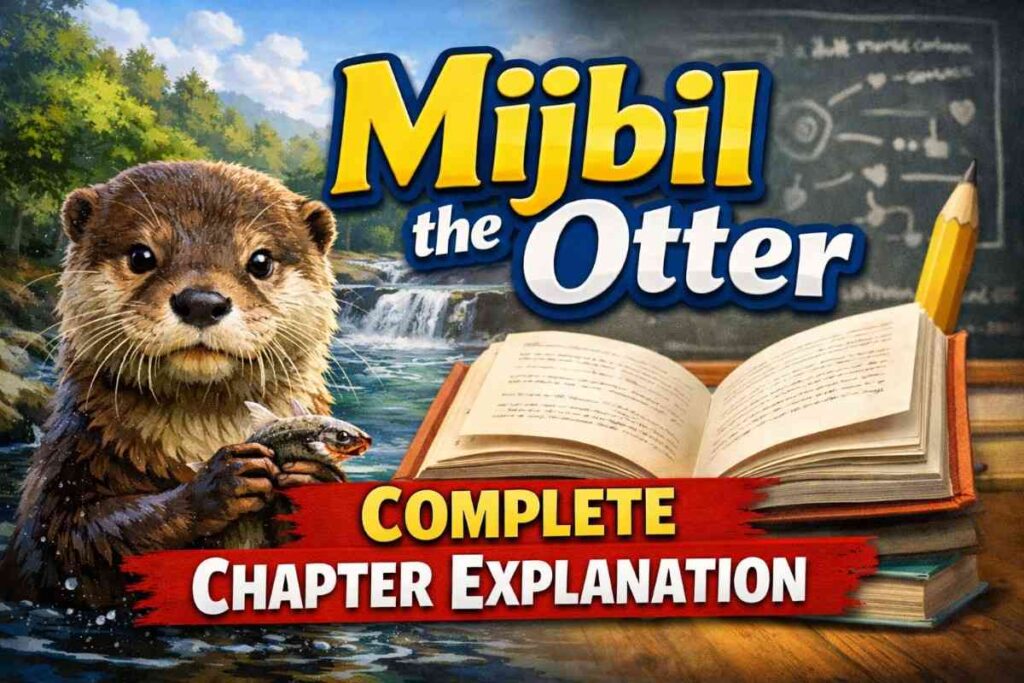
The creature that emerges from the sack is extraordinary. It is covered from head to tail in symmetrical pointed scales of dried mud, which make it look like a small, medieval dragon. Beneath the mud, Maxwell can just about see a soft, chocolate-brown, velvety fur. When the otter shakes itself, Maxwell half expects a cloud of dust — but the mud is so caked on that it takes him a full month to fully clean it off.
He names the otter Mijbil. Scientists later identify it as a species unknown to science at the time, and name it Lutrogale perspicillata maxwelli — or Maxwell’s otter — in his honour.
Mijbil’s Personality — First Days
For the first twenty-four hours, Mijbil is neither hostile (unfriendly) nor warm. He is simply aloof and indifferent — keeping his distance, sleeping on the floor as far from Maxwell’s bed as possible. Maxwell does not force friendship. He simply lets Mijbil be.
On the second night, something shifts. Mijbil quietly climbs onto Maxwell’s bed in the early hours of the morning and sleeps curled in the crook of his knees until morning tea arrives. From this moment, a deep bond begins to grow.
Mijbil and Water
Maxwell puts a body-belt on Mijbil and takes him on a lead to the bathroom. What happens next is unforgettable. Mijbil goes absolutely wild with joy in the water — plunging, rolling, shooting up and down the bathtub underwater, splashing enough to fill the place like a hippo has been bathing.
Maxwell learns something fundamental about otters here: every drop of water must be “extended” — spread around, splashed, moved, used. Water bowls must be overturned. Still water is, to an otter, a waste. Water must be made to do things.
Two days after the bathroom trip, Mijbil escapes from the bedroom on his own and rushes down the corridor to the bathroom. By the time Maxwell gets there, Mijbil is already up on the bathtub, fumbling at the chromium taps with his paws. In less than a minute, he has turned the tap far enough to produce a trickle of water — and moments later, achieves a full flow.
This is a moment of pure delight. An otter, figuring out a tap. Maxwell watches, amazed.
(On later occasions, Mijbil would sometimes turn the tap the wrong way and grow frustrated — chittering with irritation when no water came out.)
Mijbil at Play
Very soon, Mijbil follows Maxwell everywhere without a lead and comes when called. He is playful and inventive. He spends hours dribbling a rubber ball around the room using all four feet, like a four-footed soccer player. He can also throw the ball using a quick, powerful flick of the neck — to a surprising height and distance.
But his favourite game is lying on his back and juggling small objects between his paws. His best toys for this are marbles — he can roll two or more marbles up and down his wide, flat belly without dropping a single one. This image alone — a little otter happily juggling marbles on his tummy — captures everything wonderful about this chapter.
Section III: The Journey to England
The days in Basra pass peacefully, but Maxwell dreads the upcoming journey. He must take Mijbil to England, and then to Camusfearna in Scotland.
The British airline to London refuses to fly animals. So Maxwell books a flight via Paris on a different airline.
The airline insists that Mijbil must be packed into a box no larger than eighteen inches square, to be kept on the floor at Maxwell’s feet.
Maxwell has a box made. An hour before the flight, he puts Mijbil in the box to let him get used to it — then leaves for a hurried meal.
When he returns, he is met with an appalling spectacle (a shocking sight). The box is completely silent. But from its airholes and the gaps around the lid, blood has trickled and dried. Maxwell quickly tears open the box. Mijbil is inside — exhausted, blood-spattered, whimpering. He has torn the lining of the box to shreds trying to escape.
There are only ten minutes until the flight. The airport is five miles away. Maxwell removes the sharp edges from the box, puts a miserable Mijbil back in, and holds down the lid with his hand.
The car drives through Basra “like a ricocheting bullet.” Maxwell is rushed onto the already-waiting aircraft by infuriated officials.
He is lucky — his seat is at the extreme front. He spreads newspapers on the floor, calls the air hostess, and hands her a parcel of fish for Mijbil to eat later. He confides in her about the ordeal of the past half-hour.
The air hostess is wonderful. She suggests that Maxwell might prefer to have his pet on his knee rather than in the box. Maxwell is overjoyed — he could have kissed her hand.
But he is unprepared for what happens next.
Chaos on the Plane
The moment the box is opened, Mijbil is gone in a flash — shooting down the aisle of the aircraft at high speed. Passengers squawk and shriek. A woman stands on her seat screaming: “A rat! A rat!”
Maxwell spots Mijbil’s tail disappearing beneath the legs of a portly (stout) white-turbaned Indian man. He dives for it, misses, and finds his face covered in curry. The air hostess, calm and charming, suggests he return to his seat while she retrieves the otter.
Maxwell sits down. He is craning his neck watching the “hunt” when suddenly, from around his feet, he hears a distressed chitter of recognition — and Mijbil leaps onto his knee, nuzzling his face and neck.
Mijbil has found his way back to his human. It is a beautiful, funny, and deeply moving moment.
Section IV: Life in London
After the eventful journey, Maxwell and Mijbil settle in Maxwell’s London flat for nearly a month.
Mijbil plays for hours with a wonderful assortment of toys — ping-pong balls, marbles, rubber fruit, and a terrapin shell (the shell of a small turtle) that Maxwell had brought from Mijbil’s native Iraqi marshes.
With the ping-pong ball, Mijbil invents his own game. Maxwell has a damaged suitcase whose lid stays on a slope from one end to the other. Mijbil discovers that if he places the ball on the high end, it rolls down to the low end. He then dashes to the other end to ambush the arriving ball — crouching, springing up in mock surprise, grabbing it, and trotting back to the high end to do it all over again. He can keep himself entertained like this for up to half an hour.
Walks in London
Maxwell takes Mijbil for walks on a lead in the London streets, exactly as he would walk a dog.
Mijbil quickly develops what Maxwell calls compulsive habits — repetitive behaviours he must perform on every walk, just like children who must step on every paving block, touch every seventh railing post, or walk around every second lamp post.
Opposite Maxwell’s flat is a single-storey primary school with a low wall about two feet high running along its front. On his way home (but never on the way out), Mijbil would tug Maxwell to the wall, jump up on it, and gallop the full length of its thirty yards — to the absolute distraction of both the pupils and teachers inside.
Londoners and Their Guesses
Here is one of the most humorous parts of the chapter. Maxwell notes, fairly, that it is not strange that the average Londoner would not know what an otter looks like. But the variety of wrong guesses surprises him enormously.
Otters belong to a group of animals called Mustellines — which includes badgers, mongooses, weasels, stoats, minks, and others. People’s guesses covered all these animals but never landed on “otter.” Londoners guessed: a baby seal, a squirrel, a walrus, a hippo, a beaver, a bear cub, a leopard (one that had “changed its spots”), and even a brontosaur (a dinosaur).
But the best question, the one Maxwell awards the highest score, comes from a labourer digging a hole in the street. He sees Maxwell and Mijbil from a distance, puts down his tools, puts his hands on his hips, and stares. As Maxwell approaches, he can see the man’s expression of surprise and affront — as if this is some kind of a joke being played on him.
The man glares and growls: “Here, Mister — what is that supposed to be?”
The italics on “supposed” say everything. He is not just asking what the animal is — he is questioning whether it even ought to exist.
Word Meanings — Every Important Word Explained
Good students learn new vocabulary from every chapter. Here are all the important words from “Mijbil the Otter” explained simply:
| Word / Phrase | Meaning |
|---|---|
| Crossed my mind | A thought came into my mind |
| A stone’s throw | A very short distance |
| Cabled | Sent a message by telegraph (like a telegram) |
| Squirmed | Twisted and wriggled about |
| Thraldom | Being under someone’s control (old-fashioned word) |
| Fixation | A very strong attachment or obsession |
| Medievally-conceived | Imagined in the style of the Middle Ages |
| Christened | Named / given a name |
| Hostile | Unfriendly, showing opposition |
| Aloof and indifferent | Keeping a distance; showing no interest or feeling |
| Apathy | Absence of interest or feeling |
| So to speak | As it were; one could say this |
| Provoking | Causing anger or annoyance |
| Fumbling | Trying to do something in a clumsy way |
| Flick | A quick, light movement |
| Dreaded the prospect | Was in great fear of something that was going to happen |
| An appalling spectacle | A shocking, horrifying scene |
| Whipped off | Quickly removed |
| Ricocheting bullet | A bullet that changes direction after hitting a surface |
| Infuriated | Very angry |
| Took her into my confidence | Shared my private experience or secret with her |
| Portly | Stout / fat |
| Bounded on to | Climbed up quickly |
| Nuzzle | To rub gently with the nose |
| Terrapin shell | The shell of a small turtle found in North America |
| Engrossed | Completely absorbed / interested |
| Ambush | To attack suddenly from a hidden position |
| Compulsive habits | Habits that are impossible to control |
| Upright | A post or rod placed straight up |
| Distraction | Something that takes away attention from what one is doing |
| Barrage of conjectural questions | A stream of questions full of guesses |
Comprehension Questions & Answers
These are the questions from the textbook, answered in the way your teacher expects — clearly, completely, and in your own words.
Oral Comprehension Check — Section I & II
Q1. What “experiment” did Maxwell think Camusfearna would be suitable for?
Maxwell thought that Camusfearna — his cottage in the West Highlands of Scotland, ringed by water — would be a suitable place to keep an otter as a pet, instead of a dog. He considered this an “experiment” because keeping an otter is unusual and he was unsure how it would go.
Q2. Why does he go to Basra? How long does he wait there, and why?
Maxwell goes to Basra with his friend to collect and answer their mail from Europe at the Consulate-General. However, his friend’s mail arrives but his does not. He tries cabling England and booking phone calls, but there are constant delays — a broken telephone line, a religious holiday, another breakdown. He ends up waiting for about ten days in total before his mail arrives.
Q3. How does he get the otter? Does he like it? Pick out the words that tell you this.
Maxwell gets the otter unexpectedly. His friend had sent it as a gift, delivered by two Arab men who arrive in Maxwell’s bedroom with a wriggling sack. The note says: “Here is your otter.”
He clearly grows very fond of it. He describes his attachment as a “thraldom to otters” — a spell he cannot break. He says this bond has “not yet ended, and may, for all I know, not end before I do” — suggesting this otter changed his life entirely.
Q4. Why was the otter named “Maxwell’s otter”?
Mijbil turned out to be a species of otter previously unknown to science. Because Maxwell was the first person to have one and brought it to the attention of zoologists, the species was officially named Lutrogale perspicillata maxwelli — Maxwell’s otter — in his honour.
Q5. In the beginning, the otter was… (tick the right answer)
✅ Aloof and indifferent
For the first twenty-four hours, Mijbil neither showed hostility nor friendliness. He simply kept his distance and chose to sleep as far from Maxwell’s bed as possible.
Q6. What happened when Maxwell took Mijbil to the bathroom? What did it do two days after that?
In the bathroom, Mijbil went wild with joy — plunging, rolling, shooting up and down the bathtub, and splashing enormously. He discovered a great love for water.
Two days later, Mijbil escaped from the bedroom and rushed down the corridor to the bathroom on his own. He got up on the bathtub and began fumbling with the chromium taps. In less than a minute, he managed to turn the tap and produce a full flow of water — showing extraordinary intelligence and problem-solving ability.
Oral Comprehension Check — Section III
Q1. How was Mij to be transported to England?
The British airline would not fly animals. So Maxwell booked a flight to Paris via another airline, and then from Paris to London. The airline required Mijbil to be kept in a box no larger than eighteen inches square, on the floor at Maxwell’s feet.
Q2. What did Mij do to the box?
When Maxwell left Mijbil in the box for about an hour before the flight, Mijbil tried desperately to escape. He tore the lining of the box to shreds. By the time Maxwell returned, blood had trickled from the airholes — Mijbil had injured himself. He was found exhausted, blood-spattered, and whimpering.
Q3. Why did Maxwell put the otter back in the box? How do you think he felt when he did this?
Maxwell had no choice but to put Mijbil back in the box because there were only ten minutes left before the flight and the airport was five miles away. He had to make the flight.
He must have felt deeply guilty, distressed, and heartbroken. The word “miserable” — which he uses to describe Mijbil — also reflects how he himself was feeling.
Q4. Why does Maxwell say the air hostess was “the very queen of her kind”?
The air hostess was extraordinarily kind and understanding. Most people in her position might have been strict or unsympathetic about an unusual animal on a flight. But she listened calmly, understood the situation, suggested that Mijbil could sit on Maxwell’s knee, and even offered to help catch the otter when it escaped. Her calm grace and compassion left a deep impression on Maxwell.
Q5. What happened when the box was opened?
The moment the box was opened, Mijbil shot out at high speed down the aisle of the plane. Passengers panicked — there were screams and shrieks. One woman stood on her seat screaming “A rat! A rat!” Maxwell chased after him, missed, and ended up with his face covered in curry. Eventually, Mijbil found his own way back to Maxwell’s feet and jumped onto his knee.
Oral Comprehension Check — Section IV
Q1. What game had Mij invented?
Mij invented a game using Maxwell’s damaged suitcase whose closed lid remained permanently sloped from one end to the other. Mij would place a ping-pong ball at the high end and watch it roll down to the low end. He would then dash around to the other end to “ambush” the ball — crouching, then springing up in mock surprise to grab it — before carrying it back to the top to start all over again.
Q2. What are “compulsive habits”? What does Maxwell say are the compulsive habits of (i) school children (ii) Mij?
Compulsive habits are behaviours a person (or animal) feels an irresistible urge to repeat — they cannot help doing them.
(i) School children: They must step squarely on the centre of each paving block, touch every seventh upright of iron railings, or pass to the outside of every second lamp post on their way to and from school.
(ii) Mij: On his way home (but never on the way out), Mij would always tug Maxwell to the low wall outside the primary school, jump onto it, and gallop the full thirty-yard length of it — distracting everyone inside.
Q3. What group of animals do otters belong to?
Otters belong to a group of animals called Mustellines, which also includes the badger, mongoose, weasel, stoat, mink, and others.
Q4. What guesses did the Londoners make about what Mij was?
Londoners guessed that Mij was: a baby seal, a squirrel, a walrus, a hippo, a beaver, a bear cub, a leopard (that had changed its spots), and even a brontosaur. None of them guessed correctly that he was an otter.
Thinking About the Text — Deep Answers
Q1. What things does Mij do which tell you that he is an intelligent, friendly and fun-loving animal who needs love?
Mijbil shows his intelligence when he figures out how to turn on a tap — an action that requires observation, memory, and physical problem-solving. He invents his own games (the suitcase ball game, the juggling with marbles), showing creativity and a playful mind.
He shows his friendly nature when he climbs onto Maxwell’s bed on the second night and sleeps curled beside him — a gesture of trust and affection. On the aeroplane, he finds his own way back to Maxwell and nuzzles his face and neck — a clear expression of love.
His need for love is shown by how quickly he bonds with Maxwell and how he responds to being called by name. His distress in the box (tearing it to shreds, crying when the lid is opened) shows that separation from someone he loves is deeply painful.
Q2. What are some of the things we come to know about otters from this text?
From this text we learn that otters love water deeply and instinctively — still water distresses them. They are highly intelligent and can solve problems (like turning a tap). They are playful and inventive. They form strong bonds with their human companions. They have compulsive, repetitive behaviours. They belong to the Mustelline family. They are uncommon in urban environments and not easily recognised. They were once found in large numbers in the marshes near Basra, Iraq.
Q3. Why is Mij’s species now known to the world as Maxwell’s otter?
Mij’s species was completely unknown to zoologists before Maxwell acquired him. It had never been identified or documented by scientists. Because Maxwell was the first person to bring this species to the attention of the scientific world, zoologists named it Lutrogale perspicillata maxwelli — or Maxwell’s otter — as a tribute to him.
Thinking About Language — Grammar Made Simple
Part I: “Would” and “Used to” — Describing Past Habits
This is one of the most important grammar points in this chapter for your Class 10 English exam.
When we want to describe something that happened regularly in the past but does not happen anymore, we use either “would” or “used to”.
Both “would” and “used to” can describe repeated actions in the past:
- Mij would follow me without a lead.
- He would play for hours with toys.
- I used to follow my brother all over the place.
However — and this is crucial — only “used to” can describe past states or situations. You cannot use “would” with state verbs like be, have, believe, know, like, love, want.
Examples:
- ✅ We used to believe there were ghosts in school. (belief = state of mind)
- ❌ We would believe there were ghosts in school. (WRONG)
- ✅ Thirty years ago, more women used to be housewives. (situation)
- ❌ Thirty years ago, more women would be housewives. (WRONG)
Exercise answers from the textbook table:
| Subject | Would/Used to | Action/State |
|---|---|---|
| Emperor Akbar | used to be | fond of musical evenings (state) |
| Every evening we | would take | long walks on the beach (action) |
| Fifty years ago, very few people | used to own | cars (situation) |
| Till the 1980s, Shanghai | used to have | very dirty streets (situation) |
| My uncle | would spend | his holidays by the sea (action) |
Part II: Noun Modifiers
A modifier is a word that gives more information about a noun. Usually adjectives do this, but nouns themselves can also modify other nouns.
Examples of adjectives as modifiers:
- An eminently suitable spot — “eminently suitable” describes the spot
- His wide, flat belly — adjectives modify the noun “belly”
Examples of nouns as modifiers:
- The dinner party — “dinner” is a noun modifying “party”
- A designer dress — “designer” is a noun modifying “dress”
- The car keys — “car” is a noun modifying “keys”
Answers from textbook exercise (Part II, Question 1):
| Phrase | Type of Modifier |
|---|---|
| An otter fixation | Noun |
| The iron railings | Noun |
| The Tigris marshes | Proper Noun |
| The London streets | Proper Noun |
| Soft velvet fur | Adjective + Noun |
| A four-footed soccer player | Adjective + Noun |
Part III: Quantity Phrases
Maxwell writes: “He shook himself, and I half expected a cloud of dust.”
A cloud of dust tells us about a large, diffused quantity of something not usually countable. English has many such phrases:
| Phrase | Used With |
|---|---|
| A portion of | fried fish, food |
| A pool of | water, blood |
| Flakes of | snow, cotton |
| A huge heap of | stones |
| A gust of | wind |
| Little drops of | blood, water |
| A piece of | gold, paper, cotton |
| A pot of | water, coffee |
Exercise answers (Part III, Question 2):
- (ii) Can you give me a lump of clay, please.
- (iii) The piece of information you gave was very useful.
- (iv) Because of these factories, a cloud of smoke hangs over the city.
- (v) Two stones rubbed together can produce sparks of fire.
- (vi) He gave me a bunch of flowers on my birthday.
Key Themes of the Chapter
Understanding the themes will help you write excellent long-answer questions and essays.
1. The Joy of an Unexpected Bond Maxwell did not plan to get an otter. The otter arrived as a surprise gift. Yet within days, it changed his life entirely. This teaches us that some of the most meaningful relationships in life are unplanned.
2. Responsibility in Keeping a Pet The chapter subtly shows what it means to truly care for an animal. Maxwell makes a body-belt for Mijbil. He takes him on walks. He figures out what he loves (water, play, marbles). He worries about transporting him safely. Care is not just feeding — it is attention, observation, and respect.
3. Animal Intelligence and Personality Gavin Maxwell portrays Mijbil not as a “dumb animal” but as a being with his own personality, preferences, quirks, and emotions. Mijbil is intelligent (he figures out taps), creative (he invents games), loving (he nuzzles Maxwell on the plane), and stubborn (he develops compulsive habits). This asks us to reconsider how we think about non-human animals.
4. The Humour of Everyday Life The chapter is genuinely funny — the chaos on the aeroplane, the Londoners’ guesses, the labourer’s unforgettable question. Maxwell uses humour as a way of sharing warmth, not mockery. Life is absurd and wonderful, and a good writer captures both.
5. Loneliness and Companionship The chapter begins with Maxwell lonely after his dog’s death. The otter fills that void. This is a quiet but powerful theme — the profound need, in both humans and animals, for love and company.
Character Sketch: Gavin Maxwell
Maxwell is a thoughtful, patient, and deeply observant man. He does not force friendship on Mijbil — he waits for the otter to come to him. He is gentle and responsible. He worries about Mijbil’s wellbeing on the flight and feels genuine guilt at having to put him back in the box. His admiration for the air hostess is expressed with warmth and gratitude.
As a writer, he is gifted. He brings Mijbil alive on the page through precise, loving observation. His language is vivid but never overdone. He is funny without being cruel, emotional without being sentimental.
Character Sketch: Mijbil (Mij)
Mijbil is one of the most endearing characters in the entire Class 10 syllabus — and he is an otter. He begins as a mystery (the mud-caked creature from the sack) and grows into a full personality. He is cautious at first, then trusting. He is intelligent, inventive, loving, playful, and occasionally maddening. He hates being confined. He loves water unconditionally. He finds his own way back to Maxwell on the aeroplane. He is, in every meaningful sense of the word, a character.
Exam Tips: What to Focus On
Here is what often comes in Class 10 English exams from this chapter:
- Short answer questions: Describe Mijbil’s behaviour in the bathroom. / What happened on the aeroplane?
- Long answer questions: How does Maxwell show that Mijbil is an intelligent and loving animal? / What qualities of the air hostess does Maxwell admire?
- Grammar: Would vs. Used to (fill in the blank exercises) / Noun modifiers / Quantity phrases
- Vocabulary: Definitions of “thraldom,” “aloof,” “apathy,” “compulsive habits,” “barrage of conjectural questions”
- Themes: Human-animal bond / Responsibility of pet ownership
A Final Thought: What This Chapter Really Teaches
At its heart, “Mijbil the Otter” is about paying attention. Maxwell pays attention to Mijbil — every flick of his tail, every game he invents, every expression of joy or frustration. And because he pays attention, he sees a whole world in one small creature.
This is what great writing does. It teaches us to look more carefully at the ordinary world around us and find it extraordinary.
The next time you see a stray cat washing its face, a dog chasing a leaf, or a bird tilting its head at you — pay attention. You might be looking at a story.
Call to Action
Did this guide help you understand “Mijbil the Otter” better? Share it with a classmate who might be struggling with the chapter — because learning is always better when it is shared.
If you found this helpful, explore guides for other chapters in the First Flight Class 10 textbook. And remember — the goal of reading English is not just to pass an exam. It is to learn to see the world with a little more wonder.
Good luck with your studies. 📖
Written as a complete classroom resource for Class 10 NCERT English students. All content is based on the NCERT First Flight textbook, Chapter 8 — Mijbil the Otter by Gavin Maxwell.