
📌 Bookmark this page. This is your complete French classroom — come back to it every day. No teacher. No expensive course. Just you, this guide, and your willingness to learn.
Why Learn French? (And Why It’s Easier Than You Think)
Let’s start with the most important question: Why should YOU learn French?
Here are real, life-changing reasons:
French is Spoken by 300 Million People Worldwide
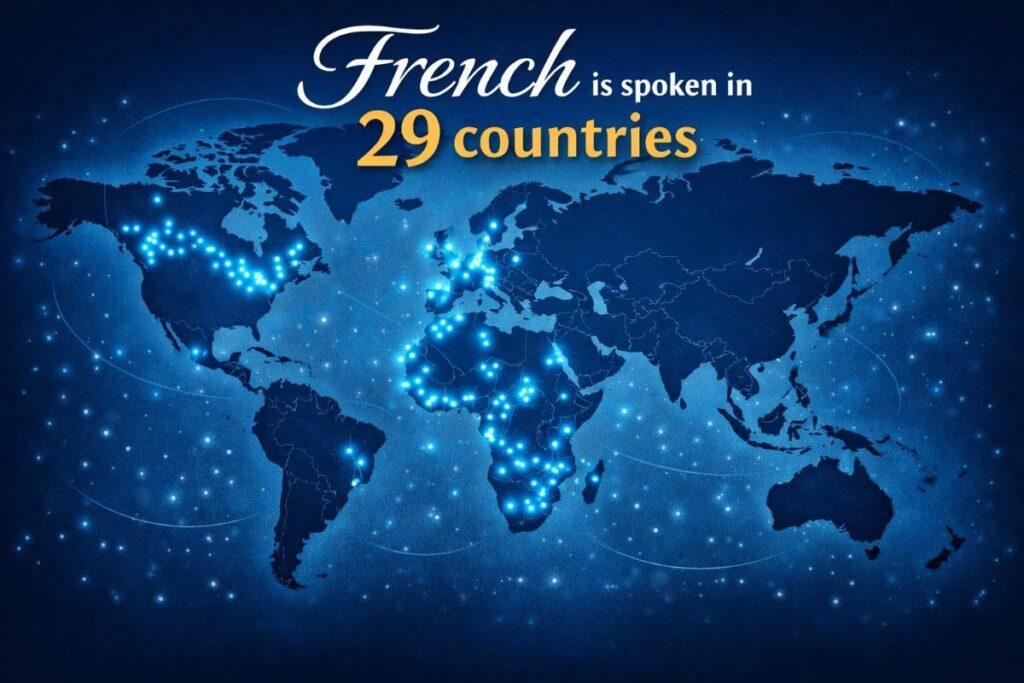
French isn’t just spoken in France. It’s the official language of 29 countries including:
- 🇫🇷 France (of course!)
- 🇨🇦 Canada (especially Quebec)
- 🇧🇪 Belgium
- 🇨🇭 Switzerland
- 🇨🇮 Ivory Coast, Senegal, Madagascar (Africa!)
- 🇭🇹 Haiti
So learning French opens doors across 5 continents.
French is the Language of Beauty, Food, Fashion & Art
Every time you say “café,” “ballet,” “chef,” “restaurant,” “fiancé,” or “croissant” in English — you’re already speaking French! That’s right. English has borrowed thousands of French words. This means you already know more French than you think.
French Boosts Your Career
French is one of the official languages of the United Nations, the EU, the Olympic Committee, and NATO. Knowing French can give you a huge competitive edge in international careers.
French Makes Learning Other Languages Easier
Once you know French, learning Spanish, Italian, Portuguese, and Romanian becomes much, much easier because they all belong to the same language family.
Is French Hard to Learn for English Speakers?
No! And here’s the secret: English and French share roughly 30% of their vocabulary. That means thousands of English words are almost identical in French. You’ll see this throughout this guide.
How English and French Are Already Connected
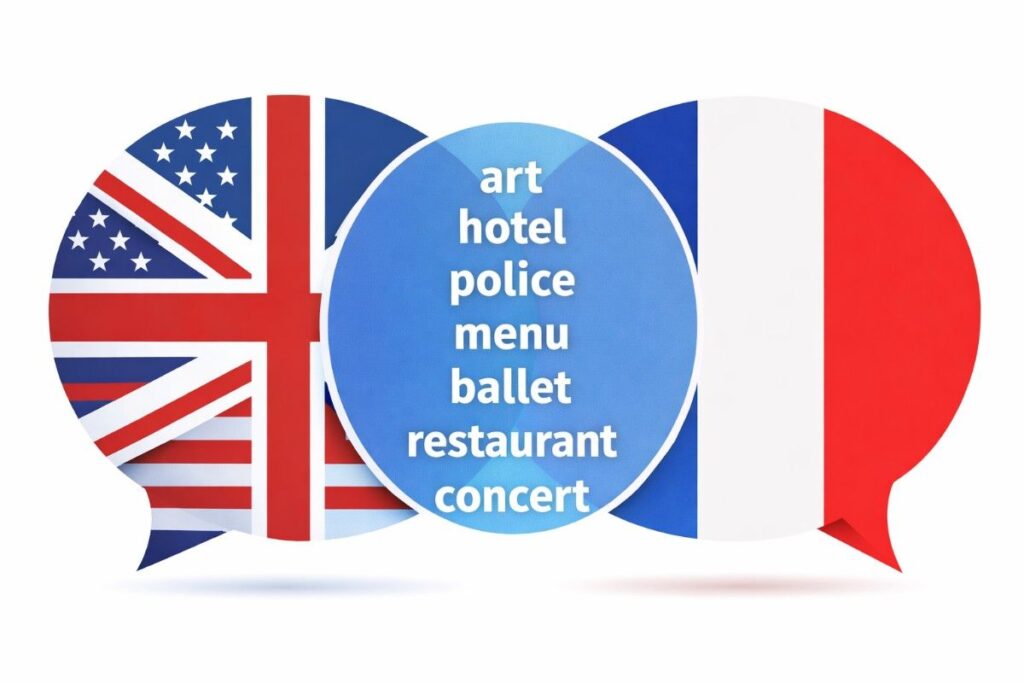
This is the most exciting secret in language learning. You already speak some French without knowing it.
After the Norman Conquest of England in 1066, French became the language of the English royal court for nearly 300 years. This is why English absorbed so many French words.
Words That Are Identical in English and French:
| English | French | Pronunciation in French |
|---|---|---|
| hotel | hôtel | oh-TEL |
| police | police | poh-LEES |
| art | art | ar |
| animal | animal | ah-nee-MAL |
| restaurant | restaurant | res-toh-RAHN |
| concert | concert | kohn-SAIR |
| ballet | ballet | ba-LAY |
| café | café | ka-FAY |
| menu | menu | meh-NEW |
| nature | nature | na-TYUR |
| culture | culture | kul-TUR |
| zone | zone | zohn |
| rose | rose | rohz |
| radio | radio | ra-dee-OH |
| tiger | tigre | TEE-gruh |
Words That Are Almost the Same:
| English | French |
|---|---|
| nation | nation |
| possible | possible |
| information | information |
| invitation | invitation |
| observation | observation |
| important | important |
| excellent | excellent |
| intelligent | intelligent |
| different | différent |
| natural | naturel |
| general | général |
| special | spécial |
| normal | normal |
| modern | moderne |
The Pattern: Most English words ending in -tion, -able, -ible, -ment, -ent, -ant, -al, -ous have French equivalents that look almost identical!
💡 Quick Tip: Every time you see an English word ending in -tion (like “information”), just say it with a French accent and you have the French word! “Information” in French = information (een-for-mah-SYOHN).
The French Alphabet — From A to Z
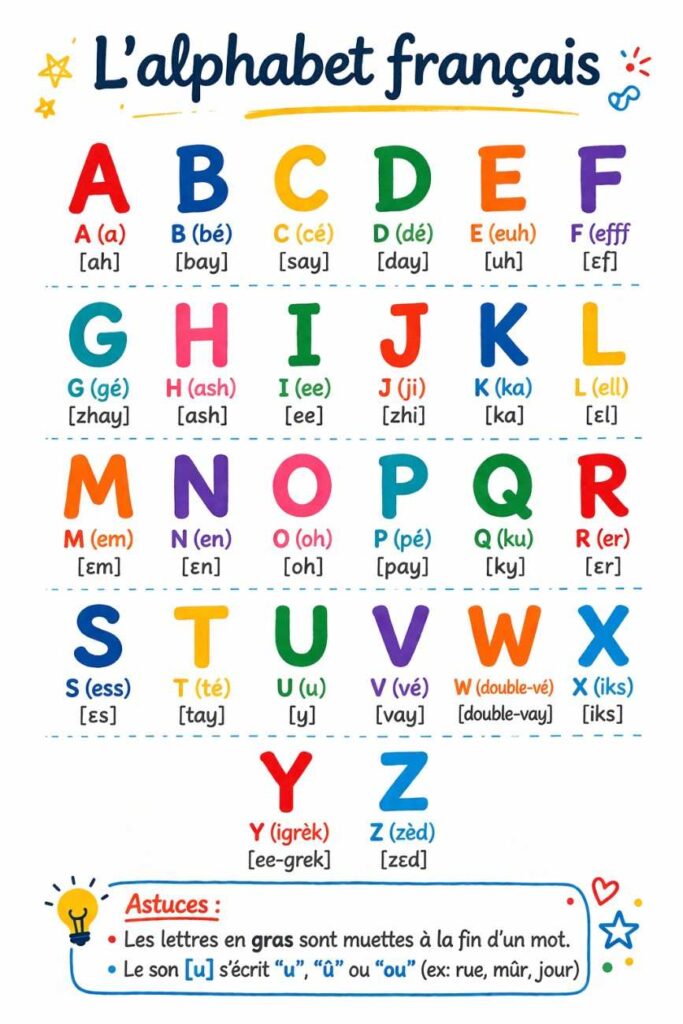
The French alphabet has the same 26 letters as English. But the letters are pronounced differently. Let’s go through each one.
The French Alphabet (How to Say Each Letter)
| Letter | French Name | Say It Like… |
|---|---|---|
| A | ah | “ah” as in “spa” |
| B | bay | “bay” as in “bay leaf” |
| C | say | “say” as in “say hello” |
| D | day | “day” as in “day time” |
| E | euh | a soft “uh” sound |
| F | ef | “ef” |
| G | zhay | “zhay” — French G sounds like the “s” in “measure” |
| H | ash | “ash” — but H is almost SILENT in French! |
| I | ee | “ee” as in “feet” |
| J | zhee | “zhee” — French J sounds like “measure” |
| K | kah | “kah” |
| L | el | “el” |
| M | em | “em” |
| N | en | “en” |
| O | oh | “oh” |
| P | pay | “pay” |
| Q | kew | “kew” |
| R | air | French R is SPECIAL — see pronunciation section! |
| S | es | “es” |
| T | tay | “tay” |
| U | ew | Purse your lips and say “ew” — unique French sound! |
| V | vay | “vay” |
| W | doobluh vay | “double-v” — French borrowed this letter! |
| X | eeks | “eeks” |
| Y | ee-grek | “Greek i” — interesting name! |
| Z | zed | “zed” (like British English) |
🎯 Practice This:
Spell your name out loud using French letter sounds. For example:
- SARA = Es-Ah-Air-Ah
- JOHN = Zhee-Oh-Ash-En
- MIKE = Em-Ee-Kah-Euh
This is exactly how French people spell things out on the phone!
French Pronunciation: How to Say What You See
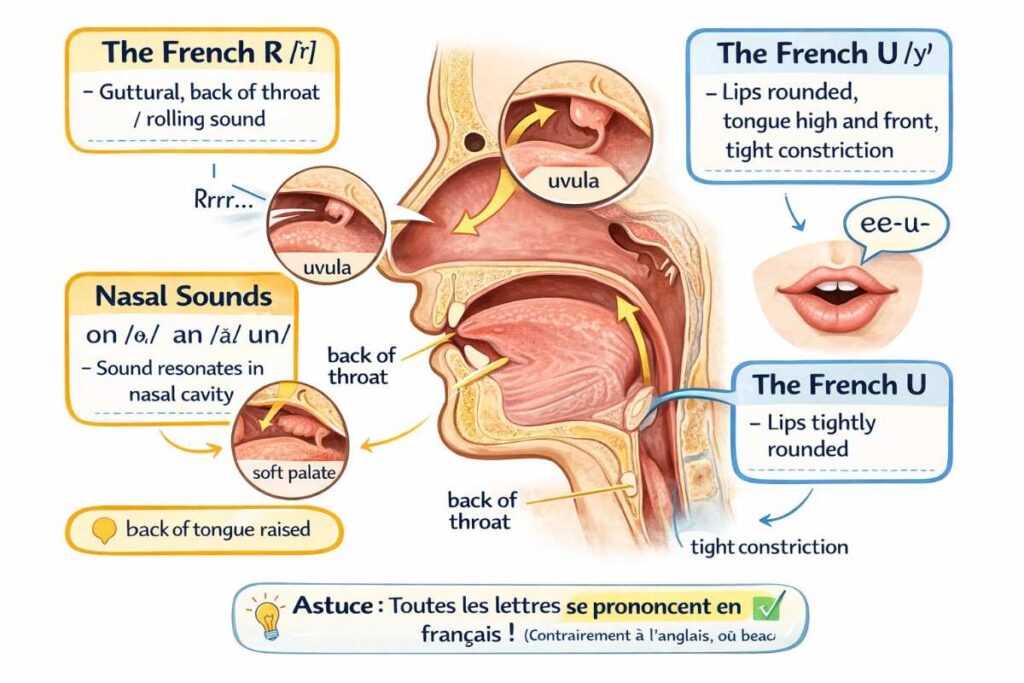
This is the part most beginners fear. But let’s break it down into simple, logical rules.
The Golden Rule of French Pronunciation: French has MANY sounds that don’t exist in English, but once you learn the patterns, they’re always consistent. French is actually MORE regular in pronunciation than English!
(Think about it — in English, “through,” “though,” “tough,” and “cough” all end in “-ough” but sound completely different. French doesn’t do this to you!)
Rule 1: Silent Letters at the End
In French, most final consonants are NOT pronounced.
| Word | Spelling | Pronunciation | Meaning |
|---|---|---|---|
| chat | C-H-A-T | sha | cat |
| petit | P-E-T-I-T | puh-TEE | small |
| grand | G-R-A-N-D | grahn | big |
| vous | V-O-U-S | voo | you (formal) |
| Paris | P-A-R-I-S | pa-REE | Paris |
🤯 Mind blown? “Paris” is pronounced “pa-REE” not “PAIR-is”! The S is silent!
Rule 2: The French R
This is THE most iconic French sound. The French R is NOT like the English R. It’s made in the back of your throat, almost like a gentle gargling sound.
How to practice it:
- Say the English word “ugh”
- Now make that sound more musical, less disgusted
- That’s approximately the French R!
Practice words:
- rouge (roozh) — red
- rue (rew) — street
- merci (mair-SEE) — thank you
- bonjour (bohn-ZHOOR) — hello
Rule 3: The French U
The French U sound doesn’t exist in English. It’s spelled “u” and sounds somewhere between “oo” and “ee.”
How to practice:
- Shape your lips to say “oo” (like in “food”)
- While your lips stay in that shape, try to say “ee” (like in “feet”)
- The sound you make is the French U!
Practice:
- tu (tew) — you
- lune (loon) — moon
- rue (rew) — street
- vu (vew) — seen
Rule 4: Nasal Sounds
French has special nasal vowels — sounds made through your nose as well as your mouth. There are 4 main ones:
| Written | Sound | English Approximation | Example |
|---|---|---|---|
| an / en | ahn | Like “on” said with mouth open | France = “frahnss” |
| in / ain | an | Like “can’t” without the t | pain (bread) = “pan” |
| on | ohn | Like “long” without the g | bon = “bohn” |
| un | uhn | Like “fun” said nasally | un (a/one) = “uhn” |
Rule 5: “CH” Sounds Like “SH”
In French, CH makes a “SH” sound, NOT a “CH” sound like in English.
- chocolat = sho-koh-LAH (not “choc-o-lat”)
- chat = sha (cat)
- chercher = shair-SHAY (to search)
Rule 6: “G” Before E or I = Soft Sound
- G before a, o, u = hard G (like “go”)
- G before e, i = soft ZH sound (like the “s” in “measure”)
Examples:
- gare (gar) — train station [hard G]
- Gilles (zheel) — a name [soft ZH]
- général (zhay-nay-RAL) — general [soft ZH]
Rule 7: “Liaison” — When Silent Letters Wake Up
Here’s a beautiful quirk of French: when a word ends in a normally-silent consonant and the NEXT word begins with a vowel, that consonant suddenly becomes pronounced and links the two words together. This is called liaison.
- les amis = “lay-za-MEE” (the friends) — the S in “les” wakes up!
- vous avez = “voo-za-VAY” (you have) — the S in “vous” wakes up!
- un enfant = “uhn-nahn-FAHN” (a child) — the N in “un” wakes up!
The Magic Sounds of French — Accents
French uses accent marks on letters. These aren’t decoration — they actually change how you pronounce words or distinguish meaning between words that look the same.
The 5 French Accents
1. É — Accent Aigu (Accent Pointing Right ↗) Only appears on “e”. Makes the sound “ay” (like “hey” without the H).
- café = ka-FAY
- étudiant = ay-tew-DYAHN (student)
2. È — Accent Grave (Accent Pointing Left ↖) Appears on e, a, u. On “e”, it makes an open “eh” sound.
- père = pair (father)
- très = treh (very)
3. Ê — Accent Circonflexe (The “Hat” ^) Appears on all vowels. Usually makes the vowel longer or more open. Historically, it shows that an “s” used to follow (which is why English cognates often have “s”!)
- forêt = fo-RAY (forest → same as English “forest”!)
- île = eel (island → “isle”!)
- fête = fet (party/festival → English “festival”!)
- hôpital = oh-pee-TAL (hospital → same word!)
4. Ë — Tréma (Diaeresis) Appears on e, i, u. Means the vowel is pronounced separately from the one before it.
- Noël = no-EL (Christmas — each vowel spoken)
- naïf = na-EEF (naive)
5. Ç — Cédille (The Hook Under C) Only under “c”. Makes it sound like “S” instead of “K”.
- français = frahn-SAY (French)
- leçon = luh-SOHN (lesson)
- garçon = gar-SOHN (boy/waiter)
Quick Accent Memory Trick:
Think of É (accent aigu) as pointing up — your voice goes up: “AY!” Think of È (accent grave) as pointing down — your voice opens down: “EH.”
Numbers 0 to 1000 (With Patterns!)
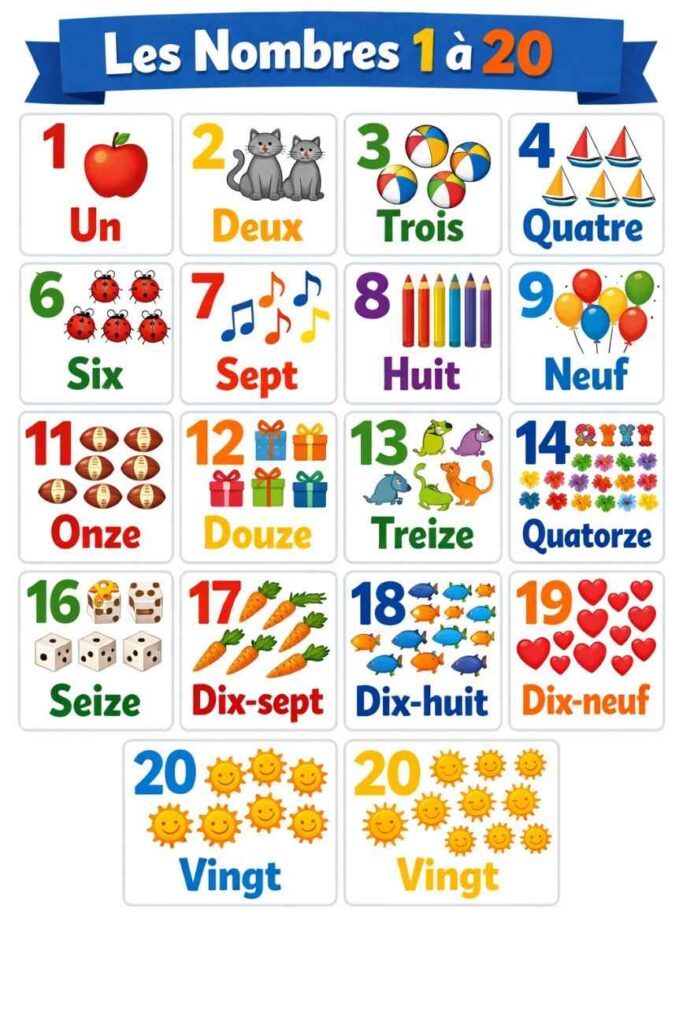
Numbers 0–20 (Learn These By Heart!)
| Number | French | Pronunciation |
|---|---|---|
| 0 | zéro | ZAY-roh |
| 1 | un / une | uhn / oon |
| 2 | deux | duh |
| 3 | trois | twah |
| 4 | quatre | KAT-ruh |
| 5 | cinq | sank |
| 6 | six | sees |
| 7 | sept | set |
| 8 | huit | weet |
| 9 | neuf | nuf |
| 10 | dix | dees |
| 11 | onze | ohnz |
| 12 | douze | dooz |
| 13 | treize | trez |
| 14 | quatorze | ka-TORZ |
| 15 | quinze | kanz |
| 16 | seize | sez |
| 17 | dix-sept | dee-SET |
| 18 | dix-huit | deez-WEET |
| 19 | dix-neuf | deez-NUF |
| 20 | vingt | van |
💡 Notice the Pattern! 17, 18, 19 are literally “10+7”, “10+8”, “10+9” in French! (dix-sept = 10-7, dix-huit = 10-8, dix-neuf = 10-9)
Numbers 20–100
| Number | French | Pattern |
|---|---|---|
| 20 | vingt | (learn) |
| 21 | vingt et un | 20 AND 1 |
| 22 | vingt-deux | 20-2 |
| 30 | trente | (learn) |
| 40 | quarante | (learn) |
| 50 | cinquante | (learn) |
| 60 | soixante | (learn) |
| 70 | soixante-dix | 60+10 ← Wait, WHAT?! |
| 80 | quatre-vingts | 4×20 ← Seriously?! |
| 90 | quatre-vingt-dix | 4×20+10 |
| 100 | cent | sahn |
🤯 French Number Weirdness Explained!
70 = “soixante-dix” literally means “sixty-ten” 80 = “quatre-vingts” literally means “four-twenties”
90 = “quatre-vingt-dix” literally means “four-twenties-ten”This dates back to the Celtic counting system that the Gauls used before the Romans came! Belgium and Switzerland actually use septante (70), huitante (80), and nonante (90) — much simpler! But in France, you get the “math version.”
Practical Number Examples
- My phone number has 10 digits → “Mon numéro a dix chiffres”
- I’m 25 years old → “J’ai vingt-cinq ans”
- The price is 47 euros → “Le prix est quarante-sept euros”
- I live on the 3rd floor → “J’habite au troisième étage”
Ordinal Numbers (1st, 2nd, 3rd…)
| English | French | Abbreviation |
|---|---|---|
| 1st | premier / première | 1er / 1ère |
| 2nd | deuxième | 2ème |
| 3rd | troisième | 3ème |
| 4th | quatrième | 4ème |
| 5th | cinquième | 5ème |
Rule: Add -ième to the end of most numbers! (deux → deuxième, trois → troisième)
Days, Months, and Seasons
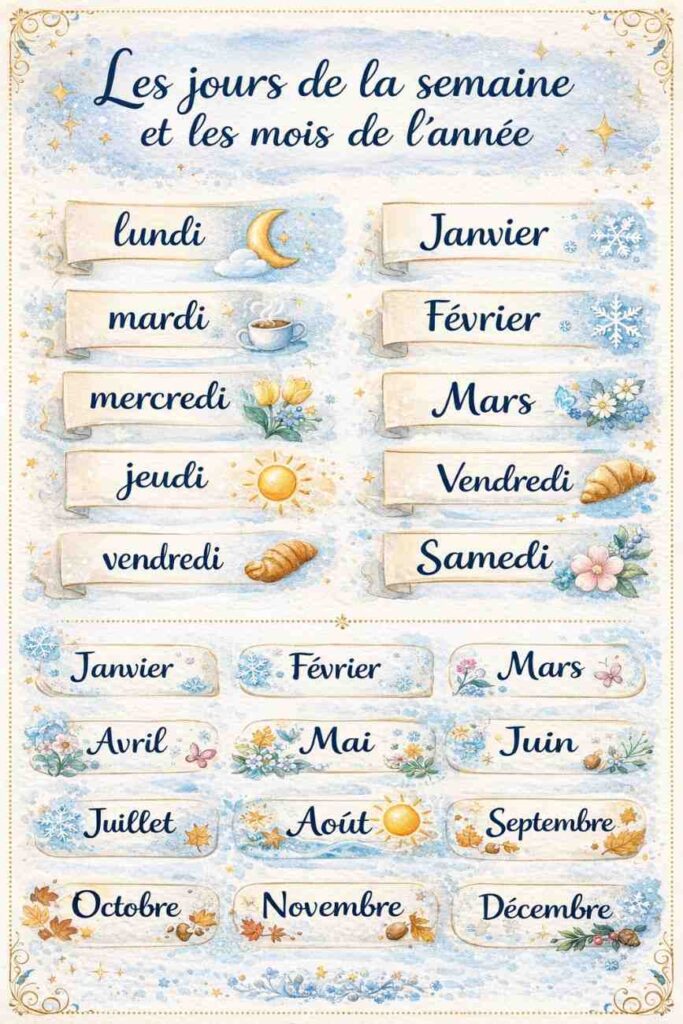
Days of the Week (Les Jours de la Semaine)
🔑 Important: In French, days of the week are NOT capitalized!
| English | French | Pronunciation | Memory Trick |
|---|---|---|---|
| Monday | lundi | LUHN-dee | “Lune” = moon → Moon-day (like English!) |
| Tuesday | mardi | mar-DEE | “Mars” planet = Mars-day (like English “Tuesday” from Tiw/Mars) |
| Wednesday | mercredi | mair-kruh-DEE | “Mercure” = Mercury planet |
| Thursday | jeudi | zhuh-DEE | “Jupiter” planet |
| Friday | vendredi | vahn-druh-DEE | “Vénus” planet |
| Saturday | samedi | SAM-dee | “Sabbath” (religious origin) |
| Sunday | dimanche | dee-MAHNSH | “Dominus” = Lord’s Day |
💡 Cool Fact! Monday through Friday in French are named after the same planets as in English — just in French! Moon, Mars, Mercury, Jupiter, Venus. This is because both languages inherited Roman naming traditions!
Months of the Year (Les Mois de l’Année)
| English | French | Pronunciation |
|---|---|---|
| January | janvier | zhahn-VYAY |
| February | février | fay-VRYAY |
| March | mars | mars |
| April | avril | a-VREEL |
| May | mai | may |
| June | juin | zhwan |
| July | juillet | zhwee-AY |
| August | août | oot |
| September | septembre | sep-TAHM-bruh |
| October | octobre | ok-TOH-bruh |
| November | novembre | no-VAHM-bruh |
| December | décembre | day-SAHM-bruh |
💡 Notice: Most months look almost identical to English! January/janvier, February/février, March/mars, April/avril, September/septembre, October/octobre, November/novembre, December/décembre. You basically already know them!
How to Say Dates in French
French date order: day → month → year (different from American English!)
- March 15, 2024 = le quinze mars 2024
- July 4 = le quatre juillet
- December 25 = le vingt-cinq décembre
Useful Phrases:
- “Today is Monday” = Aujourd’hui c’est lundi (oh-zhoor-DWEE say luhn-dee)
- “What day is it?” = Quel jour sommes-nous? (kel zhoor som-NOO?)
- “What’s today’s date?” = Quelle est la date d’aujourd’hui?
The Four Seasons (Les Quatre Saisons)
| Season | French | Pronunciation | With “in the…” |
|---|---|---|---|
| Spring | printemps | PRAN-tahn | au printemps |
| Summer | été | ay-TAY | en été |
| Autumn | automne | oh-TOHN | en automne |
| Winter | hiver | ee-VAIR | en hiver |
Colors in French
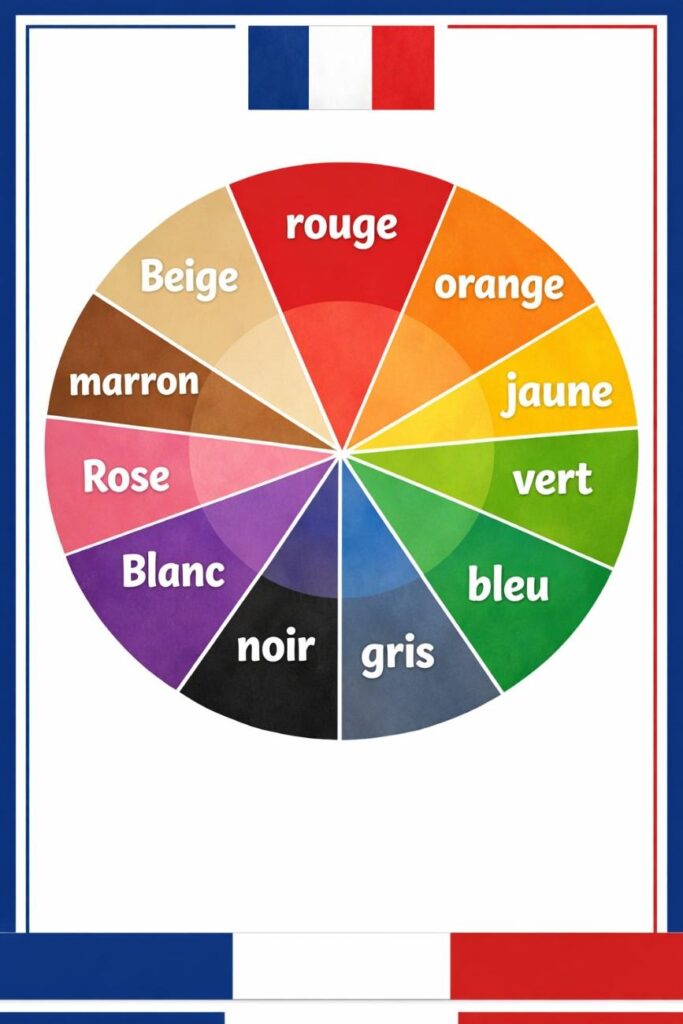
Colors in French have a special rule: they change based on whether the noun is masculine or feminine!
But don’t panic — let’s learn the basic colors first, then the rule.
| Color | French (Masc.) | French (Fem.) | Pronunciation |
|---|---|---|---|
| Red | rouge | rouge | roozh |
| Blue | bleu | bleue | bluh |
| Green | vert | verte | vair / vairt |
| Yellow | jaune | jaune | zhohn |
| Orange | orange | orange | oh-RAHNZH |
| Pink | rose | rose | rohz |
| Purple | violet | violette | vyo-LAY / vyo-LET |
| Black | noir | noire | nwahr |
| White | blanc | blanche | blahn / blahnsh |
| Grey | gris | grise | gree / greez |
| Brown | marron | marron | ma-ROHN |
| Beige | beige | beige | bezh |
The Gender Rule for Colors
In French, every noun is either masculine (m) or feminine (f). Colors must agree with the noun they describe.
Usually, add -e to make a color feminine:
- vert (green, m) → verte (green, f)
- noir (black, m) → noire (black, f)
- bleu (blue, m) → bleue (blue, f)
Real Examples:
- A black cat = un chat noir (chat is masculine)
- A black car = une voiture noire (voiture is feminine)
- A green apple = une pomme verte (pomme is feminine)
- A green bag = un sac vert (sac is masculine)
🧠 Memory Trick: Think of feminine colors as “dressed up” with an extra -e at the end!
Using Colors in Sentences
- My favorite color is blue → Ma couleur préférée est le bleu
- The sky is blue → Le ciel est bleu
- She has red hair → Elle a les cheveux roux (roux = red for hair!)
- What color is your car? → De quelle couleur est ta voiture?
Basic Greetings and Polite Phrases
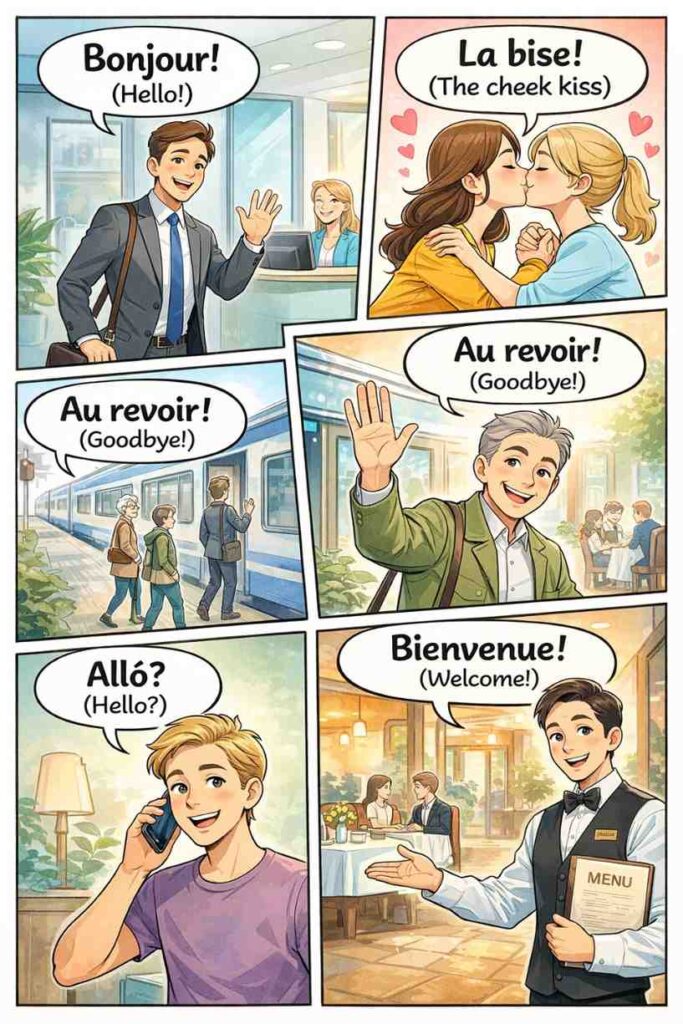
This is the section you’ll use from Day 1. Learn these greetings and you’ll be able to navigate any French interaction!
Hello and Goodbye
| French | Pronunciation | English | When to Use |
|---|---|---|---|
| Bonjour | bohn-ZHOOR | Hello / Good morning | Any time of day (formal & informal) |
| Bonsoir | bohn-SWAHR | Good evening | After about 6pm |
| Bonne nuit | bon-NWEE | Good night | When going to sleep |
| Salut | sa-LEW | Hi / Bye (informal) | With friends your age |
| Coucou | koo-KOO | Hey! (very casual) | With close friends |
| Au revoir | oh ruh-VWAHR | Goodbye | Any situation |
| À bientôt | ah byan-TOH | See you soon | When you expect to meet again |
| À demain | ah duh-MAN | See you tomorrow | When you’ll meet tomorrow |
| À tout à l’heure | ah too-tah-LUHR | See you in a bit | When you’ll meet soon |
Essential Polite Words
| French | Pronunciation | English |
|---|---|---|
| S’il vous plaît | seel voo PLAY | Please (formal) |
| S’il te plaît | seel tuh PLAY | Please (informal) |
| Merci | mair-SEE | Thank you |
| Merci beaucoup | mair-SEE boh-KOO | Thank you very much |
| De rien | duh ryAN | You’re welcome (informal) |
| Je vous en prie | zhuh voo zahn PREE | You’re welcome (formal) |
| Pardon | par-DOHN | Excuse me / Sorry |
| Excusez-moi | ex-kew-zay MWAH | Excuse me (formal) |
| Je suis désolé(e) | zhuh swee day-zo-LAY | I’m sorry |
| Avec plaisir | a-vec play-ZEER | With pleasure |
How Are You? — The Full Range
| French | Pronunciation | English |
|---|---|---|
| Comment allez-vous? | ko-MAHN ta-lay VOO | How are you? (formal) |
| Comment vas-tu? | ko-MAHN va TEW | How are you? (informal) |
| Ça va? | sa VA | How’s it going? (very casual) |
| Très bien, merci! | tray BYAN mair-SEE | Very well, thank you! |
| Bien, merci. | BYAN mair-SEE | Fine, thank you. |
| Pas mal. | pa MAL | Not bad. |
| Comme ci, comme ça. | kom-SEE kom-SA | So-so. |
| Pas très bien. | pa tray BYAN | Not very well. |
| Et vous? / Et toi? | ay VOO / ay TWAH | And you? (formal/informal) |
Introducing Yourself
| French | English |
|---|---|
| Je m’appelle… | My name is… |
| Je suis… | I am… |
| J’ai … ans. | I am … years old. |
| Je viens de… | I come from… / I’m from… |
| J’habite à… | I live in… |
| Je parle un peu français. | I speak a little French. |
| Je suis débutant(e). | I’m a beginner. |
| Enchanté(e)! | Nice to meet you! |
| Ravi(e) de vous rencontrer! | Delighted to meet you! |
🎭 Practice Dialogue #1: First Meeting
Marie: Bonjour! Je m’appelle Marie. Et vous?
(Hello! My name is Marie. And you?)You: Bonjour! Je m’appelle [your name]. Enchanté(e)!
(Hello! My name is [your name]. Nice to meet you!)Marie: Vous êtes d’où?
(Where are you from?)You: Je viens de l’Inde. Et vous?
(I’m from India. And you?)Marie: Je suis française, de Paris. Vous parlez très bien français!
(I’m French, from Paris. You speak French very well!)You: Merci beaucoup! Je suis encore débutant(e).
(Thank you very much! I’m still a beginner.)
Pronouns: Me, You, He, She, We, They in French
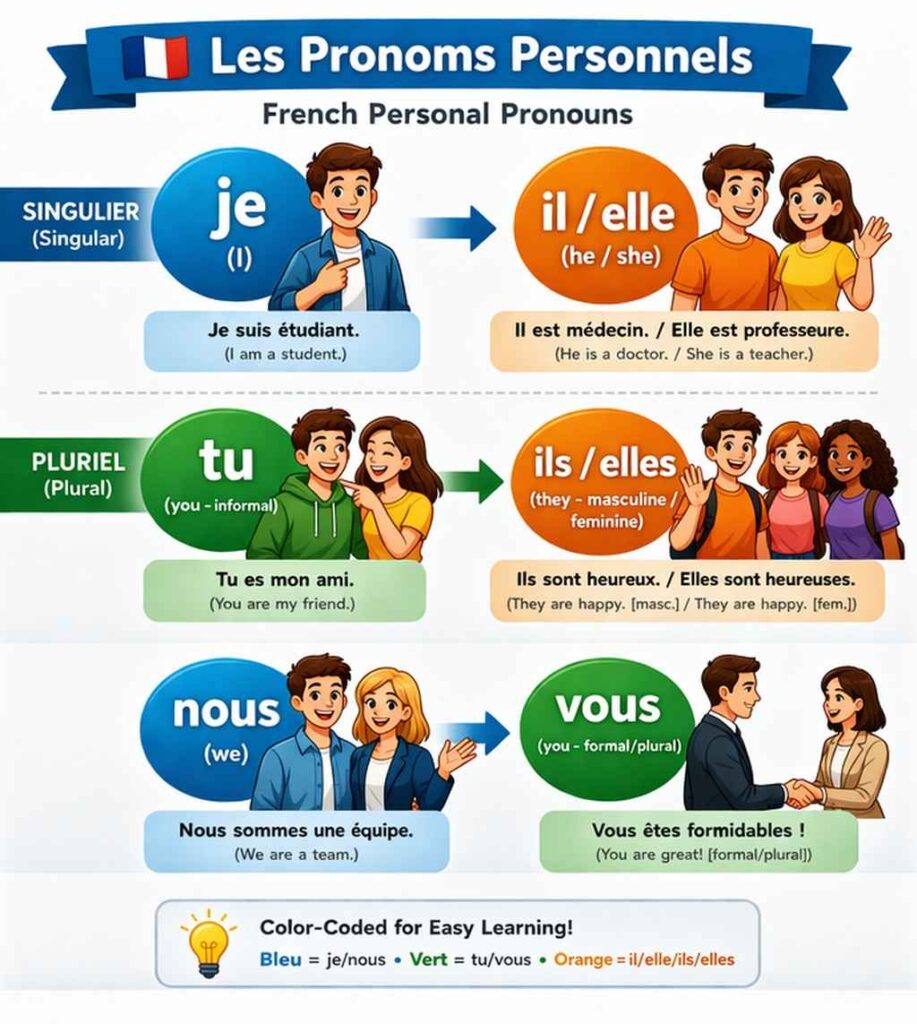
Pronouns are the words that replace nouns (like “he” instead of “John”, “she” instead of “Marie”). These are the building blocks of ALL French sentences.
Subject Pronouns (Who Is Doing the Action)
| French | Pronunciation | English | Notes |
|---|---|---|---|
| je | zhuh | I | Becomes “j'” before a vowel |
| tu | tew | you (singular, informal) | Use with friends, family, children |
| il | eel | he / it (masculine) | |
| elle | el | she / it (feminine) | |
| on | ohn | one / we (informal) | Very commonly used! |
| nous | noo | we | More formal than “on” |
| vous | voo | you (formal OR plural) | Also means “y’all” |
| ils | eel | they (masculine or mixed group) | |
| elles | el | they (feminine only) |
Tu vs. Vous — The Big French Distinction
This is one of the most important social rules in French!
TU = informal “you” (use with):
- Friends your age
- Family members
- Children
- Pets (yes, French people talk to their pets!)
- When asked to use “tu” (“On se tutoie?”)
VOUS = formal/plural “you” (use with):
- Strangers
- Older people
- Teachers, doctors, bosses
- Customers/service situations
- Any time you’re unsure — ALWAYS start with “vous”!
⚠️ Social Warning: Using “tu” with a stranger, especially an older person, in France can be considered rude. When in doubt, use VOUS!
Object Pronouns (Who Receives the Action)
You’ll encounter these, so here’s a preview:
| French | English | Example |
|---|---|---|
| me / m’ | me | Il me parle. (He talks to me.) |
| te / t’ | you | Je te vois. (I see you.) |
| le / la / l’ | him / her / it | Je le vois. (I see him.) |
| nous | us | Il nous aide. (He helps us.) |
| vous | you (pl/formal) | Je vous remercie. (I thank you.) |
| les | them | Je les connais. (I know them.) |
The Two Most Important Verbs: Être & Avoir
If you learn only two verbs in French, make it these. Être (to be) and Avoir (to have) are used in virtually every French sentence and are used to form many other tenses.
ÊTRE — To Be
| Pronoun | French | Pronunciation | English |
|---|---|---|---|
| je | suis | swee | I am |
| tu | es | ay | you are |
| il/elle/on | est | ay | he/she/one is |
| nous | sommes | som | we are |
| vous | êtes | et | you are |
| ils/elles | sont | sohn | they are |
Examples:
- Je suis étudiant. → I am a student.
- Tu es intelligent. → You are intelligent.
- Elle est belle. → She is beautiful.
- Nous sommes amis. → We are friends.
- Vous êtes professeur? → Are you a teacher?
- Ils sont fatigués. → They are tired.
AVOIR — To Have
| Pronoun | French | Pronunciation | English |
|---|---|---|---|
| je | ai | ay | I have |
| tu | as | ah | you have |
| il/elle/on | a | ah | he/she/one has |
| nous | avons | a-VOHN | we have |
| vous | avez | a-VAY | you have |
| ils/elles | ont | ohn | they have |
Examples:
- J’ai un chien. → I have a dog.
- Tu as faim? → Are you hungry? (literally: You have hunger?)
- Il a vingt ans. → He is twenty years old. (literally: He has twenty years)
- Nous avons une maison. → We have a house.
- Vous avez le temps? → Do you have time?
- Ils ont beaucoup d’amis. → They have many friends.
🤔 A Key Difference: Être vs. Avoir for Age
In English: “I am 25 years old.”
In French: “J’ai 25 ans.” (literally: I have 25 years.)
French people “have” their age, not “be” their age! This is one of the most common mistakes English speakers make. Remember: J’ai X ans for age!
🤔 Another Key Difference: Avoir for Feelings
In French, many feelings use AVOIR (to have) where English uses TO BE:
| English (to be) | French (to have) | Literal Translation |
|---|---|---|
| I am hungry | J’ai faim | I have hunger |
| I am thirsty | J’ai soif | I have thirst |
| I am hot | J’ai chaud | I have heat |
| I am cold | J’ai froid | I have cold |
| I am afraid | J’ai peur | I have fear |
| I am right | J’ai raison | I have reason |
| I am wrong | J’ai tort | I have fault |
| I am lucky | J’ai de la chance | I have luck |
How French Sentences Work (Grammar Made Simple)
Basic Sentence Structure: Subject + Verb + Object
Good news! The basic French sentence structure is the same as English:
Subject + Verb + Object
- Je (I) + mange (eat) + une pomme (an apple) → Je mange une pomme. (I eat an apple.)
- Elle (She) + parle (speaks) + français (French) → Elle parle français. (She speaks French.)
- Nous (We) + aimons (love) + Paris (Paris) → Nous aimons Paris. (We love Paris.)
Easy, right? The word order is the same!
The Key Difference: Adjective Placement
In English: adjectives come BEFORE the noun.
- A red apple, a big house, a beautiful girl
In French: most adjectives come AFTER the noun.
- une pomme rouge (an apple red → a red apple)
- une maison grande (a house big → a big house)
BUT some common adjectives come BEFORE the noun (remember with the acronym BAGS):
- Beauty: beau (beautiful), joli (pretty)
- Age: jeune (young), vieux (old), nouveau (new)
- Goodness: bon (good), mauvais (bad), meilleur (better)
- Size: grand (big), petit (small), gros (fat), long (long)
Examples of BAGS adjectives BEFORE the noun:
- un beau garçon (a handsome boy)
- une petite fille (a small girl)
- un vieux homme (an old man)
- une bonne idée (a good idea)
Gender: Every Noun is Masculine or Feminine
This is one of the biggest adjustments for English speakers. In French, every single noun has a gender — either masculine or feminine. There’s no “it” in French!
- A table (la table) is feminine
- A book (le livre) is masculine
- A dog (le chien) is masculine
- A cat (le chat) is masculine, but a female cat (la chatte) is feminine
The Articles (The & A)
| Masculine | Feminine | Plural | |
|---|---|---|---|
| the (definite) | le | la | les |
| a / an (indefinite) | un | une | des |
| some (partitive) | du | de la | des |
Examples:
- le garçon (the boy) — masculine
- la fille (the girl) — feminine
- les enfants (the children) — plural
- un chat (a cat) — masculine
- une maison (a house) — feminine
Elision: Le/La becomes L’ Before Vowels
When a noun starts with a vowel sound, le and la both become l’:
- le + ami → **l’**ami (the friend)
- la + école → **l’**école (the school)
- le + hôtel → **l’**hôtel (the hotel)
Tips for Remembering Noun Genders
Some patterns that are usually masculine:
- Words ending in -ment (le gouvernement, le appartement)
- Days, months, seasons (le lundi, le printemps)
- Languages (le français, le chinois)
Some patterns that are usually feminine:
- Words ending in -tion, -sion (la nation, la passion)
- Words ending in -ure (la nature, la culture)
- Countries ending in -e (la France, la Chine)
- Sciences and academic fields (la biologie, la chimie)
💡 Pro Tip: Always learn a new word WITH its article! Don’t learn “chat” (cat) — learn “le chat.” This way you automatically know the gender!
Family Members in French
| English | French | Pronunciation |
|---|---|---|
| family | la famille | la fa-MEEL |
| father | le père | luh pair |
| mother | la mère | la mair |
| parents | les parents | lay pa-RAHN |
| son | le fils | luh fees |
| daughter | la fille | la fee |
| brother | le frère | luh frair |
| sister | la sœur | la sur |
| grandfather | le grand-père | luh grahn-pair |
| grandmother | la grand-mère | la grahn-mair |
| grandparents | les grands-parents | lay grahn-pa-RAHN |
| uncle | l’oncle | lohnk-luh |
| aunt | la tante | la tahnt |
| cousin (m) | le cousin | luh koo-ZAN |
| cousin (f) | la cousine | la koo-ZEEN |
| husband | le mari | luh ma-REE |
| wife | la femme | la fam |
| baby | le bébé | luh bay-BAY |
| child | l’enfant | lahn-FAHN |
| nephew | le neveu | luh nuh-VUH |
| niece | la nièce | la nyes |
🎭 Talking About Your Family:
- “I have two brothers and one sister.” = J’ai deux frères et une sœur.
- “My mother’s name is ___.” = Ma mère s’appelle ___.
- “My father works in Delhi.” = Mon père travaille à Delhi.
- “I live with my family.” = J’habite avec ma famille.
- “Do you have siblings?” = Tu as des frères et sœurs?
Body Parts in French
| English | French | Pronunciation |
|---|---|---|
| head | la tête | la tet |
| hair | les cheveux | lay shuh-VUH |
| face | le visage | luh vee-ZAZH |
| eye(s) | l’œil / les yeux | luh-Y / lay ZYUH |
| ear(s) | l’oreille / les oreilles | lo-RAY / lay zo-RAY |
| nose | le nez | luh nay |
| mouth | la bouche | la boosh |
| tooth/teeth | la dent / les dents | la dahn / lay dahn |
| lip(s) | la lèvre / les lèvres | la lev-ruh |
| tongue | la langue | la lahng |
| neck | le cou | luh koo |
| shoulder | l’épaule | lay-POHL |
| arm | le bras | luh bra |
| elbow | le coude | luh kood |
| hand | la main | la man |
| finger | le doigt | luh dwah |
| chest | la poitrine | la pwah-TREEN |
| back | le dos | luh doh |
| stomach | le ventre / l’estomac | luh vahn-truh |
| leg | la jambe | la zhahmb |
| knee | le genou | luh zhuh-NOO |
| foot/feet | le pied / les pieds | luh pyay |
| toe | l’orteil | lor-TAY |
| heart | le cœur | luh kuhr |
| skin | la peau | la poh |
| blood | le sang | luh sahn |
Useful Body Part Phrases:
- “My head hurts.” = J’ai mal à la tête. (I have hurt at the head)
- “I have a stomachache.” = J’ai mal au ventre.
- “My back hurts.” = J’ai mal au dos.
- “She broke her arm.” = Elle s’est cassé le bras.
- “Can you wash your hands?” = Tu peux te laver les mains?
Common Everyday Verbs
French verbs follow patterns. Once you know the pattern, you can conjugate hundreds of verbs! Most French verbs belong to one of three groups.
Group 1: -ER Verbs (The Most Common Group)
Take the infinitive, remove -ER, and add these endings:
| Pronoun | Ending | Example: PARLER (to speak) |
|---|---|---|
| je | -e | je parle |
| tu | -es | tu parles |
| il/elle/on | -e | il/elle parle |
| nous | -ons | nous parlons |
| vous | -ez | vous parlez |
| ils/elles | -ent | ils/elles parlent |
Common -ER Verbs:
| French | English | Conjugation (je…) |
|---|---|---|
| parler | to speak | je parle |
| manger | to eat | je mange |
| aimer | to love/like | j’aime |
| habiter | to live | j’habite |
| travailler | to work | je travaille |
| étudier | to study | j’étudie |
| regarder | to watch | je regarde |
| écouter | to listen | j’écoute |
| chercher | to search | je cherche |
| trouver | to find | je trouve |
| donner | to give | je donne |
| penser | to think | je pense |
| acheter | to buy | j’achète |
| arriver | to arrive | j’arrive |
| entrer | to enter | j’entre |
| quitter | to leave | je quitte |
| chanter | to sing | je chante |
| danser | to dance | je danse |
| jouer | to play | je joue |
| marcher | to walk | je marche |
Group 2: -IR Verbs
Remove -IR, add these endings:
| Pronoun | Ending | Example: FINIR (to finish) |
|---|---|---|
| je | -is | je finis |
| tu | -is | tu finis |
| il/elle/on | -it | il/elle finit |
| nous | -issons | nous finissons |
| vous | -issez | vous finissez |
| ils/elles | -issent | ils finissent |
Common -IR Verbs:
- finir (to finish), choisir (to choose), grandir (to grow up), réfléchir (to think/reflect)
Irregular Verbs (Learn Them By Heart!)
Some very common verbs are completely irregular. You must memorize these:
ALLER — To Go
| je vais | tu vas | il/elle va |
|---|---|---|
| nous allons | vous allez | ils/elles vont |
VENIR — To Come
| je viens | tu viens | il/elle vient |
|---|---|---|
| nous venons | vous venez | ils/elles viennent |
FAIRE — To Do / To Make
| je fais | tu fais | il/elle fait |
|---|---|---|
| nous faisons | vous faites | ils/elles font |
PRENDRE — To Take
| je prends | tu prends | il/elle prend |
|---|---|---|
| nous prenons | vous prenez | ils/elles prennent |
POUVOIR — To Be Able To / Can
| je peux | tu peux | il/elle peut |
|---|---|---|
| nous pouvons | vous pouvez | ils/elles peuvent |
VOULOIR — To Want
| je veux | tu veux | il/elle veut |
|---|---|---|
| nous voulons | vous voulez | ils/elles veulent |
SAVOIR — To Know (a fact)
| je sais | tu sais | il/elle sait |
|---|---|---|
| nous savons | vous savez | ils/elles savent |
Food and Drinks in French
The Basics
| English | French | Pronunciation |
|---|---|---|
| food | la nourriture | la noo-ree-TYUR |
| drink | la boisson | la bwa-SOHN |
| breakfast | le petit-déjeuner | luh puh-tee day-zhuh-NAY |
| lunch | le déjeuner | luh day-zhuh-NAY |
| dinner | le dîner | luh dee-NAY |
| snack | le goûter / le snack | luh goo-TAY |
| meal | le repas | luh ruh-PA |
| hunger | la faim | la fan |
| thirst | la soif | la swaf |
Common Foods
| English | French |
|---|---|
| bread | le pain |
| baguette | la baguette |
| croissant | le croissant |
| butter | le beurre |
| cheese | le fromage |
| egg(s) | l’œuf / les œufs |
| meat | la viande |
| chicken | le poulet |
| beef | le bœuf |
| fish | le poisson |
| rice | le riz |
| pasta | les pâtes |
| soup | la soupe |
| salad | la salade |
| vegetable | le légume |
| fruit | le fruit |
| apple | la pomme |
| banana | la banane |
| strawberry | la fraise |
| tomato | la tomate |
| potato | la pomme de terre |
| carrot | la carotte |
| chocolate | le chocolat |
| cake | le gâteau |
| ice cream | la glace |
| sugar | le sucre |
| salt | le sel |
| pepper | le poivre |
Common Drinks
| English | French |
|---|---|
| water | l’eau |
| coffee | le café |
| tea | le thé |
| milk | le lait |
| juice | le jus |
| orange juice | le jus d’orange |
| wine | le vin |
| red wine | le vin rouge |
| white wine | le vin blanc |
| beer | la bière |
| soda | le soda / la limonade |
Expressing Food Preferences
- “I like coffee.” = J’aime le café.
- “I love cheese!” = J’adore le fromage!
- “I don’t like fish.” = Je n’aime pas le poisson.
- “I’m vegetarian.” = Je suis végétarien(ne).
- “I’m allergic to nuts.” = Je suis allergique aux noix.
- “This is delicious!” = C’est délicieux!
- “It’s too spicy.” = C’est trop épicé.
- “Can I have more?” = Je peux en avoir plus?
At the Restaurant: Real Conversation Practice
This is a complete, realistic restaurant dialogue you can actually use!
The Full Restaurant Experience
Arriving:
- Waiter: “Bonjour! Vous avez une réservation?”
- (Hello! Do you have a reservation?)
- You: “Bonjour! Oui, au nom de [your name].” / “Non, c’est possible d’avoir une table pour deux?”
- (Hello! Yes, under the name [your name].) / (No, is it possible to have a table for two?)
Getting Seated:
- Waiter: “Par ici, s’il vous plaît.”
- (This way, please.)
- You: “Merci.” (Thank you.)
Ordering Drinks:
- Waiter: “Qu’est-ce que vous voulez boire?”
- (What would you like to drink?)
- You: “Je voudrais une carafe d’eau, s’il vous plaît.” / “Un verre de vin rouge, s’il vous plaît.”
- (I would like a carafe of water, please.) / (A glass of red wine, please.)
Reading the Menu:
- Waiter: “Vous avez choisi?”
- (Have you chosen? / Are you ready to order?)
- You: “Pas encore. Je peux avoir encore un moment?”
- (Not yet. Can I have another moment?)
- Or: “Oui! Je voudrais le poulet rôti, s’il vous plaît.”
- (Yes! I would like the roasted chicken, please.)
Special Requests:
- “Sans oignons, s’il vous plaît.” (Without onions, please.)
- “Est-ce que c’est sans gluten?” (Is this gluten-free?)
- “Qu’est-ce que vous recommandez?” (What do you recommend?)
- “Quel est le plat du jour?” (What is the dish of the day?)
During the Meal:
- “C’est excellent!” (It’s excellent!)
- “Je pourrais avoir du pain?” (Could I have some bread?)
- “L’addition, s’il vous plaît!” (The bill, please!)
Paying:
- Waiter: “Ça a été?” (Was everything okay?)
- You: “Oui, c’était délicieux! L’addition, s’il vous plaît.”
- (Yes, it was delicious! The bill, please.)
- “On peut payer par carte?” (Can we pay by card?)
- “Gardez la monnaie.” (Keep the change.)
Key Restaurant Vocabulary
| French | English |
|---|---|
| la carte / le menu | the menu |
| l’entrée | the starter/appetizer |
| le plat principal | the main course |
| le dessert | dessert |
| l’addition | the bill |
| le pourboire | the tip |
| la réservation | reservation |
| une table pour deux | a table for two |
| bien cuit | well done (meat) |
| saignant | rare (meat) |
| à point | medium (meat) |
| végétarien | vegetarian |
Shopping in French
Essential Shopping Phrases
| French | English |
|---|---|
| Combien ça coûte? | How much does it cost? |
| C’est combien? | How much is it? |
| C’est trop cher. | It’s too expensive. |
| Avez-vous quelque chose de moins cher? | Do you have something cheaper? |
| Je cherche… | I’m looking for… |
| Est-ce que vous avez…? | Do you have…? |
| Je fais du [taille]. | I’m a size [size]. |
| Puis-je l’essayer? | Can I try it on? |
| Ça me va bien? | Does it suit me? / Does it fit? |
| Je vais le/la prendre! | I’ll take it! |
| Je peux payer par carte? | Can I pay by card? |
| Vous avez le reçu? | Do you have the receipt? |
| Je voudrais un remboursement. | I would like a refund. |
| Où sont les soldes? | Where are the sales? |
| C’est en solde. | It’s on sale. |
Shopping Vocabulary
| English | French |
|---|---|
| shop / store | la boutique / le magasin |
| supermarket | le supermarché |
| market | le marché |
| bakery | la boulangerie |
| butcher | la boucherie |
| pharmacy | la pharmacie |
| clothes | les vêtements |
| shoes | les chaussures |
| bag | le sac |
| price | le prix |
| discount | la réduction |
| cash | l’argent liquide / le liquide |
| card | la carte (bancaire) |
| receipt | le reçu |
| size (clothing) | la taille |
| size (shoes) | la pointure |
| too big | trop grand |
| too small | trop petit |
| too tight | trop serré |
| too loose | trop large |
Asking for Directions
Getting lost in France is actually an opportunity to practice French!
Asking for Directions
- “Excusez-moi, où est la gare?” (Excuse me, where is the train station?)
- “Comment aller à l’hôtel?” (How do I get to the hotel?)
- “C’est loin d’ici?” (Is it far from here?)
- “Il y a un métro près d’ici?” (Is there a metro near here?)
- “Pouvez-vous me montrer sur la carte?” (Can you show me on the map?)
Understanding the Answer — Direction Words
| French | English |
|---|---|
| tout droit | straight ahead |
| à gauche | to the left |
| à droite | to the right |
| tournez | turn |
| continuez | continue |
| traversez | cross |
| prenez | take |
| au coin de | at the corner of |
| en face de | opposite / across from |
| à côté de | next to / beside |
| devant | in front of |
| derrière | behind |
| entre | between |
| près de | near |
| loin de | far from |
| au bout de | at the end of |
| le carrefour | the crossroads/intersection |
| le feu rouge | the traffic light |
| le pont | the bridge |
🎭 Directions Dialogue:
You: Excusez-moi! Où est la boulangerie la plus proche, s’il vous plaît? (Excuse me! Where is the nearest bakery, please?)
Local: Ah, c’est facile! Allez tout droit, puis tournez à gauche au feu rouge. C’est juste à côté de la pharmacie. (Ah, it’s easy! Go straight ahead, then turn left at the traffic light. It’s right next to the pharmacy.)
You: C’est loin? (Is it far?)
Local: Non, c’est à cinq minutes à pied. (No, it’s five minutes on foot.)
You: Merci beaucoup! (Thank you very much!)
Local: Bonne journée! (Have a good day!)
Telling Time in French
Asking and Telling the Time
- “What time is it?” = Quelle heure est-il? (kel ur ay-TEEL?)
- “It is…” = Il est…
The Basic Time Formula
Il est + [hour] + heure(s) + [minutes]
| Time | French | Literal English |
|---|---|---|
| 1:00 | Il est une heure. | It is one hour. |
| 2:00 | Il est deux heures. | It is two hours. |
| 10:00 | Il est dix heures. | It is ten hours. |
| 12:00 PM | Il est midi. | It is midday. |
| 12:00 AM | Il est minuit. | It is midnight. |
| 3:15 | Il est trois heures et quart. | It is three and a quarter. |
| 3:30 | Il est trois heures et demie. | It is three and a half. |
| 3:45 | Il est quatre heures moins le quart. | It is four minus a quarter. |
| 3:10 | Il est trois heures dix. | It is three ten. |
| 3:50 | Il est quatre heures moins dix. | It is four minus ten. |
Time Vocabulary
| French | English |
|---|---|
| l’heure | the hour / time |
| la minute | the minute |
| la seconde | the second |
| le matin | the morning |
| l’après-midi | the afternoon |
| le soir | the evening |
| la nuit | the night |
| maintenant | now |
| bientôt | soon |
| tard | late |
| tôt | early |
| à l’heure | on time |
| en retard | late |
| en avance | early / ahead of time |
24-Hour Time (Used in France for Official Purposes)
France commonly uses 24-hour time in schedules, transportation, and formal contexts:
- 14h00 = 2:00 PM (quatorze heures)
- 20h30 = 8:30 PM (vingt heures trente)
- The train departs at… = Le train part à…
Emotions and Feelings
| English | French | Pronunciation |
|---|---|---|
| happy | heureux / heureuse | uh-RUH / uh-RUHZ |
| sad | triste | treest |
| angry | en colère | ahn ko-LAIR |
| tired | fatigué(e) | fa-tee-GAY |
| hungry | j’ai faim | zhay fan |
| thirsty | j’ai soif | zhay swaf |
| scared | effrayé(e) | ef-ray-AY |
| surprised | surpris(e) | sur-PREE |
| excited | excité(e) | ex-see-TAY |
| bored | ennuyé(e) | ahn-nwee-AY |
| in love | amoureux / amoureuse | a-moo-RUH |
| proud | fier / fière | fyair |
| embarrassed | gêné(e) | zhay-NAY |
| nervous | nerveux / nerveuse | nair-VUH |
| relaxed | détendu(e) | day-tahn-DEW |
| confused | confus(e) | kohn-FEW |
| lonely | seul(e) | sul |
Expressing Feelings in Sentences
- “I feel happy today.” = Je me sens heureux aujourd’hui.
- “I’m very tired.” = Je suis très fatigué(e).
- “I’m a little nervous.” = Je suis un peu nerveux/nerveuse.
- “Don’t be sad!” = Ne sois pas triste!
- “Are you okay?” = Ça va? / Tu vas bien?
- “I’m fine.” = Je vais bien.
- “I’m not feeling well.” = Je ne me sens pas bien.
Weather and Nature
Talking About Weather
The most common construction is: Il fait + [condition] OR Il + [verb]
| French | English | Structure |
|---|---|---|
| Il fait beau. | The weather is nice. | il fait |
| Il fait mauvais. | The weather is bad. | il fait |
| Il fait chaud. | It is hot. | il fait |
| Il fait froid. | It is cold. | il fait |
| Il fait du soleil. | It’s sunny. | il fait |
| Il fait du vent. | It’s windy. | il fait |
| Il pleut. | It’s raining. | il (verb “pleuvoir”) |
| Il neige. | It’s snowing. | il (verb “neiger”) |
| Il y a des nuages. | There are clouds. | il y a |
| Il y a du brouillard. | It’s foggy. | il y a |
| Il y a de l’orage. | There’s a storm. | il y a |
Weather Vocabulary
| English | French |
|---|---|
| sun | le soleil |
| rain | la pluie |
| snow | la neige |
| wind | le vent |
| cloud | le nuage |
| fog | le brouillard |
| storm | l’orage |
| thunder | le tonnerre |
| lightning | la foudre / les éclairs |
| temperature | la température |
| degree | le degré |
| umbrella | le parapluie |
| raincoat | l’imperméable |
Useful Weather Phrases
- “What’s the weather like?” = Quel temps fait-il?
- “It’s 35 degrees today.” = Il fait 35 degrés aujourd’hui.
- “Should I bring an umbrella?” = Est-ce que je dois prendre un parapluie?
- “I love rainy weather.” = J’aime le temps pluvieux.
- “It’s very cold in winter here.” = Il fait très froid ici en hiver.
At School, Work, and Home
At School (À l’École)
| English | French |
|---|---|
| school | l’école |
| university | l’université |
| classroom | la salle de classe |
| teacher | le professeur / la professeure |
| student | l’étudiant(e) |
| lesson | la leçon / le cours |
| homework | les devoirs |
| test / exam | l’examen / le contrôle |
| grade | la note |
| backpack | le sac à dos |
| pencil | le crayon |
| pen | le stylo |
| book | le livre |
| notebook | le cahier |
| library | la bibliothèque |
| subject | la matière |
| mathematics | les mathématiques |
| history | l’histoire |
| science | les sciences |
| language | la langue |
At Work (Au Travail)
| English | French |
|---|---|
| work | le travail |
| office | le bureau |
| meeting | la réunion |
| colleague | le/la collègue |
| boss | le/la chef(fe) / le patron |
| salary | le salaire |
| job / profession | le métier / la profession |
| le courriel / l’email | |
| computer | l’ordinateur |
| phone | le téléphone |
| deadline | la date limite |
| vacation | les vacances |
| sick leave | le congé maladie |
At Home (À la Maison)
| English | French |
|---|---|
| house | la maison |
| apartment | l’appartement |
| room | la pièce |
| kitchen | la cuisine |
| living room | le salon |
| bedroom | la chambre |
| bathroom | la salle de bain |
| toilet | les toilettes / le WC |
| door | la porte |
| window | la fenêtre |
| table | la table |
| chair | la chaise |
| bed | le lit |
| sofa | le canapé |
| floor | le sol |
| wall | le mur |
| ceiling | le plafond |
| stairs | les escaliers |
Making Questions in French
In French, there are THREE main ways to ask a question. All are correct; they differ in formality.
Method 1: Intonation (Just Raise Your Voice at the End) — Most Casual
Simply take a normal sentence and raise your voice at the end to indicate a question.
- Statement: Tu parles français. (You speak French.)
- Question: Tu parles français ↑? (You speak French?)
This is how French people actually speak casually!
Method 2: Add “Est-ce que” at the Start — Middle Ground
Add “est-ce que” (es-kuh) before any statement to make it a question.
- Est-ce que tu parles français? (Do you speak French?)
- Est-ce que vous avez une chambre libre? (Do you have a free room?)
- **Est-ce qu’**il fait chaud? (Is it hot?)
Note: “est-ce que” becomes “est-ce qu'” before a vowel!
Method 3: Inversion (Flip Verb and Subject) — Most Formal
Swap the verb and the subject pronoun, connect with a hyphen.
- Tu parles → Parles**-tu** français? (Do you speak French?)
- Vous avez → Avez**-vous** une chambre? (Do you have a room?)
- Il est → Est**-il** là? (Is he there?)
💡 When the verb ends in a vowel and the pronoun starts with a vowel, add -t- between them:
- Il parle → Parle**-t-il**? (Does he speak?)
- Elle a → A**-t-elle**? (Does she have?)
The Question Words (Les Mots Interrogatifs)
| Question Word | French | Pronunciation | Example |
|---|---|---|---|
| Who? | Qui? | kee | Qui est-ce? (Who is it?) |
| What? | Qu’est-ce que? / Quoi? | kes-kuh / kwah | Qu’est-ce que tu fais? (What are you doing?) |
| Where? | Où? | oo | Où habitez-vous? (Where do you live?) |
| When? | Quand? | kahn | Quand arrive-t-il? (When does he arrive?) |
| How? | Comment? | ko-MAHN | Comment ça va? (How are you?) |
| Why? | Pourquoi? | poor-KWAH | Pourquoi tu pleures? (Why are you crying?) |
| How many? | Combien? | kohm-BYAN | Combien ça coûte? (How much does it cost?) |
| Which? | Quel / Quelle? | kel | Quel est ton prénom? (What is your first name?) |
Saying “No” — Negation in French
Making negative sentences in French is actually very logical. You create a “sandwich” around the verb!
The Basic Negation: NE…PAS
Formula: Subject + NE + Verb + PAS + Rest of sentence
Think of it as the verb being “trapped” between ne and pas!
| Positive | Negative |
|---|---|
| Je parle français. (I speak French.) | Je ne parle pas français. (I don’t speak French.) |
| Elle mange. (She eats.) | Elle ne mange pas. (She doesn’t eat.) |
| Nous sommes fatigués. (We are tired.) | Nous ne sommes pas fatigués. (We are not tired.) |
| Il aime le café. (He likes coffee.) | Il **n’**aime pas le café. (He doesn’t like coffee.) |
⚠️ Important: Before a vowel, ne becomes n’!
- Je **n’**aime pas… (not “Je ne aime pas”)
In Spoken French: Ne Often Disappears!
In casual spoken French, people very often drop the ne:
- “Je sais pas.” (instead of “Je ne sais pas.”) — I don’t know.
- “C’est pas vrai!” (instead of “Ce n’est pas vrai!”) — That’s not true!
- “J’ai pas le temps.” — I don’t have time.
You should still learn the full form, but don’t be surprised when you hear just pas without ne in everyday conversation!
Other Negation Patterns
| Formula | Meaning | Example |
|---|---|---|
| ne…jamais | never | Je ne mange jamais de viande. (I never eat meat.) |
| ne…rien | nothing | Je ne vois rien. (I see nothing.) |
| ne…personne | nobody | Je ne connais personne ici. (I know nobody here.) |
| ne…plus | no longer / not anymore | Elle ne travaille plus ici. (She no longer works here.) |
| ne…que | only | Je ne parle que français. (I only speak French.) |
Adjectives: Describing Things in French
You’ve already learned that adjectives in French must agree in gender (masculine/feminine) and number (singular/plural) with the noun they describe.
How to Form Feminine Adjectives
General Rule: Add -e to the masculine form
| Masculine | Feminine | English |
|---|---|---|
| petit | petite | small |
| grand | grande | big |
| intelligent | intelligente | intelligent |
| intéressant | intéressante | interesting |
| fatigué | fatiguée | tired |
| français | française | French |
Special Patterns:
| Masculine | Feminine | Pattern | Examples |
|---|---|---|---|
| -eux | -euse | eux→euse | heureux → heureuse |
| -if | -ive | if→ive | actif → active |
| -er | -ère | er→ère | premier → première |
| -ien | -ienne | double n | ancien → ancienne |
| -eau | -elle | eau→elle | beau → belle |
| -ou | -olle | — | fou → folle (crazy) |
Totally Different Forms:
| Masculine | Feminine | English |
|---|---|---|
| bon | bonne | good |
| mauvais | mauvaise | bad |
| long | longue | long |
| blanc | blanche | white |
| sec | sèche | dry |
| doux | douce | soft/gentle |
Making Adjectives Plural
Simply add -s to the end (masculine or feminine):
- petit → petits (small, masculine plural)
- petite → petites (small, feminine plural)
BUT if it already ends in -s or -x, don’t add anything:
- heureux → heureux (stays the same!)
Most Useful Adjectives for Beginners
| French M/F | English |
|---|---|
| grand(e) / petit(e) | big / small |
| beau/belle | beautiful / handsome |
| bon(ne) / mauvais(e) | good / bad |
| chaud(e) / froid(e) | hot / cold |
| nouveau/nouvelle | new |
| vieux/vieille | old |
| jeune | young |
| fort(e) / faible | strong / weak |
| rapide / lent(e) | fast / slow |
| facile / difficile | easy / difficult |
| propre / sale | clean / dirty |
| riche / pauvre | rich / poor |
| content(e) | happy / pleased |
| sympa | nice (informal) |
| gentil(le) | kind |
| drôle | funny |
| intéressant(e) | interesting |
| ennuyeux/ennuyeuse | boring |
| important(e) | important |
| délicieux/délicieuse | delicious |
The French You’ll Hear on the Street (Casual French)
What you learn in textbooks and what French people actually say every day can be quite different! Here’s your guide to real, spoken French.
Everyday Casual Expressions
| Casual French | Formal French | English Meaning |
|---|---|---|
| C’est ouf! | C’est fou! | That’s crazy! (“ouf” is “fou” backwards — French verlan slang!) |
| C’est chelou. | C’est bizarre. | That’s weird. (“chelou” = “louche” backwards) |
| T’as capté? | Tu as compris? | Did you get it/understand? |
| Vas-y! | Allez! | Go on! / Come on! |
| C’est nickel! | C’est parfait! | It’s perfect/great! |
| J’en ai marre! | J’en ai assez! | I’m fed up! |
| C’est nul. | C’est mauvais. | It’s bad/rubbish. |
| Laisse tomber. | N’y pense plus. | Forget it. / Let it go. |
| Carrément! | Absolument! | Absolutely! / Exactly! |
| C’est bon. | Ça suffit / C’est bien. | It’s fine. / That’s enough. |
| Bof… | Je ne sais pas… | Meh… / I don’t know… |
| Ouais | Oui | Yeah |
| Nan | Non | Nah / No |
| T’inquiète! | Ne t’inquiète pas! | Don’t worry! |
Common Expressions You’ll Hear All the Time
| Expression | Meaning | When to Use |
|---|---|---|
| Ça marche! | Okay! / Sounds good! | Agreeing to a plan |
| Bonne continuation! | Keep up the good work! | Saying goodbye when someone is in the middle of something |
| C’est la vie! | That’s life! | When something goes wrong |
| N’importe quoi! | Whatever! / That’s nonsense! | Dismissing something |
| À ta santé! | Cheers! | When drinking |
| Bisous! | Kisses! | End of a message to a friend |
| Qu’est-ce qu’il y a? | What’s wrong? / What is it? | When someone seems upset |
| C’est sympa! | That’s nice! | Responding to good news |
| Pas de problème! | No problem! | Responding to thanks |
| On y va! | Let’s go! | When leaving |
| Attends! | Wait! | Asking someone to wait |
Text Message/Social Media French
| French | English |
|---|---|
| mdr | lol (mort de rire = dying of laughter) |
| ptdr | lmao (pété de rire = bursting out laughing) |
| stp / svp | please (s’il te plaît / s’il vous plaît) |
| tjrs | always/still (toujours) |
| bcp | a lot (beaucoup) |
| tt | everything (tout) |
| qd | when (quand) |
| ke / qu | que (that/what) |
| c | c’est (it is) |
| a+ | see you later (à plus tard) |
10 Mistakes Beginners Make (And How to Avoid Them)
Mistake #1: Saying “Je suis 20 ans”
❌ Wrong: Je suis 20 ans.
✅ Correct: J’ai 20 ans.
Remember: In French, you HAVE your age, not ARE your age!
Mistake #2: Using “Tu” with Strangers
❌ Wrong: Tu t’appelles comment? (to a stranger in a shop)
✅ Correct: Vous vous appelez comment?
Always start with “vous” when meeting someone for the first time or in a formal context.
Mistake #3: Not Making Adjectives Agree
❌ Wrong: une voiture noir
✅ Correct: une voiture noire
Adjectives MUST agree in gender AND number with the noun!
Mistake #4: Saying “Je suis chaud” When You Mean Hot
❌ “Je suis chaud” can sound wrong or imply something inappropriate!
✅ Correct: J’ai chaud. (I’m hot — body temperature feeling)
For weather: Il fait chaud. (It’s hot outside.)
Mistake #5: Forgetting to Make Liaison
❌ Wrong: les amis pronounced “lay amee”
✅ Correct: les amis pronounced “lay-zamee” (the S links to the vowel!)
Mistake #6: Pronouncing the Final Consonant
❌ Wrong: “Paris” pronounced “PAH-ris” (with the S)
✅ Correct: “Paris” pronounced “pah-REE” (silent S)
Most final consonants are silent in French!
Mistake #7: Translating “Very Much Like” Directly
❌ Wrong: J’aime beaucoup le français très beaucoup.
✅ Correct: J’aime beaucoup le français. OR J’aime vraiment le français.
Mistake #8: Using “Sais” and “Connais” Incorrectly
French has TWO verbs for “to know”:
- Savoir = to know a fact, how to do something
- Je sais nager. (I know how to swim.)
- Je sais que Paris est en France. (I know that Paris is in France.)
- Connaître = to know a person or place
- Je connais Marie. (I know Marie.)
- Je connais Paris. (I know Paris — I’m familiar with it.)
Mistake #9: Saying “Je voudrais” vs “Je veux”
Both mean “I want” but:
- Je voudrais = I would like (polite, conditional) — USE THIS IN SHOPS AND RESTAURANTS
- Je veux = I want (more direct, can sound demanding)
In service situations, always use “Je voudrais.”
Mistake #10: Giving Up Because of the Accent
Many beginners are scared their French accent isn’t perfect. Here’s the truth: French people absolutely LOVE when foreigners try to speak French! A non-perfect accent with genuine effort will earn you much more goodwill than perfect English.
Your Daily 15-Minute French Practice Plan
Learning a language doesn’t require hours every day. Consistency beats intensity. Here’s a realistic 15-minute daily practice routine:
The 15-Minute Daily Plan
Minutes 1-5: Vocabulary Review (New + Old)
- Learn 5 new words from this guide
- Review 10 words from yesterday using flashcards (use Anki — it’s free!)
- Say each word out loud THREE times
Minutes 6-10: Sentence Building
- Take your new words and make 2 sentences with each
- Write them down in a notebook
- Say them out loud in different tones (as a question, as a statement, with enthusiasm)
Minutes 11-15: Listening or Speaking
- Watch one YouTube Short or TikTok in French
- Repeat what the speaker says (shadowing)
- OR record yourself saying the day’s sentences and listen back
Weekly Schedule Suggestion
| Day | Focus | Activity |
|---|---|---|
| Monday | Vocabulary | Learn 10 new words from this guide |
| Tuesday | Grammar | Practice conjugating 3 new verbs |
| Wednesday | Phrases | Memorize one full dialogue from this guide |
| Thursday | Listening | Watch a French YouTube video (with subtitles) |
| Friday | Speaking | Have a “talk to yourself in French” day |
| Saturday | Review | Go through everything from the week |
| Sunday | Fun | Watch a French movie, listen to French music |
The “French Everywhere” Method
You don’t need to sit at a desk to learn French. Use your existing routine:
- 🚿 In the shower: Count in French, recite days/months
- 🚌 On the bus/commute: Listen to French podcasts, read French flashcards
- 🍽️ At meals: Name everything on the table in French
- 🛏️ Before sleep: Review 5 words from the day
- 🛒 Shopping: Name items in French as you see them
Free Resources to Keep Learning
YouTube Channels (Free!)
- Français avec Pierre — Clear, structured lessons for beginners
- InnerFrench — Immersion content for intermediate beginners
- Comme une Française — Cultural tips + language with a French host
- Learn French with Alexa — Comprehensive grammar lessons
- Easy French — Real street interviews with French people (with subtitles)
French Music to Learn With
Start with these artists — their lyrics are clear and beautiful:
- Édith Piaf — “La Vie en Rose,” “Non, je ne regrette rien” — Classic French feeling
- Stromae — Modern Belgian-French artist with clear diction
- Zaz — Jazz-influenced, beautifully enunciated French
- Angèle — Modern pop, very current French/Belgian
- MC Solaar — French rapper — great for advanced learners!
- Carla Bruni — Soft, clear French acoustic songs
French Films to Watch (With French Subtitles!)
- Amélie (Le Fabuleux Destin d’Amélie Poulain) — Beautiful, imaginative
- The Intouchables (Intouchables) — Funny, touching, modern
- Bienvenue chez les Ch’tis — Comedy, shows different French accents
- La La Land has some French — not French, but good motivation!
- Les Choristes — School drama, beautiful French
- Mon Oncle — Classic French comedy, less dialogue = easier to follow!
Podcasts for French Learners
- Coffee Break French — Very beginner-friendly
- French Pod 101 — Structured lessons for all levels
- Journal en Français Facile — RFI’s news in simple French (perfect for beginners!)
- Frantastique — Daily microlearning in French
Websites
- TV5Monde.com — French TV, news, exercises all in French
- Lingoda.com — Online French classes with real teachers
- italki.com — Find affordable French tutors
- Alliance Française — The gold standard French school, worldwide locations
- Forvo.com — Hear any French word pronounced by native speakers
The Most Important Thing: Don’t Give Up
Learning French is a journey, not a destination. Some days you’ll feel like you’re flying — you’ll understand a sentence, say something and a French person responds in French, or you’ll read a menu and know exactly what you’re ordering.
Other days, you’ll feel frustrated, confused, or like you’ve forgotten everything.
Both of those days are normal. Both of those days are progress.
Here’s what to remember:
- Every single French word you learn is one you didn’t know before
- Making mistakes is literally how your brain learns — it’s science
- You already knew more French than you thought when you started this guide
- French speakers appreciate EFFORT more than perfection
- The best time to start was yesterday. The second best time is RIGHT NOW.
Your Challenge for Today
Before you close this guide, do these three things:
- Say “Bonjour, je m’appelle [your name]. Je suis étudiant(e) de français.” out loud, right now.
- Write in the comments: what is your favorite French word you learned today?
- Bookmark this page and come back tomorrow for review.
Bonne chance et bon courage! 🇫🇷
(Good luck and be courageous!)
Summary: Your Quick Reference Cheat Sheet
| Category | Must-Know |
|---|---|
| Greetings | Bonjour, Salut, Au revoir, Merci, S’il vous plaît |
| Numbers | un, deux, trois, quatre, cinq… |
| Days | lundi, mardi, mercredi, jeudi, vendredi, samedi, dimanche |
| Verbs | être (to be), avoir (to have), aller (to go), faire (to do) |
| Pronouns | je, tu, il/elle, nous, vous, ils/elles |
| Articles | le/la/les (the), un/une/des (a/some) |
| Question words | Qui, Quoi, Où, Quand, Comment, Pourquoi |
| Negation | ne…pas around the verb |
| Key phrases | Je voudrais, Je ne comprends pas, Parlez-vous anglais? |
Written for absolute French beginners — from zero to conversational. Share this guide with anyone who wants to learn French! If this guide helped you, leave a comment and let us know how your French journey is going.
Tags: #LearnFrench #FrenchForBeginners #FrenchLanguage #LanguageLearning #FrenchGrammar #SpokenFrench #FrenchPronunciation #FrenchVocabulary #LearnFrenchFast #FrenchForEnglishSpeakers