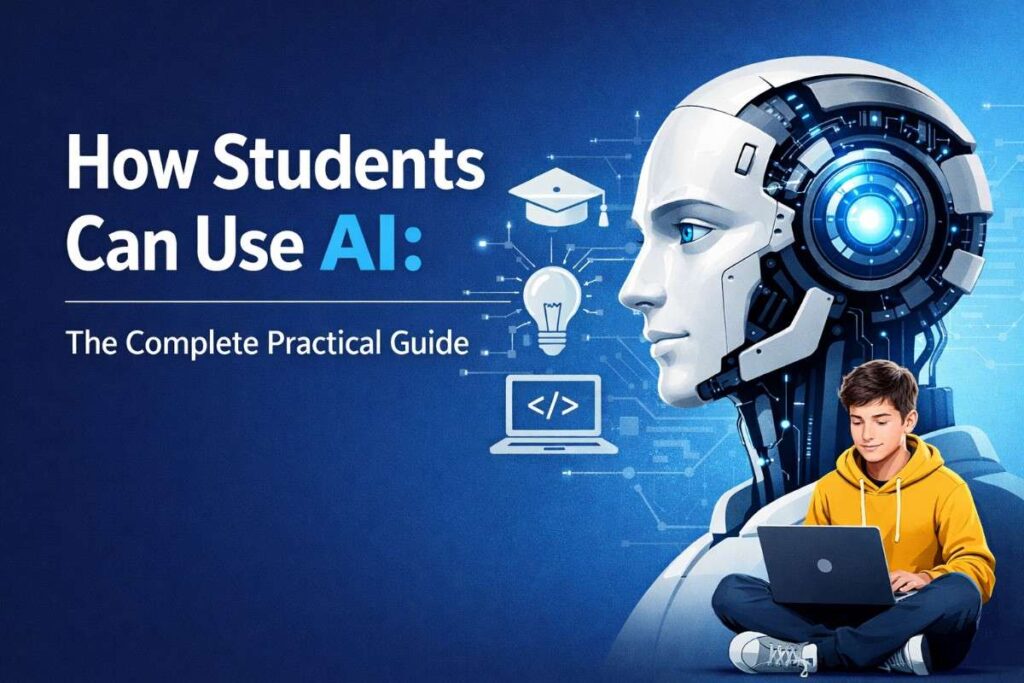

How Students Can Use AI for Studying: The Complete Practical Guide
Artificial intelligence is changing how students learn, research, write, and prepare for exams. If you understand how students can use AI for studying, you can turn AI into a powerful learning assistant that helps you learn faster, understand concepts deeply, and organize your academic life more efficiently.
Many students today either ignore AI completely or misuse it by copying answers. Both approaches are mistakes.
The smartest students use AI differently.
They use AI to:
- understand difficult concepts
- create structured notes
- generate practice questions
- improve writing
- plan study schedules
- learn new skills faster
In this practical guide, you will learn how students can use AI for studying in real life, including exact prompts, AI tools, and smart techniques used by high-performing learners.
Why Learning How to Use AI for Studying Is Important
Education is changing quickly.
Students today must deal with:
- large amounts of information
- complex subjects
- limited time
- competitive exams
Artificial intelligence helps solve these problems by acting as a personal learning assistant.
When students learn how to use AI for studying, they can:
✔ learn faster
✔ understand difficult topics
✔ save study time
✔ improve research skills
✔ organize knowledge better
According to research published by MIT Technology Review, AI-powered learning tools can significantly improve student engagement and personalized learning.
Best AI Tools Students Should Use for Studying
Before learning how students can use AI for studying, you should know the most useful tools.
1. ChatGPT – The Personal AI Tutor
ChatGPT can help students:
- explain concepts
- generate quizzes
- correct writing
- create study plans
- simulate conversations
Example prompt students can copy:
Act as an expert teacher.

Explain the concept of photosynthesis in very simple language.

Include:
1. simple explanation
2. real-life example
3. memory trick
4. 5 practice questions
Instead of simply giving an answer, this prompt forces AI to teach the concept properly.
2. NotebookLM – AI for Studying Books and PDFs
NotebookLM allows students to upload:
- textbooks
- research papers
- notes
- study material
The AI then analyzes the documents and explains them.
Example prompt:
Analyze this chapter and create structured notes.

Include:
• key ideas
• important definitions
• examples
• exam questions
• quick revision summary
This converts long chapters into high-quality revision notes.
Learn more:
https://notebooklm.google
3. Claude AI – Deep Research and Analysis
Claude AI is excellent for:
- analyzing long documents
- explaining complex topics
- structuring essays
Example prompt:
Explain the Industrial Revolution step-by-step.

Include:
1 causes
2 important inventions
3 social impact
4 economic impact
5 modern relevance
How Students Can Use AI for Studying Difficult Subjects
Many students struggle with difficult topics.
Instead of memorizing blindly, AI can help break the topic into smaller steps.
Example prompt:
Act as a patient teacher.

Explain this topic step by step.

Start from beginner level and gradually increase difficulty.

Include examples and simple explanations.
This technique transforms AI into a step-by-step tutor.
Using AI to Create Smart Study Notes
Traditional note-making takes a lot of time.
AI can create high-quality revision notes instantly.
Prompt example:
Convert this chapter into revision notes.

Include:
• key concepts
• bullet points
• important formulas
• summary
• 5 test questions
This allows students to review chapters quickly before exams.
How Students Can Use AI to Prepare for Exams
AI can simulate exam preparation.
Example prompt:
Act as an exam coach.

Create a 15-day study plan for my history exam.

Daily study time: 3 hours.

Include revision strategy, practice tests, and memory techniques.
Students can also generate practice questions.
Prompt:
Create 20 exam-style questions from this chapter.

Difficulty level: medium to advanced.
Using AI to Improve Writing Skills
AI can help students improve:
- grammar
- essay structure
- clarity
Example prompt:
Act as an academic writing coach.

Review my essay and suggest improvements.

Focus on:
• clarity
• grammar
• argument strength
• structure
This helps students become better writers instead of copy-paste users.
Using AI to Learn English Faster
AI is extremely useful for language learning.
Students can practice conversations with AI.
Prompt:
Act as my English speaking partner.

Ask daily conversation questions.

Correct my grammar mistakes and explain why.
Using AI to Manage Study Time
Many students struggle with time management.
AI can create structured schedules.
Example prompt:
Create a weekly study timetable.

Subjects:
Math
Science
English
History

Daily study time: 4 hours.

Include revision and practice tests.
AI acts as a study planner.
Common Mistakes Students Make When Using AI
Students must avoid several mistakes.
Copying AI answers directly
AI should help you understand concepts, not replace thinking.
Asking vague questions
Bad prompt:
“Explain science”
Better prompt:
“Explain Newton’s laws with examples and simple explanations.”
Not verifying information
Always verify important information using reliable sources.
The Future of AI in Education
Artificial intelligence will become a major part of education.
Future classrooms may include:
- AI tutors
- adaptive learning systems
- personalized education plans
- AI research assistants
Students who learn how to use AI for studying today will have a huge advantage in the future.
Final Advice for Students
Artificial intelligence is one of the most powerful tools students can use today.
But remember one rule:
AI should help you think, not think instead of you.
Students who use AI wisely will:
- learn faster
- understand deeper
- manage time better
- develop stronger skills
AI will not replace students.
But students who know how to use AI will outperform those who do not.



Pingback: Study Planner for Students: The Ultimate Guide - Wordify English