
Here’s something I want you to think about before we start.
You’ve probably walked past a hundred things in your city or town and never really looked at them. The old man selling something from a cart. The smell that hits you when you pass a certain lane. The sound that starts your morning without you ever consciously noticing it.
Now imagine someone writing about those things. Not in a documentary voice, not in a tourism-brochure voice, but in the voice of someone who grew up with them, who misses them, who remembers them the way you remember the smell of your grandmother’s kitchen.
That’s Glimpses of India — Chapter 5 of your Class 10 English textbook, First Flight.
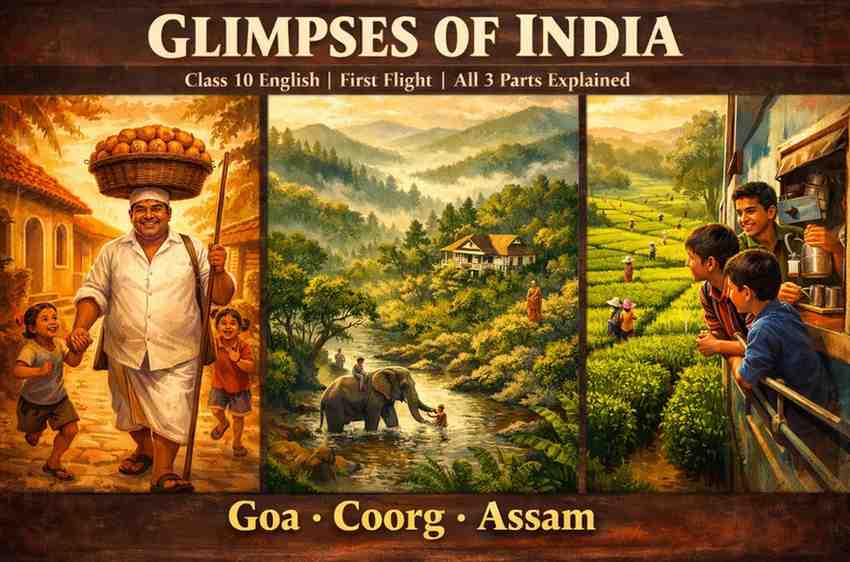
It’s not one story. It’s three. Three writers, three different corners of India — Goa, Coorg, and Assam — three completely different ways of loving a place. And together, they form the most affectionate, vivid portrait of this country that the Class 10 English curriculum has to offer.
Let’s take a journey. No ticket needed.
🍞 PART I: A Baker from Goa — by Lucio Rodrigues
The Sound That Starts Before Sunrise
Before we get into the story, close your eyes for a second and imagine this:
You’re seven years old. You’re in a warm bed. It’s early morning, and the light is just starting to come in. And then — from somewhere down the lane — you hear it. A rhythmic sound. Thud. Jingle. Thud. Jingle.
That sound means something. It means something warm and fragrant is on its way. And you’re on your feet before your brain has fully woken up.
That’s how “A Baker from Goa” begins — not with a description, not with history, but with a sound that woke up an entire childhood.
This short piece, written by Lucio Rodrigues, is what the textbook itself calls a “pen-portrait” — a word-sketch of a person, painted so vividly you can almost smell the bread. And it is one of the warmest, most nostalgic things in all of Class 10 English literature.
The Portuguese Left. The Bread Stayed.
Goa was a Portuguese colony for over 450 years — from 1510 until 1961, when India reclaimed it. The Portuguese influence on Goan culture is deep and lasting — in the architecture, the music, the food, the festivals. And perhaps most deliciously: in the bread.
The Class 10 English extract opens with the elders of Goa reminiscing — thinking fondly back — about the Portuguese days and their famous loaves of bread. The “eaters of loaves” — the Portuguese — are gone. But the “makers” are still there.
That contrast is the whole heart of this piece. Colonisers come and go. But the traditions they leave behind — the recipes, the techniques, the way of life — those can outlast empires. The baker’s furnace is still burning. The fire has not been extinguished.
And in some places, incredibly, you can still hear it — that sound. The “thud and jingle” of the baker’s bamboo, announcing his arrival.
These bakers are called pader in Goa. And in Rodrigues’ childhood, the pader was not just a bread-seller. He was a “friend, companion and guide.”
The Children Weren’t Running for the Bread
Here’s the detail in this Class 10 English extract that makes it genuinely fun: the children of the village would rush out to meet the baker every morning. The sound of his bamboo would wake them from sleep and they’d scramble to meet him.
Why?
Not for the bread. The bread — the actual loaves — were bought by the maid-servant, “some Paskine or Bastine,” as the author says with a charming specificity. The children couldn’t care less about the loaves.
What they wanted were the bread-bangles — small circular breads, sized like bracelets, that children would pick out carefully from the baker’s basket. And sometimes, if they were lucky, sweet bread of a “special make.”
Read that and you can almost see it — little kids crowding around a basket, choosing their bread-bangle with the same focused seriousness that you’d choose between two flavours of ice cream.
The baker would arrive with a musical entrance — “jhang, jhang” — balancing his basket on his head with one hand while banging the bamboo on the ground with the other. He’d greet the lady of the house with “Good morning,” put down his basket, and the loaves would be distributed — elders getting the proper bread, children getting their bangles.
The children would be pushed aside with a gentle rebuke (a scolding, a mild telling-off), but they wouldn’t give up. They’d climb benches and peep into the basket anyway.
The author admits they didn’t even brush their teeth before eating. And then — with perfect childhood logic — asks: “Why should we? The tiger never brushed his teeth. Hot tea could wash and clean up everything so nicely, after all!”
That line. That tiger never brushed his teeth line. It is, hands down, one of the funniest and most relatable things ever written in a Class 10 English textbook. Every child who has ever used animal-logic to avoid doing something they didn’t want to do has had this exact thought.
The Baker Was Essential — Not Just Nice to Have
Beyond the childhood nostalgia, Rodrigues makes a serious point about the pader’s role in Goan society. This wasn’t just a snack-seller. The baker was woven into the fabric of every important occasion.
- Marriage gifts were considered incomplete without the sweet bread called bol
- Parties and feasts lost their charm without bread
- A daughter’s engagement required sandwiches prepared by the lady of the house
- Christmas wasn’t Christmas without cakes and bolinhas (a type of coconut cookie)
The baker’s furnace in the village was not a luxury — it was a necessity. No baker, no celebration.
This is what makes this Class 10 English extract more than just a memory piece. It’s a meditation on how certain traditions hold communities together. Remove the baker, and you remove something from the centre of Goan life.
The Pader’s Look: A Uniform That Became a Joke
In Portuguese days, the baker wore a kabai — a single-piece long frock reaching down to the knees. By the time the author was a child, bakers wore shirts and trousers that were shorter than full-length but longer than half pants — occupying that awkward middle zone.
The joke? That zone became so associated with bakers that even today, if someone wears pants that reach just below the knee, people say he is dressed “like a pader.”
A profession so recognisable that it became a fashion reference. That’s how deeply the pader was embedded in Goan consciousness.
The Baker Was Rich — And His Body Showed It
This final detail is delivered with the dry humour that characterises this entire Class 10 English extract. Baking, the author tells us, was a “profitable profession”. The baker and his family never starved. They always looked “happy and prosperous.”
And the evidence? Their “plump physique” — their pleasantly well-fed bodies. The author calls this their “open testimony” — a visible, public statement of their comfortable life.
Even today, if someone has a round, well-fed appearance, they are casually compared to a baker. A jackfruit-like appearance, he calls it — round, large, solid, full.
The pader was not just a cultural figure. He was a prosperous, respected, well-fed pillar of his community.
⛰️ PART II: Coorg — by Lokesh Abrol
“A Piece of Heaven That Must Have Drifted from the Kingdom of God”
If “A Baker from Goa” is warm and nostalgic, “Coorg” is breathless. It’s the writing of someone who has stood somewhere so beautiful that they can’t quite believe it’s real.
Lokesh Abrol begins with what might be the most poetic opening line in all of Class 10 English non-fiction:
“Midway between Mysore and the coastal town of Mangalore sits a piece of heaven that must have drifted from the kingdom of God.”
Coorg, also called Kodagu, is the smallest district of Karnataka. It sits between Mysore and Mangalore — inland, up in the hills, wrapped in mist and rainforest. Thirty percent of the district is covered in evergreen rainforest. Coffee plantations spread across the slopes. Colonial bungalows sit tucked under tree canopies like secrets.
The air, the author says, “breathes of invigorating coffee.”
That phrase. The air breathes. Not “smells of” — breathes. Coffee-scented air that is itself alive, itself invigorating. This is writing that earns its reputation in Class 10 English literature.
Who Are the Coorgi People — And Where Did They Come From?
This is where the Coorg extract gets genuinely fascinating, and where most Class 10 English students either get very interested or completely lost. Let’s make sure it’s the former.
The Kodavus — the people of Coorg — are described as a “proud race of martial men and beautiful women.” They are fiercely independent. And their origins are, remarkably, a matter of historical mystery.
Two competing theories exist:
Theory 1: Greek descent. The story goes that when Alexander the Great marched his army through India in 326 BC, a part of his force moved south along the coast. When returning became impractical — too far, too dangerous — they settled. They married locals. Over generations, their Greek culture blended with Indian traditions, producing the distinct Kodavu customs that remain different from Hindu mainstream practices.
Theory 2: Arab descent. The Kodavus wear a traditional long black coat called the kuppia — and it bears a striking resemblance to the kuffia, the traditional garment of Arabs and Kurds. This similarity supports the idea of Arab origin.
Neither theory is conclusively proven. But both add something remarkable to the Kodavu identity: the possibility that the people of one small Karnataka district carry within them the blood of ancient Greeks or Arab traders. In a country as diverse as India, Coorg is one more stunning reminder that we are a civilisation built on layers.
What is certain is this: whatever their origin, the Kodavus developed a culture of fierce pride, hospitality, and martial excellence. The Coorg Regiment is one of the most decorated in the Indian Army. The first Chief of the Indian Army, General Cariappa, was a Coorgi. And even today, the Kodavus are the only people in India permitted to carry firearms without a licence — a privilege tied to their long history as warriors.
When you visit a Coorgi home, the tradition demands that you are received warmly and regaled with tales of valour — stories of courage from fathers and sons who served in wars. Hospitality is not optional in Coorg. It is cultural identity.
The River, the Wildlife, the Feeling of Being Very Small
The Kaveri river — one of the most sacred rivers in South India — gets its water from the hills and forests of Coorg. In these clear waters, mahaseer (a large and prized freshwater fish) swim in abundance. Kingfishers dive. Squirrels and langurs drop half-eaten fruit into the water seemingly for the sheer joy of watching the ripples.
Elephants are bathed and scrubbed in the river by their mahouts (the men who care for and ride them). There is a gentleness to this image that stays with you — massive animals being tended to by careful hands in cool moving water.
And for the visitor who thought they were laidback? Coorg converts them. River rafting, canoeing, rappelling, rock climbing, mountain biking, trekking — the list of adventures available in Coorg goes on. You cannot be passive here.
The wildlife keeps you company whether you want it or not: macaques, Malabar squirrels, langurs, slender loris — all watching you from the tree canopy with what feels like polite judgement. And the author adds, with the most casually brilliant line: “I do, however, prefer to step aside for wild elephants.”
Yes. Good call.
Brahmagiri, Nisargadhama, Bylakuppe — Coorg’s Surprises
Climb to the Brahmagiri hills and you get a panoramic view — the entire misty landscape of Coorg spread below you like a painting. Walk across the rope bridge and you reach Nisargadhama, a 64-acre island of lush greenery.
And then, perhaps the most unexpected discovery of all: Bylakuppe — home to India’s largest Tibetan settlement. Buddhist monks in red, ochre, and yellow robes walk these paths, and running into them is described as a “bonus” — one of the many surprises Coorg holds for visitors searching for the “heart and soul of India.”
That phrase — heart and soul of India — is how the Coorg extract ends. And it’s not hyperbole. In Coorg, you find ancient warrior culture, colonial-era bungalows, Tibetan monasteries, sacred rivers, and coffee that flavours the very air. It is, in miniature, everything India is.
🍵 PART III: Tea from Assam — by Arup Kumar Datta
“Chai-Garam… Garam-Chai”
If the first two extracts in this Class 10 English chapter are portraits of place, Tea from Assam is a portrait of curiosity. It follows two boys on a train journey — and what one of them knows about tea that the other can barely believe.
The story opens with a vendor’s call: “Chai-Garam… garam-chai.” It is one of the most Indian sounds in existence — the sing-song cry of a chai vendor on a train platform. Students studying this Class 10 English extract will recognise it immediately. It is the soundtrack of Indian travel.
Rajvir is visiting his classmate Pranjol in Assam. Pranjol’s father manages a tea garden — a tea estate — in Upper Assam, and Pranjol has invited Rajvir for the summer holiday. They’re on the train together, and as they sip their tea, Rajvir drops a fact that sets the tone for the entire extract:
“Do you know that over eighty crore cups of tea are drunk every day throughout the world?”
Eighty crore cups. Every. Single. Day. That is not a small thing you’re sipping from that cutting chai.
Two Boys, One Fascinated, One Bored
Here is the beautiful contrast at the heart of this Class 10 English story — the contrast between novelty and familiarity.
Pranjol has spent his entire life on a tea plantation. He was born there. He grew up there. To him, tea estates are just… home. Ordinary. Background. He buried his nose in a detective novel and didn’t look up.
Rajvir, on the other hand, had never seen anything like what was outside that window. And as the train moved from paddy fields into tea country, the landscape transformed:
“Against the backdrop of densely wooded hills a sea of tea bushes stretched as far as the eye could see.”
A sea. Not a field, not a plantation — a sea of green. Tall shade-trees dwarfing the tiny bushes. And among those bushes, small doll-like figures moving with purpose — the tea pluckers, doing the most labour-intensive part of turning a leaf into the cup in your hand.
Rajvir was captivated. Pranjol shrugged.
This is one of the truest observations in Class 10 English literature: the things we take for granted are the things that take someone else’s breath away. The person who grew up near the mountains forgets the mountains. The person seeing them for the first time cannot stop staring.
The Legends of Tea — China, India, and Very Old Stories
This is the part of “Tea from Assam” that Class 10 English exams love, and students need to know cold. So let’s tell these legends properly.
Legend 1: The Chinese Emperor
A Chinese emperor had a habit of always boiling his water before drinking — a hygiene practice. One day, some leaves from the twigs burning under the pot fell into the boiling water. The water took on a delicious flavour. Those leaves, it is said, were tea leaves. This discovery — accidental, gentle, domestic — gave the world its most consumed beverage.
Legend 2: Bodhidharma
This one is Indian, and significantly more dramatic.
Bodhidharma was an ancient Buddhist monk and ascetic — someone who lives with extreme discipline and self-denial. He was so committed to his meditations that when he felt sleepy, he did something radical: he cut off his own eyelids.
(Yes. His eyelids. Stay with me.)
From where his eyelids fell on the ground, ten tea plants grew. The leaves of these plants, when put in hot water and drunk, could banish sleep. The very affliction that had driven him to such extremes was cured by what his sacrifice had created.
Whether you believe it or not, this legend is extraordinary — it connects tea to awakening, to the desire to stay present, to the refusal to give in to unconsciousness. The next time you drink tea to stay awake for a night study session, remember: there’s a legend that says that’s literally what tea was made for.
Rajvir adds a third fact, historical rather than legendary: tea was first drunk in China as far back as 2700 B.C. Words like “tea,” “chai,” and “chini” are all derived from Chinese. Tea reached Europe only in the 16th century, and initially was drunk more as a medicine than a beverage.
Pranjol, for the record, was not convinced by any of this. He scoffed. But he had no counter-argument.
Arriving at Dhekiabari: The Real Tea Country
The train arrives at Mariani junction. Pranjol’s parents receive them. They drive toward Dhekiabari — the tea estate where Pranjol grew up.
An hour into the drive, the car turns sharply off the main road. They cross a cattle-bridge. And then, stretching on both sides of a gravel road, acre upon acre of tea bushes — all neatly pruned to the same height, orderly rows disappearing into the distance.
Groups of tea pluckers move through these rows — bamboo baskets strapped to their backs, plastic aprons protecting their clothes — plucking the newly sprouted leaves by hand. This is the second-flush or sprouting period: May to July, when the tea plant is most productive and yields the finest leaves.
Rajvir knows this. He mentions it to Mr. Barua — Pranjol’s father — who is visibly surprised. “You seem to have done your homework before coming,” he says.
And Rajvir’s reply is one of the most graceful lines in this Class 10 English extract: “Yes, Mr Barua. But I hope to learn much more while I’m here.”
He did his research. But he came with humility. He knows that a book is just the beginning. The real learning is standing in a field with the people who live it.
🗺️ The Three Glimpses Together — What Is This Chapter Really About?
Take a step back from all three extracts and look at what Chapter 5 of Class 10 English is doing as a whole.
Each piece is about something ordinary becoming extraordinary when you pay attention to it.
A baker with a bamboo staff. A mountain district with warriors descended from Alexander’s army. A morning cup of tea connected to a Chinese emperor and a monk who cut off his eyelids.
None of these things are dramatic on the surface. None of them are the big, tourist-brochure India of the Taj Mahal or the Himalayas. They are the smaller, quieter India — the India of traditions, of sounds, of flavours, of things that have survived centuries without anyone making a fuss about them.
And that is the greatest thing about this chapter: it teaches you to look at your own country differently. Not as something you see on a map or recite in a general knowledge quiz, but as something alive — made of stories, held together by bread and coffee and tea, populated by warriors and bakers and curious boys on trains.
📊 Quick Comparison: All Three Extracts Side by Side
| A Baker from Goa | Coorg | Tea from Assam | |
|---|---|---|---|
| Author | Lucio Rodrigues | Lokesh Abrol | Arup Kumar Datta |
| Type of Writing | Personal pen-portrait | Travel writing / essay | Narrative story |
| Tone | Warm, nostalgic, funny | Lyrical, descriptive, admiring | Curious, informative, conversational |
| Central Figure | The pader (baker) | Coorg’s land and people | Tea and its history |
| Theme | Tradition, culture, survival | Beauty, history, identity | Curiosity, heritage, discovery |
| What It Celebrates | Goan bread culture | Karnataka’s hidden gem | Assam’s tea legacy |
| Best Line | “The tiger never brushed his teeth” | “A piece of heaven that must have drifted from the kingdom of God” | “Tea was first drunk in China as far back as 2700 B.C.” |
📝 All Important Words You Must Know for Class 10 English Exams
Reminiscing nostalgically — Thinking fondly and with longing about the past. The elders in Goa are doing this about Portuguese times and their bread.
Heralding — Announcing the arrival of something. The baker’s bamboo heralded his arrival — it was his announcement sound.
Rebuke — An expression of disapproval; a scolding. The children were pushed aside with a mild rebuke by the baker.
Fragrance — A pleasant scent. The author remembers the fragrance of freshly baked loaves.
Plump physique — A pleasantly fat body. The baker’s well-fed appearance was evidence of his prosperity.
Open testimony — A visible, public statement of character. The baker’s plump physique was open testimony to his profitable profession.
Martial — Related to war or warriors. The Kodavus are described as a proud race of martial men.
Canopies — Roof-like coverings that form shelter. Coffee estates are tucked under tree canopies.
Mainstream — The tradition that most people follow. Coorgi culture is distinct from the Hindu mainstream.
Laidback — Relaxed, not in a hurry. Even laidback people become converts to adventure in Coorg.
Tales of valour — Stories of courage and bravery, usually in war. Coorgi homes are full of them.
Most decorated — Having received the maximum number of awards for bravery. The Coorg Regiment is one of the most decorated in the Indian Army.
Panoramic view — A view of a wide area of land. You get a panoramic view from the Brahmagiri hills.
Ardent — Enthusiastic and passionate. Rajvir was an ardent fan of detective stories.
Second-flush — The second sprouting period of the tea plant (May to July), which yields the finest tea.
📝 Complete Q&A — Written the Way a Class 10 English Topper Would
PART I: A Baker from Goa
Q: What are the elders in Goa nostalgic about?
The elders of Goa are nostalgic about the Portuguese days and the famous bread that was a central part of their culture. They remember the loaves fondly, recalling a time when the presence of the baker — the pader — was a constant, joyful part of daily life. The bread, the furnaces, the bamboo sound — all of it represents a tradition that has partially faded, and the elders miss it.
Q: Is bread-making still popular in Goa? How do you know?
Yes, bread-making continues to survive in Goa. The author tells us that the bakers — the paders — are still present, still mixing, moulding and baking. The furnaces still exist. The fire has not been extinguished. And in some places, the familiar sound of the baker’s bamboo can still be heard. Sons have taken over from fathers, keeping the family profession alive even if the profession is not as dominant as it once was.
Q: What is the baker called? When would he come every day?
The baker is called a pader in Goa. He came at least twice a day — once in the morning when he set out on his selling round, and again when he returned after emptying his basket. His arrival was announced by the rhythmic thud and jingle of his bamboo staff.
Q: Why did the children run to meet the baker?
Not for the actual bread — the loaves were bought by the maid-servants. The children ran to meet the baker for the bread-bangles, small ring-shaped breads that they chose carefully from the basket. Sometimes there was also sweet bread of a special make. The smell of the fresh loaves and the excitement of picking their bread-bangles made the baker’s arrival the highlight of the morning.
Q: What does the author mean by a “jackfruit-like appearance”?
A jackfruit is a large, round, bulky fruit. When the author says someone has a “jackfruit-like appearance,” he means they are pleasantly plump and well-rounded — indicating that they are prosperous, well-fed, and comfortable. It is the author’s playful way of describing how the baker and his family always looked well-nourished, which was a visual sign of their successful, comfortable profession.
PART II: Coorg
Q: Where is Coorg? What is special about it?
Coorg — also called Kodagu — is the smallest district of Karnataka, located midway between Mysore and the coastal town of Mangalore. It is special for its evergreen rainforests (which cover 30% of the district), its coffee and spice plantations, its unique culture and martial tradition, its wildlife, and its adventure sports opportunities. The author calls it “a piece of heaven” that seems to have drifted from the kingdom of God.
Q: What is the story about the descent of the Kodavu people?
The Kodavus are possibly of Greek or Arabic descent. One theory says that a part of Alexander the Great’s army moved south along the coast and settled in Coorg when returning became impractical. They married locals and their Greek culture blended with Indian traditions. Another theory points to Arab origin, supported by the kuppia — a long black coat with an embroidered waist-belt worn by Kodavus — which closely resembles the kuffia worn by Arabs and Kurds.
Q: What are the Kodavus known for?
The Kodavus are known for their fierce independence, strong martial tradition, and deep hospitality. The Coorg Regiment is one of the most decorated in the Indian Army. The first Chief of the Indian Army, General Cariappa, was a Coorgi. Kodavus are the only people in India permitted to carry firearms without a licence. They are also known for their warm, story-filled hospitality — Coorgi homes are always ready to recount tales of valour.
PART III: Tea from Assam
Q: What are the two legends about the origin of tea mentioned in the story?
The first legend is Chinese: a Chinese emperor who always boiled water before drinking accidentally had tea leaves fall into the boiling water from the twigs burning beneath the pot. The flavoured water tasted delicious, and the practice of drinking tea began.
The second legend is Indian: Bodhidharma, an ancient Buddhist monk, cut off his eyelids to stay awake during meditation. Ten tea plants grew from where his eyelids fell. The leaves of these plants, when brewed in hot water, banished sleep — making tea the beverage of wakefulness and spiritual discipline.
Q: What is the “second flush” and why is it important?
The second flush is the second sprouting period of the tea plant, which lasts from May to July. During this period, the tea bushes sprout the finest, most flavourful leaves. Rajvir mentions this to Pranjol’s father upon arriving at the estate, demonstrating the preparation and curiosity he had brought to the trip.
Q: How does Rajvir differ from Pranjol in his attitude towards tea country?
Rajvir is completely captivated by the tea landscape — the sea of green bushes, the doll-like figures of tea pluckers, the scale of the plantations. He has read extensively about tea before the trip. He is curious, enthusiastic, and moved by what he sees. Pranjol, who was born and raised on a plantation, sees none of this wonder — to him it is simply home, ordinary and unremarkable. This contrast illustrates how familiarity can dull our appreciation of things that others find extraordinary.
🎯 Exam Strategy for Glimpses of India — Class 10 English
For this chapter, Class 10 English board exams typically test on three things: factual recall, tone identification, and theme.
Factual recall is straightforward if you’ve read this post carefully.
Tone questions are specific to “A Baker from Goa.” The textbook itself asks about the tone of various lines — nostalgic, hopeful, naughty, matter-of-fact. Here’s the quick guide:
- “The thud and jingle of the bamboo can still be heard…” — Nostalgic (remembering, slightly longing)
- “The son still carries on the family profession” — Hopeful (the tradition survives)
- “The tiger never brushed his teeth…” — Naughty/Funny (childhood logic being applied cheekily)
- “Cakes and bolinhas are a must for Christmas…” — Matter-of-fact (stating a fact about tradition)
For theme questions: Connect all three pieces. They celebrate India’s regional diversity, the survival of tradition, the importance of curiosity, and the beauty of ordinary things when seen with attentive eyes.
💭 The Question This Chapter Is Really Asking
Here’s what NCERT doesn’t say explicitly but this entire Chapter 5 of Class 10 English is whispering throughout:
Have you looked at where you live?
Not Goa. Not Coorg. Not Assam. Wherever you are. Have you noticed the people who’ve been there for generations? The sounds that start your mornings? The foods that appear at every celebration? The history hiding in the name of the street you walk down every day?
Lucio Rodrigues noticed a baker. Lokesh Abrol noticed a mountain district most people pass through without stopping. Arup Kumar Datta noticed that the cup of tea in his hand had a story going back 4,700 years.
Your town, your neighbourhood, your street — all of it has its own version of the pader, its own version of Coorg’s warrior-descendants, its own legend about something that has been going on quietly, every day, longer than anyone alive can remember.
This chapter is your invitation to start paying attention.
📣 One Last Thing Before You Go
India is the kind of country where you could spend your whole life in one state and still not exhaust its stories.
A Portuguese-era baker still selling bread from a bamboo basket. A warrior community that might be descended from Alexander’s army. A cup of tea connected to a monk, an emperor, and two thousand seven hundred years of history.
These aren’t things you find in guidebooks. They’re the things you only find when someone takes the time to look.
That’s what Chapter 5 of Class 10 English First Flight does. It takes the time to look. And it invites you to do the same.
Tell me in the comments: which of the three parts hit you hardest? The baker’s nostalgia, Coorg’s beauty, or the legends of tea? And — honestly — is there something about where you live that deserves a “glimpse” like this?
Share this with your Class 10 English batch — because this chapter deserves to be felt, not just studied.
📌 Also Read: A Letter to God Class 10 — Complete Story Explained | From the Diary of Anne Frank Class 10 — The Story Nobody Tells You Right | Coorg Travel Guide — Why Karnataka’s Hidden Gem Is Worth the Trip