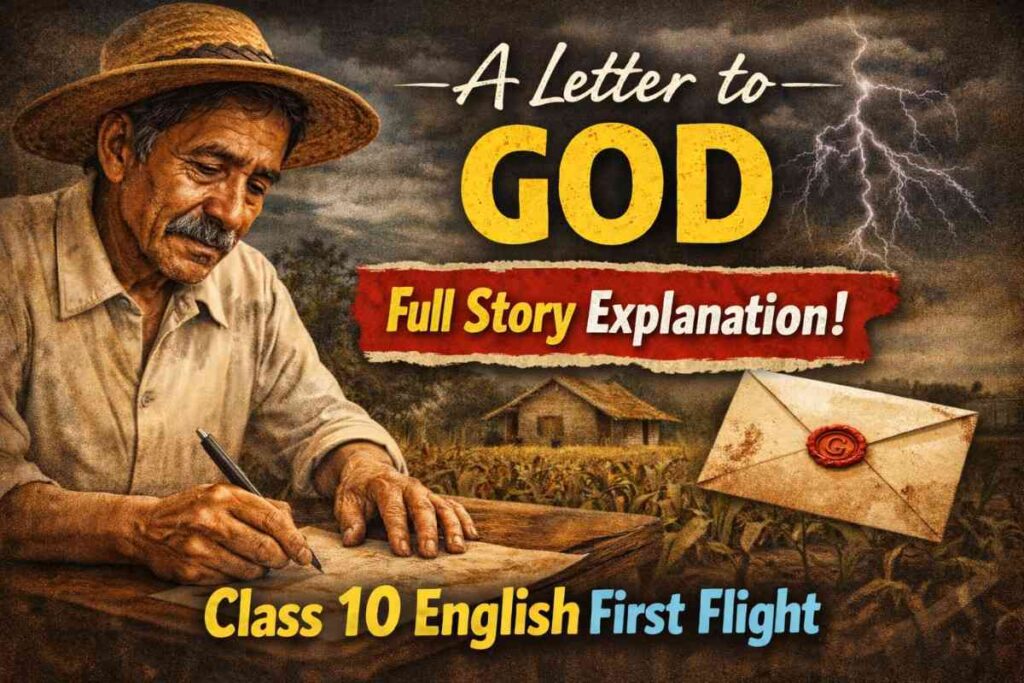

Introduction: When a Man Writes Directly to God
What would you do if everything you worked for — every drop of sweat, every long hard day under the scorching sun — was destroyed in a single hour?
Most people would cry. Most people would give up. Most people would sit in the ruins of their life and wonder why God had abandoned them.
But Lencho did something that nobody in the entire history of the post office had ever seen before.
He picked up a pen. And he wrote a letter — directly to God.
“A Letter to God” is the very first chapter of your Class 10 English textbook First Flight. It is written by G. L. Fuentes, a Mexican author, and the story originally comes from Latin America. It is short. It is simple. But the moment you reach the last line, you will feel something shift inside you — a mix of laughter, sadness, and deep thought — all at the same time.
This is not just a story about a farmer and a hailstorm. This is a story about the most powerful force in the human heart — faith. And about the most painful human experience — irony.
Let us understand every single detail of this story, so deeply that you could explain it to your own teacher.
About the Author — Who Was G. L. Fuentes?
Gregorio López y Fuentes (1897–1966) was a famous Mexican novelist, journalist, and poet. He was born in a small village in Mexico and grew up seeing the hard lives of poor farmers — people who depended entirely on rain, soil, and hope.
He wrote many novels about rural Mexican life, but this short story is his most widely read work outside of Mexico. The reason is simple: the story is universal. The struggle of a poor farmer, his faith in God, and the cruel twist at the end — these are things that readers everywhere, in every country, in every language, understand and feel.
The Story at a Glance — Quick Overview
| Feature | Details |
|---|---|
| Chapter Name | A Letter to God |
| Author | G. L. Fuentes |
| Type of Text | Short Story / Fiction |
| Set In | A small valley in Latin America (Mexico) |
| Main Character | Lencho — a poor farmer |
| Key Event | A hailstorm destroys Lencho’s crops; he writes a letter to God asking for money |
| Central Theme | Blind faith vs. Irony; Human kindness |
| Textbook | First Flight — Class 10 NCERT English |
Part 1 — The Beautiful Beginning (Before the Storm)
The story opens with one of the most beautiful and peaceful pictures you can imagine.
There is a house — just one single house — sitting on the top of a low hill in the middle of a wide, quiet valley. From up there, you can see everything: the river, the ripe cornfield dotted with colourful flowers, the rolling green land. It is a picture of simple, quiet beauty.
This house belongs to Lencho — a hardworking farmer. Lencho is not rich. He does not have fancy machines or modern tools. He has only two things: his fields and his faith.
The story tells us that Lencho knew his fields intimately — meaning he knew every corner of his land, the way you know the face of someone you love. He had been watching the sky all morning, scanning the north-east horizon with hopeful eyes.
Because the fields needed rain. Desperately.
“Now we’re really going to get some water, woman,” Lencho said to his wife.
She was inside, preparing supper. She replied quietly, “Yes, God willing.”
Those two words — God willing — tell you everything about the kind of family this is. They are people of faith. Simple, deep, unshakeable faith.
The older boys were working in the fields. The younger children were playing outside the house. The wife called everyone in for dinner.
And then — right as they sat down to eat — the rain finally came.
Part 2 — The Rain That Became a Nightmare
At first, it was exactly what Lencho had prayed for.
Big, beautiful drops of rain began to fall. The air turned fresh and sweet. Huge mountains of dark clouds rolled in from the north-east. Lencho was so happy that he went outside just to feel the rain on his skin — not because he had to, but purely for the joy of it.
He came back inside with a huge smile and said something that is one of the most beautiful lines in the story:
“These aren’t raindrops falling from the sky — they are new coins. The big drops are ten cent pieces and the little ones are fives.”
Think about what this tells you about Lencho. He does not just see rain. He sees money. He sees his crops growing. He sees his family eating well. He sees hope falling from the sky, coin by coin.
He stood looking at his field of ripe corn, draped in a gentle curtain of rain, with a satisfied expression on his face. Everything was perfect.
And then everything went wrong.
A strong wind began to blow.
And with the rain — something else started falling. Something hard. Something white. Something that sounded like stones hitting the roof.
Hailstones.
Large, merciless hailstones began crashing down from the sky. They were round and white like silver coins, but these “coins” brought only destruction.
“It’s really getting bad now. I hope it passes quickly.”
It did not pass quickly.
For a full hour, the hail rained down on everything — the house, the garden, the hillside, and worst of all, the cornfield.
When it finally stopped, Lencho walked out to survey the damage.
The field was white — as if someone had poured salt all over it. Not a single leaf remained on the trees. Every flower was gone. The corn was completely and totally destroyed.
In one hour, an entire year’s work had been wiped out.
Lencho stood in the middle of his ruined field and said to his sons, in a voice heavy with pain:
“A plague of locusts would have left more than this. The hail has left nothing. This year we will have no corn.”
That night was the most sorrowful night the family had ever known.
- “All our work, for nothing.”
- “There’s no one who can help us.”
- “We’ll all go hungry this year.”
These are not just sad words. These are the words of people staring at starvation. This is a farming family. Their food, their money, their entire survival depends on that crop. And it is gone.
Part 3 — The Letter That Shocked the Post Office
But even in the darkest hour, there was one single hope burning in the hearts of everyone in that house.
Help from God.
Lencho was not an educated man. He worked with his hands, not his mind. But he could write. And that night, as he sat in the darkness thinking about what to do, he made a decision that was either the most naive or the most beautiful thing a human being could do.
He would write a letter. To God.
The next Sunday morning, before sunrise, Lencho sat down and began to write. It took effort — you can almost picture him, tongue pressed to the side of his mouth, brow wrinkled with concentration, writing each word carefully.
This is what he wrote:
“God, if you don’t help me, my family and I will go hungry this year. I need a hundred pesos in order to sow my field again and to live until the crop comes, because the hailstorm…”
He addressed the envelope simply: “To God.”
He walked to town. He stamped the letter. He dropped it in the mailbox. And he walked home with the calm confidence of a man who has already solved his problem.
Part 4 — The Post Office Reaction
Now here is where the story takes a beautiful and funny turn.
One of the post office employees picked up the letter, looked at the address — To God — and burst out laughing. He ran to show his boss, the postmaster, this extraordinary piece of mail.
The postmaster was a fat, friendly, good-natured man. He laughed too, at first. But then — and this is the moment that makes this story special — he stopped laughing. He picked up the letter. He read it. And something happened inside him.
“What faith! I wish I had the faith of the man who wrote this letter. Starting up a correspondence with God!”
He turned serious. He sat quietly with the letter in his hands for a moment. And then he made a decision.
He would reply to this letter. He would not let Lencho’s faith be broken.
But there was a problem. To reply, he needed money. Real money. And the post office did not have funds for things like this.
So the postmaster did something remarkable. He went around and collected money from his employees. He gave a portion of his own salary. He asked his personal friends to contribute. He gathered everything he could.
But even with all of that effort, he could not gather a hundred pesos — the full amount Lencho had asked for. He managed to collect only a little more than seventy pesos — just over half.
He put the money in an envelope, addressed it to Lencho, and wrote a short letter with it. The letter had only one word as a signature:
God.
Part 5 — The Twist That Changes Everything
The following Sunday, Lencho came to the post office a little earlier than usual.
He asked the postman if there was a letter for him. The postman handed it over. The postmaster watched from his office window, feeling the warm glow of someone who has done a truly good deed.
Lencho opened the envelope. He saw the money. He counted it.
He felt no surprise whatsoever.
Of course there was money. He had written to God. God had answered. This was exactly what he had expected. His faith was so absolute, so complete, so unshakeable that receiving money from God did not surprise him even slightly. It was as natural to him as the sun rising in the morning.
But then he finished counting. And his face changed.
Seventy pesos. Not a hundred.
Lencho’s expression hardened. He became angry.
In his mind, there was only one possible explanation. God would never make a mistake. God would never send less than what was needed. God had clearly sent the full hundred pesos.
So someone had stolen thirty pesos from the envelope. And who had handled the letter? Who had handled the money?
The post office employees.
Immediately, Lencho went to the counter. He asked for paper and ink. He sat down at the public writing table — forehead creased with effort — and wrote a second letter to God. When he finished, he bought a stamp, licked it, pressed it onto the envelope with a firm blow of his fist, and dropped it into the mailbox.
The moment the letter hit the mailbox, the postmaster rushed to open it.
This is what it said:
“God: Of the money that I asked for, only seventy pesos reached me. Send me the rest, since I need it very much. But don’t send it to me through the mail because the post office employees are a bunch of crooks.”
The Irony — The Greatest Twist in the Story
Stop. Re-read that last paragraph one more time.
The men who gave their own money to help a stranger they had never met — the men who dipped into their own pockets out of pure kindness, out of a desire to protect one man’s faith — these very same men are now being called “a bunch of crooks” by the man they helped.
This is irony — and it is the most powerful kind.
The people who showed the most humanity in the entire story are punished for it by being accused of theft.
Lencho’s faith in God is so enormous and so blind that there is literally no room in his mind for human goodness. He cannot conceive of the idea that ordinary people — post office workers — would do something selfless and kind. In his world, only God is good. Humans are suspects.
And so, in trying to protect his faith, the postmaster’s beautiful act of kindness becomes invisible. Worse — it becomes a crime in Lencho’s eyes.
This is the cruel, funny, heartbreaking irony at the heart of the story.
Key Themes of the Story
1. Faith — Blind But Beautiful
Lencho’s faith is extraordinary. It is the kind of faith that most people only talk about — he actually acts on it. He does not pray and hope. He writes a letter and expects a reply. His belief is so strong that receiving money from God does not even surprise him.
But the story also shows us the danger of blind faith. When faith is so absolute that it leaves no room for human goodness, it can become deeply unfair. Lencho cannot see the kindness of the postmaster because he has already decided that only God can be kind.
2. Irony — The Story’s Greatest Weapon
The entire story builds toward one single ironic punch. The very people who embody the goodness of God — giving from their own pockets to help a stranger — are the people Lencho calls thieves. The reader sees both sides simultaneously, and that creates a feeling that is both funny and deeply sad at the same time.
3. Human Goodness
The postmaster is the unsung hero of the story. Nobody asks him to collect money. Nobody forces him to protect Lencho’s faith. He does it purely because he is moved by the simple power of one man’s belief. His act of kindness is quiet, anonymous, and completely unrecognized — which, in many ways, makes it even more beautiful.
4. Conflict Between Man and Nature
The hailstorm is not just a weather event. It represents the way nature can, in a single moment, undo everything that human beings work and plan and hope for. For a poor farmer, one bad season can mean starvation. This is the harsh, helpless reality that the story brings to life.
Character Analysis — Who Is Lencho?
Lencho is one of the most fascinating characters in Class 10 English because he is neither a hero nor a villain. He is simply a man shaped entirely by his circumstances and his beliefs.
| Quality | Evidence From the Story |
|---|---|
| Hardworking | He knows his fields “intimately” — he has spent his entire life working them |
| Simple / Uneducated | He writes with great effort, wrinkling his brow to express his thoughts |
| Deeply Religious | He has unshakeable faith in God; writes to God without any doubt |
| Naive | He cannot imagine that humans could be kind; assumes the post office workers stole the money |
| Ungrateful (unintentionally) | He calls the people who helped him “crooks” — not out of malice, but out of blind belief |
| Proud and Confident | He shows no surprise at receiving money — he expected it completely |
The word that perhaps best describes Lencho is naive — meaning he is innocent to the point of being foolish, not because he is stupid, but because his faith has formed a wall between him and reality.
Character Analysis — The Postmaster
The postmaster is the quiet heart of the story. He gets less space on the page, but he carries more moral weight than any other character.
| Quality | Evidence From the Story |
|---|---|
| Kind and Generous | Gives part of his own salary to help a stranger |
| Empathetic | Immediately understands what it means for Lencho to have his faith shaken |
| Selfless | Asks for nothing in return; signs the letter “God” so Lencho never knows who actually helped |
| Admirable | The story calls him “amiable” — friendly and pleasant; he organises the entire effort himself |
The postmaster never gets credit. He never gets a thank-you. He never even gets acknowledged. And yet, what he does is the most genuinely godlike act in the entire story — because helping quietly, without recognition, without expectation of reward, is perhaps the closest thing to true goodness that exists.
Important Word Meanings
| Word | Meaning |
|---|---|
| Crest | The top of a hill |
| Intimately | Very closely; in great detail |
| Downpour | Heavy, sudden rainfall |
| Draped | Covered loosely, like a curtain |
| Hailstones | Small balls of ice that fall like rain during a storm |
| Plague | A large group of insects/animals causing destruction; also a disease |
| Locusts | Insects that fly in huge groups and destroy crops |
| Sorrowful | Very sad |
| Conscience | An inner sense of right and wrong |
| Amiable | Friendly and pleasant |
| Peso | The currency (money) used in several Latin American countries |
| Resolution | A firm decision |
| Contentment | A feeling of deep satisfaction |
| Crooks | Dishonest people; thieves |
Important Quotes and Their Meaning
“These aren’t raindrops falling from the sky, they are new coins.” Lencho sees the rain as money — as the means to his family’s survival. This beautiful metaphor shows his deep connection between nature and livelihood.
“What faith! I wish I had the faith of the man who wrote this letter.” The postmaster’s reaction to Lencho’s letter is not mockery — it is genuine awe. He recognises something pure and rare in Lencho’s absolute belief.
“God could not have made a mistake, nor could he have denied Lencho what he had requested.” This is the line that sets up the entire irony. Lencho’s faith is so perfect, so complete, that it automatically makes everyone around him a suspect — because if God sent the full amount and the full amount did not arrive, someone must have stolen it.
“Don’t send it to me through the mail because the post office employees are a bunch of crooks.” The most devastating line in the story. This is where the irony crashes into the reader like a wave. The people who gave their own money are called thieves by the man they secretly saved.
The Deep Meaning — What Is the Story Really About?
On the surface, “A Letter to God” is a funny story with a sharp twist ending. But underneath, it is asking some very serious questions.
Is Lencho’s faith admirable or foolish?
Both. His faith is so pure and so strong that it is genuinely moving. The postmaster is moved by it. Even the reader is moved by it. A man who can write to God with that kind of confidence, that kind of complete trust — that is rare and beautiful. But that same faith blinds him to the kindness happening right in front of him. He cannot see the goodness of humans because he has decided that only God is good.
Who is the real “God” in the story?
The postmaster. Not because he is divine, but because what he does is what God is supposed to do — see someone in pain, respond with kindness, give without expecting anything in return, and remain anonymous. He is the human embodiment of the goodness that Lencho attributes to God. And yet Lencho never knows this.
What does the story say about human nature?
It says that human beings are capable of extraordinary kindness — but also that blind belief, however beautiful, can make us incapable of recognising that kindness when it comes.
Complete Story Summary — Step by Step
Here is the full story told simply, from beginning to end:
- Setting the scene — Lencho, a poor farmer, lives with his family in a lone house on a hilltop in a valley. His field of ripe corn is waiting for rain.
- The rain arrives — It begins to rain, and Lencho is joyful. He compares the raindrops to coins because the rain means a good harvest and income.
- The hailstorm destroys everything — A sudden hailstorm follows the rain and destroys the entire crop within an hour. The field is left bare and white, as if covered in salt.
- The family’s despair — The family spends a sorrowful night, crying over the loss of the entire crop and fearing starvation.
- Lencho’s faith — Despite everything, Lencho’s single, unshakeable hope is God. He believes God sees everything and will help him.
- The letter — On Sunday morning, Lencho writes a letter to God asking for a hundred pesos to replant his field and survive until the next harvest. He addresses it simply “To God” and mails it.
- The post office reacts — A postman finds the letter and shows it to the postmaster, who laughs but then is deeply moved by Lencho’s faith. He decides to reply.
- The collection — The postmaster collects money from his staff, gives from his own salary, and gathers just over seventy pesos — less than the hundred Lencho asked for.
- The reply — He puts the money in an envelope addressed to Lencho, with a letter signed simply “God.”
- Lencho receives the money — The next Sunday, Lencho comes to the post office, receives the envelope, and counts the money. He is not surprised — but he is angry that only seventy pesos arrived instead of a hundred.
- The second letter — Lencho writes another letter to God, saying thirty pesos are missing and asking God to send the rest — but not through the mail, because the post office employees are “a bunch of crooks.”
- The irony hits — The postmaster opens the second letter and reads it. The people who gave their own money to help Lencho have now been called thieves by him.
Why This Story Still Matters Today
You might think this is just a funny old story from Latin America with a clever ending. But it is much more than that.
Every day, all around the world, good people do kind things quietly and anonymously — and receive no credit, no gratitude, and sometimes even blame. The postmaster’s experience is more common than you think.
And Lencho exists everywhere too — the person whose belief is so strong and so fixed that they cannot see the human goodness happening right beside them. He is not a bad person. He is not even an ungrateful person in the traditional sense. He simply cannot see beyond his faith.
The story does not ask you to lose faith. It asks you to add to your faith — to also see and acknowledge the kindness of the humans around you. Because sometimes, the answer to your prayer comes not from the sky, but from the person sitting quietly at the desk in the post office.
Conclusion — What Did You Learn From A Letter to God?
“A Letter to God” is a small story that punches far above its weight. In just a few pages, it gives you:
- The beauty of unshakeable faith
- The cruelty of nature
- The quiet heroism of human kindness
- And the most painful kind of irony — where doing good earns you nothing but suspicion
The postmaster ends up being the real hero of the story. He never signs his real name. He never gets a thank you. He just does the right thing, quietly, because the situation called for it.
And isn’t that, after all, the most godlike thing any human being can do?
Did you find this explanation helpful? Share it with your classmates and help them understand this wonderful story! Stay tuned for complete explanations of all chapters from Class 10 First Flight and Footprints Without Feet — written simply, deeply, and memorably.