
“What if the most innocent act of faith you’ve ever witnessed came from a man who had never doubted God — not even when the world gave him every reason to?”
If you’re a Class 10th English student who has just opened your First Flight textbook, the very first story waiting for you is deceptively simple. It’s only a few pages long. It has a humble farmer, a terrible hailstorm, and a letter addressed to no one most of us would think to write to — God.
But “A Letter to God” by G.L. Fuentes, translated from Spanish, is one of the most quietly devastating and thought-provoking stories in the entire NCERT curriculum. On the surface, it reads like a quaint folk tale. Dig deeper, and it becomes a profound meditation on faith, irony, human nature, and the gap between sincerity and cynicism.
This blog post is your ultimate companion to this story — whether you’re preparing for board exams, writing an assignment, or simply trying to actually understand what this story is trying to tell you.
📖 About the Author: G.L. Fuentes
Gregorio López y Fuentes (1897–1966) was a celebrated Mexican novelist and journalist, best known for his powerful depictions of rural Mexican life. His works often highlighted the struggles of indigenous and farming communities against poverty, exploitation, and the indifference of systems — both human and sometimes divine.
A Letter to God is a short story that perfectly encapsulates his storytelling philosophy: using simple characters and situations to expose deep, universal truths about humanity. The story was originally written in Spanish and has been translated into many languages, eventually finding its place in the CBSE Class 10 English (First Flight) textbook — a testament to its universal relevance.
📚 Context: Where Does This Story Fit in Class 10th English?
A Letter to God is Chapter 1 of First Flight, the main prose reader in the CBSE Class 10 English curriculum. It is paired with a poem — Dust of Snow by Robert Frost — in the same chapter.
For students preparing for CBSE Board Exams, this story carries significant weightage. Questions from this chapter typically include:
| Question Type | What to Expect |
|---|---|
| Short Answer (2 marks) | Character description, plot events |
| Long Answer (5 marks) | Theme analysis, moral lesson, character study |
| Extract-Based (4 marks) | Passage comprehension, language understanding |
| Value-Based | Personal response to Lencho’s faith or the postmaster’s act |
📝 Complete Summary: A Letter to God (Class 10th)
The Setting
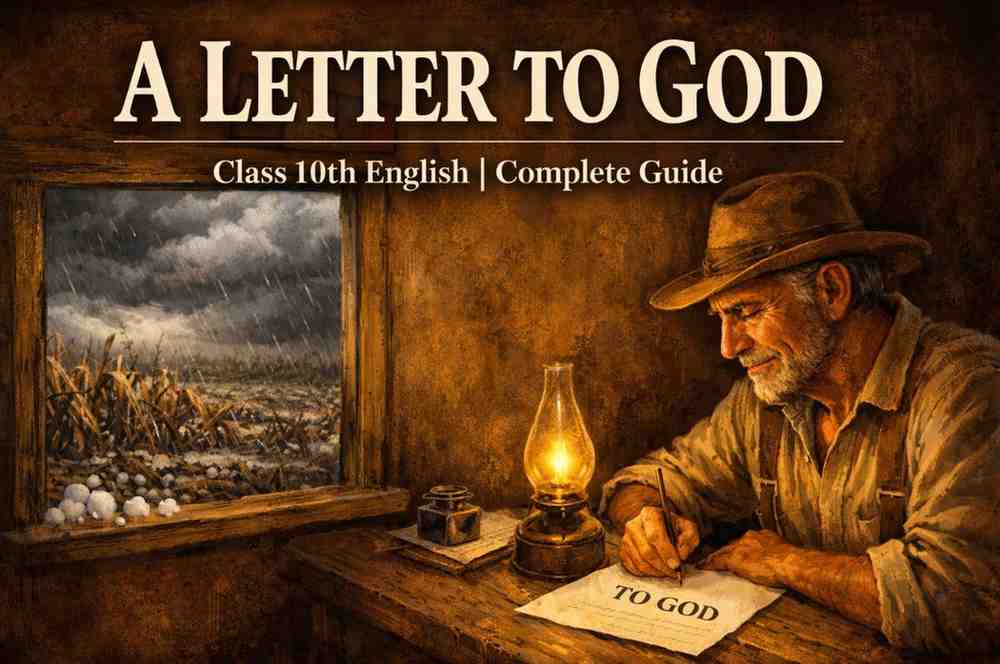
The story opens in a modest farmhouse perched on a hill. Lencho, the protagonist, is a hardworking farmer. From his window, he can see his field of ripe, nearly harvest-ready corn. It is the only source of income for his family.
Lencho watches the clouds gathering with hope rather than fear. He knows his crops desperately need rain. He compares the raindrops to “new coins” — imagining the harvest money they represent. There is poetry in his practicality.
The Catastrophe
The rain begins and Lencho is satisfied. But suddenly, the sky darkens further. What starts as a much-needed shower turns into a violent hailstorm. In a matter of hours, the hailstones — which Lencho compares to “frozen pearls” — destroy everything. Every last plant. Every corn stalk. The entire harvest is wiped out.
Lencho’s family stands in silence amid the wreckage. The devastation is total. He says simply: “A plague of locusts would have left more than this.”
The Letter
Here is where the story shifts from tragedy to something extraordinary.
Lencho is a man of deep, unquestioning faith. Rather than despair or beg neighbors, he does something almost incomprehensible to the modern mind: he sits down and writes a letter to God.
He explains his situation. He asks God for 100 pesos — the exact amount he calculates he needs to replant his crop and survive the coming year until the next harvest. He seals the letter, writes “To God” on the envelope, and walks to the post office to mail it.
The Postmaster’s Dilemma
At the post office, an employee sees the unusual letter and takes it to the postmaster. The postmaster reads it and is initially amused — then deeply moved.
He is struck by Lencho’s absolute, unshakeable faith. He calls it “the faith of the man who wrote this letter — the faith of a man who believes in God.” He doesn’t want to shatter it.
The postmaster — without being asked, without any obligation — decides to collect money from his colleagues and contributes from his own salary to send Lencho as much money as they can raise. Together, they manage only 70 pesos — not the full 100.
The postmaster himself signs the letter: “God.”
The Devastating Twist
When Lencho receives the envelope and counts the money, he finds only 70 pesos. His immediate reaction is not gratitude — it is anger.
He is certain that God would never shortchange him. Therefore, someone must have stolen the remaining 30 pesos. He writes a second letter to God:
“God, of the money that I asked for, only seventy pesos reached me. Send me the rest, since I need it very much. But don’t send it to me through the mail because the post office employees are a bunch of crooks.”
🎭 Character Analysis
Lencho — The Farmer with Unshakeable Faith
Lencho is arguably one of the most complex “simple” characters in Class 10th English literature. He is:
- Deeply religious and trusting: His faith in God is not performative — it is visceral, practical, and absolute. He doesn’t pray with empty words; he writes a letter with financial specifics.
- Hardworking and observant: He understands nature, watches clouds, and manages his farm carefully. He is not naive about the physical world.
- Ironically suspicious of humans: The greatest irony of his character is that his faith in God is unlimited, but his trust in people is minimal. He suspects “crooks” immediately, never considering that humans might act with generosity.
Lencho represents a kind of pure, uncorrupted faith that modern, cynical readers may find touching, absurd, or both.
The Postmaster — The Unsung Hero
The postmaster is a quietly heroic figure who receives far less attention than he deserves.
- He is compassionate and empathetic — moved by a stranger’s faith rather than mockery it.
- He is selfless — he contributes his own money to help someone he has never met.
- He acts without expectation of recognition — Lencho never thanks him; in fact, Lencho insults his employees.
- He represents the best of quiet human goodness — the kind that operates in the background, unnoticed and unacknowledged.
The postmaster’s actions are arguably the real miracle in the story.
🌿 Themes: What Is “A Letter to God” Really About?
1. Faith and Its Purity
The central theme is unwavering faith. Lencho’s belief is so pure that it is immune to logic. He doesn’t consider whether God reads letters, whether there’s a postal address for heaven, or whether 100 pesos is a reasonable ask. He simply believes, and acts on that belief.
This kind of faith — sometimes called naive faith or folk faith — is neither mocked nor entirely celebrated in the story. Fuentes presents it with a kind of tender ambivalence.
2. Irony — The Story’s Greatest Tool
The story is drenched in situational irony and dramatic irony.
- The greatest irony: The people Lencho suspects of stealing are the same people who sacrificed to help him.
- The postmaster performs an act of genuine human goodness — and receives suspicion and insult in return.
- Lencho’s faith in an unseen God is absolute; his faith in visible human beings is zero.
This irony is not merely a literary device — it is the moral core of the story.
3. Human Goodness vs. Human Suspicion
Fuentes juxtaposes two faces of humanity:
| The Postmaster | Lencho |
|---|---|
| Generous without reason | Suspicious without evidence |
| Acts with quiet compassion | Demands with complete entitlement |
| Trusts in human goodness | Trusts only in God |
| Unrecognized | Self-righteous |
Neither is fully right or wrong. Together, they paint a complex portrait of human nature.
4. The Relationship Between God and Humanity
The story raises a quiet but sharp theological question: If God works through human beings, does Lencho not see it?
The postmaster and the postal employees are the answer to Lencho’s prayer. They are the human instruments of the help he received. Yet Lencho cannot see this — because he has built a wall between “divine” and “human.”
This is Fuentes at his most subtle and most brilliant.
5. The Corruption of Innocence Through Cynicism
Lencho’s second letter is the story’s most heartbreaking moment — not because he is ungrateful, but because he is so confidently wrong. His purity of faith has a shadow side: an inability to see goodness in the human world around him.
🔍 Literary Devices in “A Letter to God”
Understanding literary devices is crucial for Class 10th English exams. Here’s a detailed breakdown:
| Literary Device | Example from the Story | Effect |
|---|---|---|
| Simile | “The raindrops were like new coins” | Shows Lencho’s hopeful, practical mindset |
| Metaphor | Hailstones as “frozen pearls” | Beautiful contrast — destruction described with delicate imagery |
| Irony (Situational) | Lencho suspects the very people who helped him | Creates the story’s moral punch |
| Irony (Dramatic) | We know who sent the money; Lencho doesn’t | Keeps readers emotionally engaged |
| Symbolism | The letter — symbol of pure, direct faith | |
| Personification | “The house — the only one in the entire valley — sat on the crest of a low hill” | The lonely house symbolizes the family’s isolation |
| Foreshadowing | The clouds compared to “new mountains” | Hints at the coming destruction |
📊 Key Quotes and Their Significance
Here are the most important lines from the story for exam preparation:
“The field of ripe corn dotted with flowers, always promised a good harvest.” Establishes Lencho’s dependence on nature and hope for the future.
“All through the night, Lencho thought only of one thing: the help of God, whose eyes… see everything, even what is deep in one’s conscience.” Reveals the depth and sincerity of his faith.
“…a bunch of crooks.” The story’s most ironic line — the culminating twist that delivers the moral.
📘 Important Questions for CBSE Class 10th Exams
Short Answer Questions (2-3 Marks)
Q1. What did Lencho hope for? Lencho hoped for rain to ensure a good harvest. He watched the clouds forming with the optimism of a farmer who knew his crops needed water desperately.
Q2. How did the hailstorm affect Lencho’s crops? The hailstorm completely destroyed Lencho’s harvest. The hailstones stripped the leaves off plants, shattered the corn, and left the field a scene of total devastation — not a single flower or fruit remained.
Q3. Why did the postmaster decide to help Lencho? The postmaster was deeply moved by the strength of Lencho’s faith. He did not want to shatter the spirit of a man whose belief in God was so absolute and sincere. He felt it was his duty — as a human being — to preserve that faith.
Q4. Who were the “bunch of crooks” according to Lencho? In his second letter, Lencho referred to the post office employees as “a bunch of crooks” — believing they had stolen 30 of the 100 pesos God had supposedly sent him. The deep irony is that these employees had actually collected and donated the money themselves.
Long Answer Questions (5-6 Marks)
Q5. What does the story “A Letter to God” tell us about faith and human nature?
A Letter to God presents faith as something that can simultaneously be the most beautiful and most blinding force in human life. Lencho’s faith in God is extraordinary — it is practical, specific, and completely unshakeable even after catastrophe. He does not pray in vague hope; he writes a precise, businesslike letter asking for exactly what he needs.
However, the story reveals the tragic limitation of faith that sees only the divine and misses the human. The real miracle in the story — the postmaster’s selfless generosity — goes not only unrecognized but actively condemned by Lencho. He accuses the very people who helped him of theft.
This is Fuentes’ greatest insight: faith and gratitude are not the same thing. Lencho’s story teaches us that true spiritual wisdom lies not just in believing in divine goodness, but in recognizing goodness wherever it appears — especially in ordinary human beings.
🧠 Moral Lessons: What Can We Take Away?
- Faith can move people, not just mountains. The postmaster’s generosity was directly triggered by witnessing someone’s unshakeable belief. Faith, even naive faith, has a power to inspire others.
- Human goodness is often invisible. The most meaningful acts of kindness in this world are done quietly, without recognition, without reward. The postmaster never expected a thank you — and never got one.
- Cynicism about people is easy; trust is hard. Lencho trusted God absolutely without any evidence, yet suspected humans immediately without any evidence. This asymmetry is the story’s sharpest critique.
- Gratitude requires awareness. We cannot be grateful for what we don’t see. Lencho’s failure wasn’t lack of faith — it was lack of perception.
- Goodness and irony coexist in the real world. Life doesn’t always reward the kind or correct the mistaken. Sometimes, the most beautiful acts of generosity end in silent misunderstanding.
🌍 Why This Story Still Matters Today
In a world increasingly divided between the digital and the spiritual, between cynicism and faith, A Letter to God speaks with remarkable freshness.
We live in an age where:
- People question institutions but blindly follow influencers
- Generosity is constantly suspected of having a hidden motive
- Kindness is often anonymous and unacknowledged
- Faith is personal and often disconnected from community
Lencho is not just a 20th-century Mexican farmer. He is anyone who has ever believed so purely in something invisible that they failed to see the visible goodness around them.
And the postmaster? He is every person who has ever done something kind and quietly accepted being misunderstood.
🎓 Tips for Writing an Outstanding Answer on “A Letter to God” in Board Exams
Here’s what toppers do differently when answering questions on this chapter:
- Always mention the author’s name — G.L. Fuentes — to show academic awareness.
- Use the term “irony” correctly — define it briefly, then apply it specifically to the story.
- Don’t summarize when asked to analyze — examiners want your interpretation, not a plot retelling.
- Use quotes from the story to support your points — even short ones earn marks.
- Connect themes to real life — examiners appreciate when you relate the story’s ideas to broader human experience.
- In value-based questions, always give a personal take — these questions reward original thinking.
🔄 Comparison: Lencho vs. The Postmaster
| Aspect | Lencho | The Postmaster |
|---|---|---|
| Core Trait | Pure, absolute faith | Compassionate humanity |
| Relationship with God | Direct, personal | Not mentioned |
| Relationship with Humans | Suspicious | Generous and trusting |
| Response to Hardship | Writes to God | Takes practical action |
| Outcome | Ungrateful (unknowingly) | Unrecognized (silently) |
| What They Represent | Naive religious faith | Quiet human goodness |
🏫 Connecting “A Letter to God” to Other Class 10 Texts
First Flight is full of stories that speak to each other thematically. “A Letter to God” connects beautifully to:
- “The Thief’s Story” — another exploration of trust, human nature, and the possibility of goodness in unexpected places.
- “The Hack Driver” — a story about being deceived by appearances and misplaced trust.
- “From the Diary of Anne Frank” — faith and hope in the face of overwhelming destruction.
Reading these stories in conversation with each other deepens your understanding of the curriculum’s larger moral and humanistic goals.
✅ Quick Revision: Key Facts at a Glance
| Detail | Information |
|---|---|
| Author | G.L. Fuentes (Mexican) |
| Original Language | Spanish |
| Book | First Flight (NCERT Class 10 English) |
| Chapter | 1 (Prose Section) |
| Protagonist | Lencho |
| Money Requested | 100 pesos |
| Money Received | 70 pesos |
| Who Collected the Money | Postmaster + Post Office employees |
| Central Theme | Faith, Irony, Human Goodness |
| Key Literary Device | Situational and Dramatic Irony |
| Moral | Faith in God should extend to goodness in humans |
💬 Final Thoughts: The Letter That Was Never Answered — Or Was It?
Here’s a thought experiment worth sitting with:
Lencho never knew who answered his letter. He died — metaphorically, as a character — believing God sent him 70 pesos and that postal thieves took the rest. He never experienced the full miracle.
But we, the readers, know the full picture. And that’s the author’s point.
Sometimes, the miracle happens. It just doesn’t happen the way we expect, through the channels we expect, or with the receipts we demand. Sometimes, the answer to your prayer is a middle-aged postmaster quietly emptying his own wallet because he couldn’t stand the thought of someone losing their faith.
The question Fuentes leaves us with isn’t “Does God answer letters?” It’s this: Are you paying enough attention to see how your prayers are actually answered?
📣 Your Turn!
Now that you’ve explored A Letter to God from every angle — summary, characters, themes, literary devices, exam tips, and deeper philosophy — you’re ready to write, discuss, and think about this story with real depth.
Leave a comment below and tell us:
- Which character do you connect with more — Lencho or the postmaster?
- Have you ever had an act of kindness go unrecognized? How did that feel?
- If you were the postmaster, would you have done what he did?
Share this post with your classmates — it might just make your next English class a lot more interesting. 📚
And if you found this helpful, explore our other deep-dive guides on Class 10th English chapters — because literature isn’t just for exams. It’s for life.
📌 Suggested Reading: “Nelson Mandela: Long Walk to Freedom” — Chapter 2 Analysis | Fire and Ice by Robert Frost — Complete Explanation | CBSE Class 10 English Board Exam Strategy 2025