
Okay, let me ask you something before we start.
Have you ever prayed for something so badly — an exam result, a cricket match, your crush to text back — that you promised God something ridiculous in return? “God, if I pass, I’ll never skip class again.” “God, if India wins, I’ll donate a hundred rupees.” You know what I’m talking about.
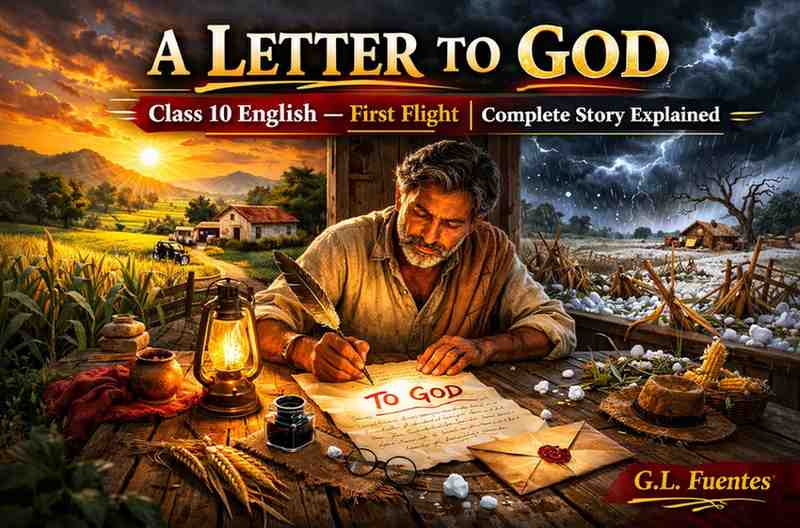
Now imagine a man who didn’t bargain with God. Who didn’t pray vaguely into the air. Who sat down at a table, picked up a pen, and wrote a proper letter — with a specific amount, a clear problem, and an address: To God.
That man is Lencho. And his story is the very first chapter of your Class 10th English textbook, First Flight. Written by the Mexican author G.L. Fuentes, translated from Spanish, and somehow so universal that NCERT put it first — before every other story, before every other lesson.
There’s a reason for that.
This story is only a few pages long, but it carries more irony, more emotion, more human truth than most novels. And in this post, I’m going to take you through every single moment of it — the full story, every important detail, every hidden meaning — in a way that actually makes sense.
No boring line-by-line breakdown. No robotic explanation. Just the story, told right.
Let’s go.
🌾 The World of Lencho — Understand This First, Everything Else Will Click
Picture this.
A single house on a hill. Not a neighbourhood, not a village. One house. Surrounded by fields, with a river winding somewhere below, and a sky that goes on forever. No neighbours to borrow from. No market nearby. No safety net of any kind.
This is where Lencho lives with his wife and sons.
He is a farmer. A corn farmer, to be specific. And his entire life — his money, his food, his family’s survival — depends on one thing: the harvest. If the harvest is good, the family eats. If it fails, they don’t. It really is that simple, and that terrifying.
Now here’s what makes Lencho different from you and me. He isn’t educated in the traditional sense. He works with his hands. The book describes him as “an ox of a man, working like an animal in the fields.” That’s not an insult — it’s a description of someone with extraordinary physical strength and endurance, someone who pours everything they have into the land every single day.
But — and this is the beautiful twist — he knows how to write.
In his community, in his world, that was not a small thing. It meant something. And it sets up everything that follows.
☁️ The Morning Everything Looked Perfect
It’s a regular morning. Lencho has been watching the sky since dawn — specifically, the clouds building in the north-east.
If you’ve grown up around farmers, you know this thing they do. They read the sky the way we read notifications. Every shade of cloud, every shift in the wind, every change in the air tells them something. Lencho had been doing this his whole life. He knew his fields, the book says, “intimately” — like you know the layout of your own room in the dark.
And what he saw that morning made him happy.
He walked inside and told his wife: “Now we’re really going to get some water, woman.”
She replied, “Yes, God willing.”
Hold that phrase. God willing. It’s such a natural, habitual thing to say — but in this story, it’s the first of many times faith sneaks quietly into the conversation. The author isn’t making a big announcement about religion. He’s showing us how deeply faith is woven into the fabric of this family’s daily life. It’s in their language. It’s as natural as saying “good morning.”
The older boys were out in the field. The younger kids were playing outside. The woman was making supper. Everything was as it should be.
Then the rain came.
🌧️ Raindrops Like New Coins — The Most Beautiful Line in the Chapter
When the first big drops started falling, Lencho did something that tells you everything about who he is.
He walked outside.
Not to check on the crops. Not to do anything practical. Just — to feel the rain on his body. He stood in it, let it soak him, just for the joy of it.
And when he came back inside, he said something that stopped me the first time I read it:
“These aren’t raindrops falling from the sky, they are new coins. The big drops are ten cent pieces and the little ones are fives.”
Think about that for a second.
A man with no formal education, who ploughs land with oxen, who has never written a poem in his life — just said something genuinely poetic. He looked at rain and saw money, yes, but not because he was greedy. Because to a farmer, rain is money. Rain is the crop. The crop is the harvest. The harvest is everything. He was seeing the world honestly, through his own eyes, and what he saw was beautiful.
This is what the textbook means when it gives this as a “metaphor” exercise. But don’t let the grammar label fool you — this is a deeply human moment. Lencho is not just a poor farmer. He is someone who finds beauty in the things that keep him alive.
For a few minutes, standing at his window watching his corn fields draped in rain, Lencho had everything.
Then the wind changed.
🧊 Frozen Pearls — When Beauty Becomes Destruction
Suddenly, the sky went dark in a different way. The wind picked up hard. And with the rain came something else.
Hailstones.
If you’ve never seen a real hailstorm on a crop field, here’s what it looks like: ice chunks, some as big as marbles, hammering down from the sky at speed. They strip leaves. They shatter stalks. They pound the earth like tiny fists.
The author calls them “frozen pearls.”
That phrase is doing something very clever. Pearls are beautiful, white, precious. Hailstones look exactly like that — round, white, gleaming. The children ran outside to collect them, thinking they were playing with something wonderful. They had no idea.
But the crops knew.
Lencho watched and kept saying, “It’s really getting bad now. I hope it passes quickly.”
It didn’t pass quickly.
For one full hour, the hail came down. Not just on the field — on the house, the garden, the hillside, the whole valley. Every inch of the land that Lencho had tended all year was being destroyed in real time, and he could do nothing but stand there and watch.
When it finally stopped, the field was white. The book says it looked “as if covered with salt.”
Salt on a field. Not sugar, not flour — salt. Because salt on land kills things. It steals moisture from the soil, it poisons growth. The author chose that image very deliberately. This wasn’t just visually white. It was the image of death.
“Not a leaf remained on the trees. The corn was totally destroyed. The flowers were gone from the plants.”
One sentence. Three total losses. Everything Lencho had worked toward — gone.
😔 “A Plague of Locusts Would Have Left More”
Lencho stood in the middle of his ruined field and looked at his sons.
He said: “A plague of locusts would have left more than this. The hail has left nothing. This year we will have no corn.”
I want you to really feel that line. A plague of locusts. In farming communities, that is the ultimate nightmare — a biblical-level disaster. Lencho is saying that even the worst natural catastrophe he could imagine would have been better than this.
Because locusts, at least, leave something. Roots. Soil. A chance to start again. But hail had stripped everything so completely that there was nothing left to salvage.
That night, his family sat together in the wreckage of their hopes, and the dialogue is heartbreaking in its simplicity:
“All our work, for nothing.”
“There’s no one who can help us.”
“We’ll all go hungry this year.”
The author doesn’t describe their tears. He doesn’t write long paragraphs about their grief. He gives us three short sentences, and they hit like three separate punches. That’s what great writing does — it trusts the reader to feel what isn’t said.
✉️ The Letter — The Moment This Story Becomes Unforgettable
Here is where most ordinary stories would show their character either giving up or finding a human solution. Lencho does neither.
That night, while his family slept in grief, Lencho lay awake thinking about God.
Not as a last resort. Not as a desperate cry. But as a logical, reasonable next step. He had been taught — and truly believed — that God’s eyes see everything. Not just actions. Not just words. Even what is “deep in one’s conscience.” God knew Lencho. God knew he was honest, hardworking, and truly in need.
So the following Sunday morning, at daybreak, Lencho sat down and did the most extraordinary thing in this story.
He wrote a letter.
“God,” he wrote, “if you don’t help me, my family and I will go hungry this year. I need a hundred pesos in order to sow my field again and to live until the crop comes, because the hailstorm…”
One hundred pesos. He didn’t write “please send me whatever you can.” He didn’t write a vague prayer. He wrote an amount — a specific, calculated number based on exactly what he needed. This is important. It tells us that Lencho’s faith was not some dreamy, head-in-the-clouds religion. It was practical, grounded, and completely sincere.
He sealed the letter. He wrote “To God” on the envelope. He put a stamp on it. And he walked to the post office and dropped it in the mailbox.
As if it were the most natural thing in the world.
😂→😢 The Post Office: Two Reactions, One Decision
Here is where the story splits into two different worlds — and where it gets truly interesting.
A postman found the letter. He did what anyone would do. He laughed. He took it to his boss — the postmaster — and showed it to him, still laughing.
The postmaster read it.
He also laughed.
But then — almost immediately — he turned serious.
He sat there, tapping the letter on his desk, and said something that tells you exactly what kind of man he was: “What faith! I wish I had the faith of the man who wrote this letter. Starting up a correspondence with God!”
Read that again. He didn’t say, “What a fool.” He didn’t say, “This poor uneducated man.” He said, “I wish I had his faith.”
This is the postmaster’s entire character in one sentence. He is not a religious man, or at least not a man of Lencho’s kind of faith. But he recognizes something precious when he sees it. He recognizes a purity of belief that he himself doesn’t have — and instead of mocking it, he is moved by it.
He makes a decision: he will not let this faith be broken.
So he did something that nobody asked him to do. He went to his employees. He asked each one to contribute something — “for an act of charity,” as the story says. He dipped into his own salary. He even reached out to friends.
He could not collect the full hundred pesos. What he managed was a little more than half — seventy pesos.
He put the money in an envelope. He addressed it to Lencho. And he wrote a letter with a single word as a signature:
God.
Stop and think about what just happened. A government employee, a man with a stable job and a comfortable life, spent his own money and asked others to spend theirs — for a stranger he had never met and would likely never meet — just to protect that stranger’s faith. He asked for nothing in return. He didn’t tell anyone. He didn’t expect a thank you.
He just… did it.
The postmaster is the real hero of this story. And most students miss that.
😠 The Twist That Makes This Story a Masterpiece
The following Sunday, Lencho came to the post office — earlier than usual. He was calm. Confident. When the postman handed him the envelope, he didn’t look surprised. The book says:
“Lencho showed not the slightest surprise on seeing the money; such was his confidence.”
Of course he wasn’t surprised. He had written to God. God had replied. Why would God not reply? This was always going to happen, as far as Lencho was concerned. His faith was that complete.
But then he counted the money.
Seventy pesos. Not a hundred. Thirty pesos short.
And Lencho — the man whose faith could literally move him to write a letter to God — became angry.
Not confused. Not curious about why there was less. Angry. Because in his mind, there was only one explanation: “God could not have made a mistake, nor could he have denied Lencho what he had requested.”
Therefore, someone had stolen the missing thirty pesos.
He walked straight to the counter, asked for paper and ink, and wrote a second letter. He sent it to the same address — To God — and it said:
“God: Of the money that I asked for, only seventy pesos reached me. Send me the rest, since I need it very much. But don’t send it to me through the mail because the post office employees are a bunch of crooks.”
The postmaster — the man who had given his own money to protect this farmer’s faith — opened that second letter and read himself described as a crook.
There it is. That’s the story.
🎭 The Irony: Let’s Actually Talk About This
The textbook asks you to explain the “irony” of this story. Most students write: “The irony is that Lencho called the post office employees crooks when they were actually the ones who helped him.”
That’s correct. But it’s surface-level. Let’s go deeper, because this is where the story earns its greatness.
Lencho’s faith is not the problem. His faith is pure, total, and genuinely beautiful. But that very faith has a blind spot built into it — he trusts the invisible (God) completely, while being instantly suspicious of the visible (humans). He never asks who actually sent the money. He never considers that a human being might have been kind enough to help. It doesn’t even occur to him, because in his worldview, goodness of that scale can only come from God.
The postmaster, meanwhile, believed in something too: the value of protecting something pure and innocent in the world. His generosity was not religious. It was simply human. And he gets nothing for it — not even gratitude. His reward is being called a thief by the man he helped.
Fuentes isn’t laughing at Lencho. He isn’t making fun of faith. He is asking us — the readers — a quiet, sharp question:
How often do we receive grace through ordinary human hands and thank an invisible force instead?
👥 The Two Men, Side by Side
| Lencho | The Postmaster | |
|---|---|---|
| Belief | Absolute faith in God | Belief in human goodness |
| Response to tragedy | Writes to God | Takes action for a stranger |
| Trust in humans | Zero | Unlimited |
| What he gives | Nothing — he asks | His own salary and time |
| What he receives | 70 pesos | Suspicion and insult |
| What he represents | Pure but blind faith | Quiet, unseen heroism |
The story needs both of them. Without Lencho’s faith, there is no story. Without the postmaster’s humanity, there is no miracle. But only the postmaster will go unrecognized — by Lencho, and by most readers who skim this story.
🔬 The Literary Devices — Explained So You’ll Never Forget Them
1. Metaphor (Raindrops = New Coins) Lencho doesn’t say rain is like coins. He says it is coins. That’s a metaphor — a direct comparison without “like” or “as.” It tells us how his mind works: rain and money are the same thing to him. One brings the other.
2. Metaphor (Hailstones = Frozen Pearls) Again — the hailstones aren’t compared to pearls, they’re called pearls. But the irony here is devastating: pearls are precious and beautiful. The hailstones look precious. They destroy everything precious.
3. Metaphor (Lencho = An Ox of a Man) He is compared to an ox — powerful, tireless, built for hard labour. This sets up the contrast: a man built like an ox, yet sensitive enough to find poetry in rainfall.
4. Situational Irony The people Lencho accuses of stealing are the people who donated to him. The situation is the opposite of what Lencho believes. That gap — between what Lencho thinks is happening and what actually happened — is the whole moral of the story.
5. Dramatic Irony We, the readers, know who sent the money from the moment the postmaster seals the envelope. Lencho never finds out. We watch him walk into the post office suspecting theft, knowing the truth he doesn’t. That painful gap between reader knowledge and character knowledge is dramatic irony.
6. Simile (Field = As If Covered with Salt) Here, the comparison uses “as if” — that makes it a simile, not a metaphor. The image of salt is brilliant because salt doesn’t just look white — it kills. It’s not just a visual description; it’s a description of death.
📝 Every Important Question — Answered Like a Topper Would
Q: What did Lencho hope for, and why?
Lencho hoped for rain. His crop of ripe corn was ready to harvest, but the land needed water for the corn to fully develop. Without rain, there would be no harvest, no money, and no food for his family. Rain was not just weather to him — it was survival.
Q: Why did Lencho compare raindrops to new coins?
Because to a farmer, every raindrop represents income. Rain grows the crops; crops are sold for money. Lencho was expressing, in the most natural and poetic way he knew, that rain was literally wealth falling from the sky. The big drops meant bigger coins, the small drops smaller ones — he even gave them denominations.
Q: What happened to Lencho’s field and how did he feel?
A hailstorm followed the rain and destroyed everything for an entire hour. Not a leaf remained on the trees, the corn was wiped out completely, and the flowers that had promised a good harvest were gone. The field turned white, as if covered in salt. Lencho’s soul, the author says, was filled with sadness. He felt the loss of an entire year’s work in a single afternoon.
Q: Why did the postmaster decide to help Lencho? Why did he sign the letter as “God”?
The postmaster was deeply moved by Lencho’s faith. He admired it, even envied it — his own words were, “I wish I had the faith of the man who wrote this letter.” He did not want Lencho to lose that faith. By collecting money and responding as “God,” he was protecting something he considered precious: a man’s pure, absolute trust. He signed it “God” because if Lencho received a letter from a postmaster, it would mean nothing. But a letter from God would confirm everything Lencho believed — and that was the point.
Q: Was Lencho surprised to receive the money? What made him angry?
No — Lencho was not surprised at all. He had complete confidence that God would reply. What made him angry was the amount: seventy pesos instead of one hundred. He was certain God wouldn’t make a mistake, which meant the missing thirty pesos had been stolen. He immediately suspected the postal employees and wrote a second letter warning God not to send money through the mail anymore.
Q: What is the irony in the story?
The central irony is layered and painful. The post office employees — especially the postmaster — sacrificed their own money to help a stranger and protect his faith. Yet Lencho, the same man they helped, accused them of being thieves. His faith in God was so absolute that he could not conceive of God making a short payment — which automatically made humans the suspects. The people who performed the most genuine act of kindness in the story became the targets of the only anger in it.
Q: What kind of person is Lencho? Would you call him naive, ungrateful, or something else?
This is actually a nuanced question. Lencho is not a bad person — he is a faithful, hardworking, deeply sincere man. But his faith, while beautiful, is also blind. He trusts God completely and humans not at all, which means he cannot see goodness when it comes through human hands. He is unquestioningly devout, somewhat naive, and — without meaning to be — ungrateful. The textbook gives you words like “naive,” “unquestioning,” and “comical” — and all of them are a little right.
💡 The Themes: What Is This Story Really About?
Faith and Its Limits: Lencho’s faith is extraordinary. But the story gently suggests that faith which only trusts the divine and never the human is incomplete. The miracle in this story was delivered by human hands — and Lencho couldn’t see it.
The Silence of Goodness: The postmaster never told anyone what he did. He never announced his generosity. He just did it, quietly, and accepted the outcome. Real goodness, the story suggests, often goes unnoticed and unrewarded. That’s what makes it real.
Irony as a Mirror: The story holds up a mirror. Lencho’s reaction feels absurd — but is it so different from how we sometimes explain away human kindness as luck, or thank God for something a person did? The story asks us to look honestly at where we assign credit and where we assign blame.
Man vs. Nature, Man vs. Man: There are two conflicts in the story. The first — between Lencho and the hailstorm — is physical and external. The second — between Lencho’s expectations and the postmaster’s reality — is internal and ironic. The first conflict is resolved by human kindness. The second is never resolved at all.
🎯 The Secret Exam Strategy for This Chapter
Here’s what most students do: they memorise answers. Here’s what toppers do: they understand the irony deeply enough to write about it in their own words.
In board exams, when a question says “explain the irony,” the examiner isn’t looking for a definition. They’re looking for you to demonstrate that you understood what made this story clever — that the helpers were suspected, that faith protected one man while insulting another, that the miracle happened through entirely human means.
If you can write that in your own words with confidence, you’ve already answered better than 80% of students.
Also — value-based questions often ask things like: “What does the postmaster’s action tell us about human nature?” The answer isn’t just “he was kind.” The answer is: he chose to protect someone’s faith at his own expense, without any expectation of acknowledgement — and that is the rarest kind of goodness.
Write that, and you’ll be remembered.
🌍 Why This Story Feels True in 2025
There’s a reason this story was written in Mexico in the 20th century and ended up in an Indian classroom in the 21st.
Because Lencho exists everywhere. The person who trusts an astrologer completely but suspects their own doctor. The person who believes their prayers were answered but doesn’t thank the friend who stayed up all night helping them. The person whose faith is so high that humans can never reach it.
And the postmaster exists everywhere too. The teacher who spends extra time on a student who never says thank you. The parent who sacrifices quietly and is never acknowledged. The stranger who helps and walks away before you can turn around.
This story is a mirror. When you read it, you’re supposed to ask yourself: Am I Lencho? Have I ever been the postmaster?
That’s why it’s the first story in your textbook. Not because it’s easy. Because it’s honest.
🔚 One Last Thing Before You Go
The story ends with the postmaster reading a letter calling him and his employees crooks.
The author doesn’t tell us what the postmaster felt. He doesn’t describe his reaction. He just ends the story there — with that letter in the postmaster’s hands.
That silence is the most powerful moment in the entire chapter.
Because in that silence, you have to decide: does the postmaster regret what he did? Does he feel hurt? Or does he understand — the way only someone truly good can understand — that Lencho didn’t mean to be cruel, that his faith is simply larger than his ability to see the truth?
I think the postmaster smiled. Not happily, not bitterly — but with the quiet understanding of someone who knew, from the moment he read that first letter, that this was always how it would end.
He protected a man’s faith. And in doing so, he proved that faith was worth protecting — even if the man whose faith he saved would never know it.
That’s A Letter to God. And that’s why it’s the first story you read in Class 10.
📣 Your Turn Now
Did the postmaster do the right thing? Should he have just thrown Lencho’s first letter away? Or was protecting that man’s faith worth every peso and every insult?
Drop your answer in the comments — and don’t give the textbook answer. Give me what you actually think.
Share this post with the one friend who’s been dreading this chapter. And if you want the same treatment for every chapter in First Flight — character breakdowns, hidden meanings, and exam strategies that actually make sense — subscribe and you’ll get it.
The rest of the textbook is just as interesting as this. I promise you.
📌 Up Next: Nelson Mandela: Long Walk to Freedom — The Lines Your Teacher Never Explains | Dust of Snow by Robert Frost — Eight Lines That Mean Everything | How to Ace CBSE Class 10 English Board Exam 2025–26