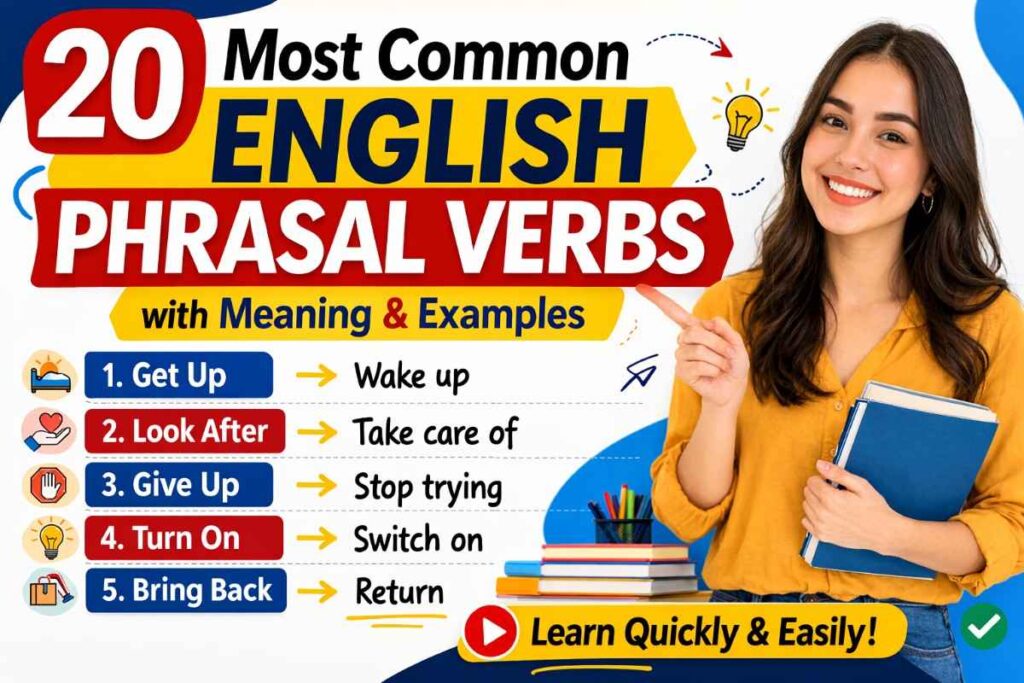

What if I told you that just 20 phrasal verbs could make your English sound 10x more natural? Read on — because that’s exactly what this article delivers.
Imagine watching your favourite English movie and hearing: “Come on, give it up!” or “I ran into my old teacher today!” — and not understanding what those phrases really mean. That’s the power (and the confusion) of English phrasal verbs.
Common English phrasal verbs are used by native speakers every single day — in conversations, emails, movies, and podcasts. Yet most English learners never properly study them, which is why their English often sounds unnatural or robotic.
If you want to speak English fluently and naturally, learning phrasal verbs with meaning is absolutely essential. This guide will give you the 20 most important phrasal verbs, their definitions, and real example sentences — plus powerful tips to actually remember them.
What Is a Phrasal Verb? (Simple Definition)
A phrasal verb is a combination of a verb + a preposition or adverb that creates a completely new meaning — different from the original verb alone.
Example:
- “Give” = to hand something to someone
- “Give up” = to stop trying (completely different meaning!)
This is why phrasal verbs confuse so many learners. You can’t always guess the meaning from the individual words. You have to learn them as a unit.
More examples of this “meaning shift”:
| Original Verb | Phrasal Verb | New Meaning |
|---|---|---|
| look | look after | to take care of |
| break | break down | to stop working / to cry |
| run | run into | to meet someone by accident |
| turn | turn up | to arrive / to increase volume |
| get | get over | to recover from something |
Notice how adding a small preposition changes the entire meaning of the verb. This is exactly what makes phrasal verbs so important to master.
Why Are Phrasal Verbs So Important?
Here’s a fact that will surprise you: native English speakers use phrasal verbs in over 70% of everyday conversations. When you replace formal verbs with phrasal verbs, your English instantly sounds more natural, friendly, and fluent.
Compare:
- ❌ “I will discontinue my subscription.” (too formal, unnatural in speech)
- ✅ “I’ll cancel my subscription.” → Better: “I’ll give up my subscription.”
Or:
- ❌ “He became unconscious.”
- ✅ “He passed out.” (how native speakers actually say it)
Knowing common English phrasal verbs is the bridge between textbook English and real-world English.
20 Most Common English Phrasal Verbs (With Meaning and Examples)
Here is your ultimate phrasal verbs list — the 20 most commonly used in daily English conversations. Study each one carefully. Pay attention to the example sentences.
| # | Phrasal Verb | Meaning | Example Sentence |
|---|---|---|---|
| 1 | Give up | Stop trying; quit | I will never give up learning English. |
| 2 | Look after | Take care of | She looks after her little brother every day. |
| 3 | Run into | Meet someone by accident | I ran into my old teacher at the mall. |
| 4 | Turn up | Arrive / increase volume | He didn’t turn up for the meeting. |
| 5 | Break down | Stop working / become upset | My car broke down on the highway. |
| 6 | Get over | Recover from | It took me a month to get over the flu. |
| 7 | Put off | Delay or postpone | Don’t put off your homework until tomorrow. |
| 8 | Come across | Find by chance / make an impression | I came across this great article online. |
| 9 | Bring up | Mention a topic / raise a child | She brought up an important point in the meeting. |
| 10 | Look forward to | Be excited about something coming | I’m looking forward to the weekend. |
| 11 | Go on | Continue / happen | What is going on here? |
| 12 | Find out | Discover / get information | I found out that he moved to another city. |
| 13 | Take off | Leave the ground / remove / become popular | The plane took off at 6 AM. |
| 14 | Make up | Invent a story / reconcile after a fight | Don’t make up excuses. Tell the truth. |
| 15 | Work out | Exercise / solve a problem / turn out well | Things will work out in the end. |
| 16 | Carry on | Continue | Carry on with your work. Don’t stop. |
| 17 | Set up | Arrange / establish | He set up his own business last year. |
| 18 | Pick up | Collect / learn casually / improve | She picked up Spanish very quickly. |
| 19 | Hold on | Wait / grip something tightly | Hold on a second — I’ll be right back. |
| 20 | Turn down | Refuse / lower volume | He turned down the job offer. |
Deep Dive: 5 Phrasal Verbs You Must Know Today
Let’s explore five of the most commonly used phrasal verbs in detail, with multiple examples so you truly understand how to use them.
1. Give Up
Meaning: To stop doing something, usually because it is too difficult.
“Learning English is hard, but never give up.” “She gave up eating sugar for a whole month.” “He gave up on the project after failing three times.”
💡 Remember: “Give up” is used for quitting habits, hobbies, goals, or attempts.
2. Look Forward To
Meaning: To be excited and happy about something that will happen in the future.
“I’m really looking forward to your birthday party!” “We are all looking forward to the summer holidays.” “She is looking forward to starting her new job.”
⚠️ Grammar Note: Always use a gerund (verb+ing) or noun after “look forward to.” ✅ I’m looking forward to meeting you. ❌ I’m looking forward to meet you.
3. Break Down
Meaning: (1) A machine stops working. (2) A person becomes emotionally overwhelmed and cries.
“The washing machine broke down again.” “She broke down in tears when she heard the sad news.” “Our car broke down in the middle of the highway.”
💡 Tip: “Break down” can be used for machines AND for emotions — both are very common.
4. Pick Up
Meaning: (1) To collect someone or something. (2) To learn something casually. (3) To improve.
“Can you pick up the kids from school today?” “He picked up English very quickly by watching movies.” “Business is starting to pick up after a slow month.”
💡 Tip: “Pick up” is one of the most versatile phrasal verbs in English. It has many meanings — learn all of them!
5. Work Out
Meaning: (1) To exercise. (2) To find a solution. (3) For a situation to end well.
“I work out at the gym every morning.” “We need to work out a solution to this problem.” “Don’t worry — everything will work out fine.”
Phrasal Verbs for Daily Situations
Here’s a quick reference list of phrasal verbs organized by situation — perfect for everyday English conversations:
🏠 At Home
| Phrasal Verb | Meaning | Example |
|---|---|---|
| Wake up | Stop sleeping | Wake up! It’s 7 AM. |
| Tidy up | Clean and organize | Please tidy up your room. |
| Turn off | Switch off | Turn off the lights. |
| Run out of | Have no more left | We’ve run out of milk. |
💼 At Work
| Phrasal Verb | Meaning | Example |
|---|---|---|
| Get back to | Reply / return to | I’ll get back to you by Friday. |
| Put together | Compile / assemble | Can you put together a report? |
| Follow up | Check progress | I need to follow up on that email. |
| Call off | Cancel | The meeting was called off. |
🗣️ In Conversations
| Phrasal Verb | Meaning | Example |
|---|---|---|
| Bring up | Mention | He brought up a great point. |
| Go over | Review | Let’s go over the main points. |
| Point out | Draw attention to | She pointed out the mistake. |
| Speak up | Talk louder / voice your opinion | Please speak up — I can’t hear you. |
5 Powerful Tips to Remember Phrasal Verbs
Knowing phrasal verbs is one thing. Remembering them is another. Here are the best strategies:
Tip 1: Learn Phrasal Verbs with Example Sentences
Never learn a phrasal verb as just a definition. Always learn it inside a sentence.
- ❌ “Give up” = quit (forgettable)
- ✅ “She gave up smoking after 10 years.” (memorable because it’s a real situation)
Tip 2: Learn Phrasal Verbs by Situation
Group phrasal verbs by the situations you use them in: at home, at work, at school, at the store. This way, when you’re in that situation, the right phrasal verb comes naturally.
Tip 3: Use Them in Your Own Sentences
After learning a new phrasal verb, create 3 personal sentences using it. The more personal the sentence, the better your brain remembers it.
Tip 4: Practice with Flashcards
Use apps like Anki or Quizlet to create digital flashcards for phrasal verbs. Study 5 new phrasal verbs per day and review old ones daily.
Tip 5: Watch English Content and Spot Them
When you watch English movies, TV shows, or YouTube, actively listen for phrasal verbs. Pause, write them down, and look up their meanings. This connects them to real emotional moments — which makes them unforgettable.
Practice Exercise: Test Your Phrasal Verbs Knowledge
Fill in the blanks with the correct phrasal verb from the list:
(give up, look after, work out, turn down, pick up)
- Don’t __________ — keep trying and you will succeed!
- She will __________ the children while their parents travel.
- He __________ the job offer because the salary was too low.
- I want to __________ a new language this year.
- Everything will __________ if you stay positive.
Answers: 1. give up | 2. look after | 3. turned down | 4. pick up | 5. work out
Conclusion – Phrasal Verbs Are the Key to Natural English
Now you know the 20 most common English phrasal verbs, their meanings, and how to use them in real sentences. Remember:
- ✅ Phrasal verbs are essential for natural, fluent English
- ✅ Learn them in context, not just as definitions
- ✅ Practice daily — use them in your speaking and writing
- ✅ Start with these 20 before moving to advanced ones
The next time someone says “Don’t give up!” — you will not only understand it perfectly, but you will smile knowing that you have mastered one of English’s most important phrasal verbs.
💬 Which phrasal verb are you going to use TODAY? Write a sentence in the comments below using your favourite one from this list! And don’t forget to share this phrasal verbs guide with your classmates and friends.
Related Articles You’ll Love:




Pingback: 100 Daily Use English Sentences for Beginners – Speak English Naturally - Wordify English